


Big Question
This dissertation research seeks to explore one central question: How do exogenous regulatory changes, particularly in immigration policy, influence strategic human capital management and innovation outcomes of multinational enterprises?
Introduction
In an era in which knowledge workers have become the primary drivers of competitive advantage, multinational enterprises face an unprecedented paradox. While technological advancement demands the best minds from around the world, rising nationalism and security concerns are creating new barriers to global talent mobility. This collision between economic necessity and political reality represents one of the most pressing challenges facing international business leaders today.
The stakes could not be higher. Foreign-born inventors contribute disproportionately to breakthrough innovations across industries, with immigrant entrepreneurs founding over 40 percent of Fortune 500 companies (Kerr & Kerr, 2016). Research provides evidence that high-skilled immigration drives innovation outcomes significantly above what educational credentials alone would predict (Hunt & Gauthier-Loiselle, 2010). Yet immigration policies, worldwide, are becoming increasingly restrictive, forcing companies to navigate a complex web of visa limitations, mobility constraints, and shifting political landscapes.
My dissertation, outlined in Table 1, addresses a fundamental question that sits at the intersection of strategy, international business, and public policy: How do regulatory changes in immigration policy reshape the way multinational enterprises manage their most valuable asset, i.e., human capital, and what are the consequences for innovation and competitive advantage?
The research presented here goes beyond traditional academic inquiry to provide actionable insights for business leaders grappling with these real-world challenges. Rather than treating immigration policy as a fixed external constraint, this work demonstrates how firms can anticipate and strategically adapt to regulatory changes to maintain their competitive edge.
The findings reveal a sophisticated interplay among policy, strategy, and performance that challenges conventional wisdom about global talent management. When governments restrict immigration, companies do not simply substitute foreign workers with domestic ones. Instead, they fundamentally reorganize their global operations, creating new forms of distributed innovation that carry both opportunities and risks. Conversely, when policies enhance immigrant mobility, the effects extend beyond simple talent retention to reshape the very nature of innovation within organizations.
Perhaps most importantly, this research introduces a new framework for thinking about immigration policy that moves beyond simplistic measures of education and skills to consider the broader ecosystem of relationships, knowledge networks, and geopolitical dynamics that determine whether talent mobility creates or destroys value. This multidimensional approach addresses growing concerns about balancing economic competitiveness with national security considerations (Schmidt, 2023). The framework recognizes that, in an interconnected world, effective immigration policy must account for the knowledge infrastructure of origin countries and geopolitical relationships that shape whether cross-border talent flows enhance or threaten national interests.
For international business leaders, the implications are profound. The ability to attract, develop, and retain global talent increasingly determines which companies thrive in the knowledge economy. Understanding how regulatory changes affect these capabilities and how to build resilience against policy shocks has become a core strategic competency. Moreover, as governments worldwide grapple with questions of technological sovereignty and innovation security, business leaders must navigate an increasingly complex landscape where talent policies intersect with national security considerations.
Essay 1: Restrictive Immigration Policies and MNE Innovation
The most striking finding from this research is that immigration restrictions do not force multinational enterprises to hire more domestic workers as policymakers intend. Instead, companies respond by fundamentally restructuring their global innovation networks, dispersing research and development activities across multiple countries (Figure 1) while accepting reduced innovation performance as the cost of regulatory compliance.

This study examined what happened when the United States dramatically reduced H-1B visa availability in 2004, cutting the program by nearly two-thirds overnight. Analyzing patent data from over 700 U.S. multinational enterprises, the research revealed that companies responded by reorganizing their global R&D operations rather than hiring domestic replacements for restricted foreign talent. This strategic restructuring resulted in a 4.7 percent increase in the geographic dispersion of their inventor networks while producing a 4.2 percent decline in innovation output.
This finding challenges the conventional policy assumption that restricting foreign talent automatically benefits domestic workers. Instead, companies chose to “ship work abroad” when they could not “ship workers home”. The result was not job creation for U.S. inventors, but rather a shift toward more complex, distributed innovation processes that proved less efficient than co-located teams. This aligns with broader research on the challenges of coordinating knowledge work across geographic boundaries (Kogut & Zander, 1993).
The impact varied significantly across industries, based on how easily knowledge could be transmitted remotely. Companies in sectors with highly codifiable knowledge, such as electronics and business services, adapted more successfully to distributed innovation than those in chemical and pharmaceutical industries, where tacit knowledge sharing proved essential.
Essay 2: H-1B Visa Portability-Led Inventor Mobility and Innovation Performance
The second study examined the opposite scenario: what happens when immigration policies become more permissive? The 2000 American Competitiveness Act introduced H-1B visa portability, allowing skilled immigrants to change employers without lengthy waiting periods. This seemingly minor administrative change produced profound effects on workplace dynamics and innovation patterns.
Foreign-born inventors suddenly gained unprecedented bargaining power through increased labor market mobility. Research demonstrates that, when workers can more easily switch employers, their negotiating position strengthens considerably (Marx, Strumsky, & Fleming, 2009). They leveraged this new mobility to secure more central positions within their organizations’ collaboration networks, working on higher-profile projects with greater visibility. However, this empowerment came with unintended consequences for the nature of innovation itself.
These newly mobile inventors shifted away from firm-specific research toward more generalizable innovations that would enhance their marketability to other employers. While they became more central to their organizations, their work became less uniquely valuable to their current companies. The research revealed a fundamental tension between employee empowerment and firm-specific value creation that has important implications for strategic human capital management (Campbell, Coff, & Kryscynski, 2012).
Essay 3: Migrants’ Human Capital and Social Capital: Implications for Immigration Policy
The third study proposes a novel approach to immigration policy that moves beyond the traditional focus on individual credentials to consider three interconnected dimensions: human capital, social capital, and geopolitical relations (Figure 2).
The conventional approach evaluates immigrants primarily on education levels and technical skills. This framework adds two critical considerations: the strength of knowledge infrastructure in immigrants’ countries of origin, which determines their ability to bridge global innovation networks, and the geopolitical relationship between origin and destination countries, which affects whether such bridging creates value or security risks.
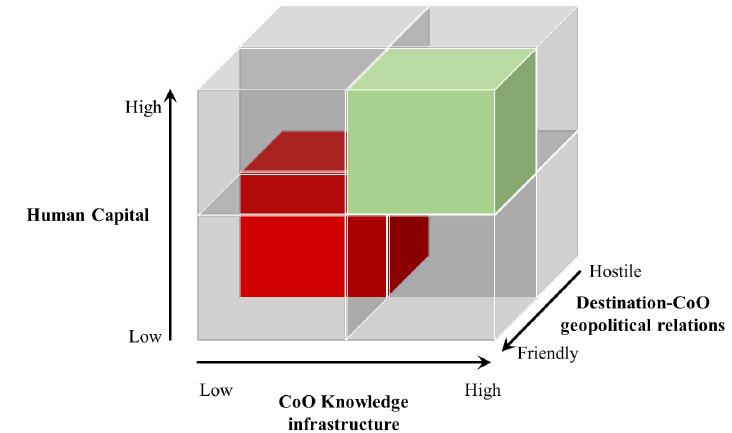
This multidimensional perspective reveals why some immigrant groups contribute disproportionately to innovation while others with similar credentials do not. Engineers from countries with robust technological ecosystems can tap into global knowledge networks that amplify their individual contributions far beyond what their formal qualifications suggest. Conversely, highly educated individuals from countries with limited innovation infrastructure may struggle to realize their full potential despite impressive credentials.
The geopolitical dimension addresses a growing concern in policy circles: how to balance economic benefits from talent mobility against potential security risks. The framework provides a more nuanced approach than blanket restrictions by recognizing that cooperative international relationships can enable mutually beneficial knowledge flows, while adversarial relationships may warrant more cautious policies. This builds on established research about the importance of social capital in knowledge transfer (Nahapiet & Ghoshal, 1998), while incorporating contemporary geopolitical realities where technological competition intersects with national security concerns.
The Innovation Imperative in an Uncertain World
These findings arrive at a critical moment for international business. The COVID-19 pandemic demonstrated both the possibilities and limitations of distributed work arrangements. Geopolitical tensions are fragmenting global supply chains and knowledge networks. Climate change and technological disruption are creating new demands for innovation while reshaping the geography of economic activity.
In this context, the ability to effectively manage global talent becomes a source of competitive advantage that extends far beyond traditional human resource functions. Companies that can navigate immigration policy changes, build resilient distributed innovation networks, and optimize the value creation potential of diverse talent pools will be better positioned to thrive in an uncertain future.
The research also reveals the limitations of treating immigration policy as a purely domestic political issue. In a knowledge-based global economy, talent mobility policies affect innovation ecosystems that span national boundaries. Countries that restrict immigration may find their domestic companies at a disadvantage, not just in accessing talent but in participating in global innovation networks.
Practical Implications for Business Leaders
The findings suggest several actionable strategies for multinational enterprises operating in an era of immigration policy uncertainty (Moreira, Mudambi, & Nayak, 2025). First, companies should develop robust scenario planning capabilities that anticipate potential policy changes and their operational implications. The research demonstrates that policy shocks can force rapid organizational restructuring, making preparedness essential.
Second, firms should invest in building distributed innovation capabilities that can function effectively across geographic boundaries. This includes developing digital collaboration platforms, creating knowledge management systems that facilitate tacit knowledge transfer, and designing project management approaches that are optimized for dispersed teams.
Third, companies should adopt a portfolio approach to talent management that balances the benefits of global mobility with the risks of policy-driven disruption. This might involve developing stronger local talent pipelines while maintaining access to global expertise through alternative arrangements such as consulting relationships or strategic partnerships.
Pedagogical Implications for Business Education
The research highlights the need for business education to better integrate insights from public policy, international relations, and innovation management. Traditional approaches to international business often treat government policy as an external constraint rather than a strategic variable that firms can influence and adapt to.
Business schools should develop curricula that help future managers understand the complex interactions among immigration policy, talent management, and innovation performance. This includes case studies that demonstrate how policy changes create both challenges and opportunities, and frameworks for analyzing the strategic implications of regulatory shifts.
The multidimensional immigration framework introduced in this research could serve as a valuable teaching tool for helping students understand how seemingly technical policy decisions can have far-reaching effects on business strategy and economic outcomes.
Policy Implications for Government Decision Makers
The findings challenge policymakers to think more strategically about immigration policy design. The research demonstrates that restrictive policies often fail to achieve their intended goals while creating unintended consequences that may undermine long-term economic competitiveness.
The multidimensional framework offers a more sophisticated approach to immigration policy that could better balance economic benefits with security concerns. Rather than applying uniform restrictions across all countries and skill categories, this approach would allow for more targeted policies that account for variations in knowledge infrastructure and geopolitical relationships.
Policymakers should also consider the dynamic effects of immigration policy on innovation ecosystems. Restrictions that seem reasonable in isolation may have cumulative effects that weaken a country’s position in global knowledge networks. The research suggests that immigration policy should be understood as innovation policy, with implications for long-term economic competitiveness that extend far beyond immediate labor market effects.
The findings also highlight the importance of policy stability and predictability. The research shows that sudden policy changes force costly organizational adaptations that may persist long after the original policy rationale has evolved. Greater consultation with business stakeholders and more gradual implementation of policy changes could reduce these adjustment costs while achieving similar policy objectives.
Acknowledgements
I would like to thank Professors Ram Mudambi, Solon Moreira, and Vivek Tandon, for their support and guidance during my doctoral studies and Professor Elizabeth Rose for her Editorial guidance in publishing this article.
About the Author
Deepak Nayak received his Ph.D. in Strategic Management from Temple University. He is a scholar of global strategy and innovation whose research examines how immigration policy shapes multinational enterprises’ human capital strategies and technological performance. His work integrates insights from international business, strategic management, and public policy to uncover how shifts in global talent mobility influence firms’ competitive advantage and innovation outcomes.