
Introduction
Interest in Africa-focused international business (IB) research has increased over time, as scholars explore a range of topics about the continent, including internationalization (Boso, Adeleye, Ibeh, & Chizema, 2019), competitive interactions of firms (Dike & Rose, 2019; Dike & Iddy, 2023), FDI and economic growth (Yimer, 2023), and the institutional environment (Barnard & Ruwisi, 2025). Sino-Africa business ties (Dike & Owusu, 2024; Ofosu & Sarpong, 2022), the success and achievement of the SDGs (Züfle & Adu-Gyamfi, 2025), sustainable leadership and development (Wolf-Gillespie & de Klerk, 2025), and net-zero and environmental sustainability (Boojihawon, 2025).
However, even as Africa has gradually become a more frequently adopted contextual basis for IB research and theorization (Zoogah, 2025), the difficulty of accessing Africa-specific data remains a serious issue bedevilling Africa-focused research, as MIF (2024) indicates that Africa ranks lowest in region-specific research. This view is bolstered by Pandita and Singh’s (2022) finding that Africa had the lowest research results publishing deficit (95.38 percent) among all continents, based on their analysis of 12.35 million articles published in Scopus-indexed journals between 2015 and 2019. Nachum et al.'s (2023) study, which demonstrates that only 124 papers of the 1,937 publications in leading IB journals from 1995 to 2021 were Africa-focused, the lowest among all regions, lends further credence to the issue of Africa’s research gap in the IB domain. The slow investment decision-making process regarding Africa is another concern caused by this Africa-focused publication output (Moses, Park, & Amankwah-Amoah, 2025).
Unarguably, there should be an abundance of business data about Africa, given the high-volume daily transactions occurring on the continent, being a leading global supplier of raw materials (including oil and gas), many of the most sought-after metals, and other mineral resources. The numerous discussions about Africa as a significant player in global geopolitics, due to its vast population of 1.5 billion and 28 percent (54 countries) membership in the United Nations, should also generate Africa-focused data for IB research.
Thus, this paper identifies the root causes of the data deficit about Africa, its impact on Africa-focused IB research and publications, and recommends how to address the problem.
The Causes of Africa’s Research Data Deficit
The research data deficit in Africa is worrisome, as only eight countries (Egypt, Mauritius, Morocco, Senegal, South Africa, Tunisia, Uganda, and Zimbabwe) scored over 70 percent on the World Bank Statistical Performance Indicators (SPI) framework for 2022, the lowest among the world regions (World Bank, 2022). With only an average coverage score of 39 percent (compared to the global average of 47 percent) and an openness score of 41 percent (relative to the worldwide average of 53 percent) (Henninger et al., 2023), it is clear that many African countries have serious gaps in both coverage and openness due to:
High Acquisition Costs
The cost of acquiring Africa-related data is often high due to poor internet coverage and electricity supply, wars, political instability and tensions, remoteness/inaccessibility of some localities, inadequate transportation facilities, technical hurdles, the absence of African country data in some global economic data repositories, and a shortage of data handling experts.
Low Investment in Data Infrastructure
The facilities for cloud computing, data collection, storage, and digital infrastructures necessary for acquiring and storing data are either in short supply or nonexistent in most African countries. Africa had the world’s lowest internet access, according to ITU (2024), with only 38 percent of the population connected, compared to the global average of 68 percent. As a result, the quantity and quality of data available for Africa-focused research are minimal.
Capacity (Skill) Gaps
There is also a shortage of talented individuals in data science in most African countries, which can be attributed to a lack of investment in education. With this low-level capacity gap, data is often handled and prepared by non-professionals, making it susceptible to error (human, migration, and system), corruption, incompleteness, and obsolescence. The resultant error-prone, low-quality data cannot be used for academic research.
Predominance of the Informal Economy
With the informal sector accounting for over 83 percent of employment on the continent (ILO, 2022), it can be conjectured that the African economy is highly informal. As a result, useful data are often unrecorded and unavailable, creating serious deficits that hamper research.
Ununified Standards and Incomplete Databases
The intrinsic cultural, national, and subregional differences among the 54 African countries create room for the adoption of different data standards. Variability in local customs and practices among nations, as well as the stigma and fear associated with certain religious practices in some regions, also impact the ability to collect data related to specific subjects. Furthermore, the recent establishment of South Sudan as an independent country in 2011, the ongoing wars in the Democratic Republic of the Congo (DRC) and Sudan, and the political instability in Somalia, Sierra Leone, and Liberia suggest that data from these regions may not be fully available in major data repositories.
Corruption and Weak Data Protection Laws
That corruption permeates every facet of African human development is no longer news, as even public sector funds and resources allocated for providing data infrastructure are often siphoned off. Cases of falsification, manipulation, withholding, or even destruction of national statistics for financial or political gains, as well as intentional restrictions of access to important databases, are prevalent in most countries. Denial of the right to public information is also widespread across Africa. Data protection laws are also weakly enforced, with only 37 of the 54 African countries having enacted data protection laws. Furthermore, the discrepancies in national data standards and the lack of clear guidance structures hinder the effectiveness of data protection laws across Africa.
Impact of Africa’s Data Deficit on IB Research and Publications
With the ongoing advocacy for more inclusive IB research and publications, it has become necessary to investigate and understand how data deficit affects Africa as a geographic basis for conducting empirical academic inquiry. The following are the main implications for Africa-oriented IB research and publications identified through this study.
Use of Poor-Quality Data in Research
The use of poor-quality data in research can yield spurious results and misinterpretations, resulting in inaccurate or false findings that do not accurately reflect a study’s intended reality, as demonstrated by Redman (1998). Such faulty findings can mislead researchers, who may attempt to reproduce them in future investigations, and policymakers, who may apply them in decision-making, rendering the resources and efforts invested in the project wasteful.
Paucity of Africa-Focused Publications in Top-Tier IB Journals
Africa’s backwardness in IB research has increasingly gained attention among scholars (Kamoche & Wood, 2023), the result being the paucity of Africa-oriented publications in such top-tier IB journals as the Journal of International Business (JIBS) and International Business Review (IBR), which is attributable to the lack of empirical evidence from Africa.
High Tendency of Predatory Publications
As data inaccessibility and poor management often compromise the quality and integrity of studies related to Africa, leading to a high rate of rejections by established, legitimate journals (Tchokote & Bouda, 2020), publishing in predatory journals appears to be the only viable option for Africa-focused researchers, including those in IB.
Solutions to Africa’s Research Data Deficit
As the research data deficit in Africa has multiple causes, a multifaceted approach is necessary to address the issue. The recommendations below form part of a strategy to address the data deficit about Africa, aiming to increase the likelihood of publishing more Africa-focused research in top-tier IB journals.
Minimize Data Collection Costs
IB researchers need to prioritize offsetting data collection costs by collaborating in their data acquisition efforts and seeking funding from research foundations. Effort must also be made to leverage existing data by reusing that which has been previously collected and used for different works in the present research. The extant datasets could also be combined with the new ones to generate a more comprehensive and up-to-date dataset, bridging the data gaps. The implementation of data management (including appropriate data storage in safe repositories) and the promotion of open data and data sharing principles must be encouraged among IB scholars for further cost minimization.
Intensify Investment in Data Infrastructure
This involves a multi-stakeholder approach, requiring governments and relevant agencies to invest more in infrastructure for data handling, including technologies, systems, tools, and policies to facilitate research. Such an investment in physical infrastructure (including communication equipment, hardware, software, and networking components that support data storage, processing, and sharing) and non-physical infrastructure (including data policies and standards) is crucial for ensuring the effective management, sharing, and utilization of data.
Bridge the Data Skill (Capacity) Gaps
The specific skill gaps or capacity needs that are lacking can be addressed by providing training, fostering a learning culture, and leveraging technologies for task automation and enhanced productivity. This will help to facilitate the acquisition, storage, and management of research data. Thus, the combined efforts of the government and its agencies, researchers, training institutes, and other key stakeholders are essential for addressing the data capacity gap.
Minimize Informality in the Economy
Although the informal economy cannot be fully eliminated in Africa, as it has taken root as the mainstay of the economic system, it can be minimized by building and bolstering the effective legal and regulatory frameworks, offering financial incentives for the formalization process, establishing supportive protection systems, and identifying and addressing the root causes of informality. Concerted efforts must be made by the relevant authorities and stakeholders to formalize businesses and to regulate and control informal activities in the economy.
Unify Data Standards across Africa
Unifying research data standards across Africa is crucial, and this can be achieved by developing a continent-wide data policy framework that promotes cross-border data flows and establishes effective data governance mechanisms. Prioritizing the regular collection and updating of national data by the National Statistics Office of each constituent country is crucial to ensure the uninterrupted, complete, and timely availability of data from African countries in global databases. Minimizing the incidence of wars and political upheavals across African countries would be an important consideration in this regard.
Mitigate Corruption and Bolster Data Protection
Addressing corruption as it affects research data in Africa requires developing the necessary legal anti-corruption frameworks, promoting transparency in all facets of research data management, and providing the needed technologies and training. Robust data protection laws specific to Africa, which comply with international standards, should be enacted, with independent data regulatory authorities established to ensure strict adherence to data privacy and sharing principles.
Design Research to Benefit Businesses
IB scholars should ensure that they design their research to benefit the businesses from which data was collected, while also making an effort to acknowledge research sponsors in the published outputs. Such goodwill efforts would make the parties feel recognized, appreciated, and motivated to contribute to future research. Additionally, IB researchers should intensify their adoption of Africa-embedded companies in case study research, enabling them to readily fund and sponsor future research.
The Holistic Framework
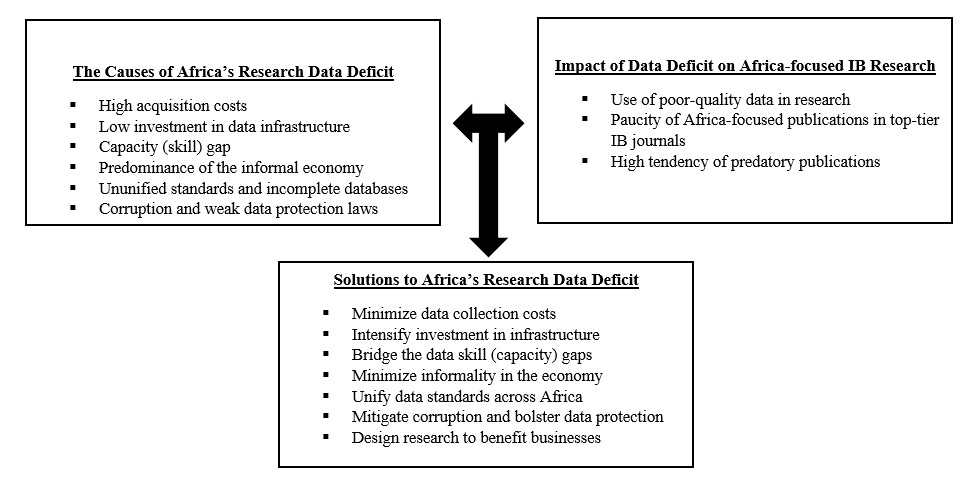
Figure 1 summarizes the causes, effects, and solutions to Africa’s research data deficit as it applies to IB.

Conclusion
This paper discusses Africa’s research data deficit, shedding light on a key issue that has perennially hindered Africa-focused scientific research and publications, especially in the international business (IB) context. The major outcome is a framework showcasing the root causes of the problem, its impact on IB research and publications (in top-tier journals), and the solutions. Thus, this work holds significant value for the major stakeholders with a vested interest in Africa-oriented research and publications, including academic researchers (mainly from the IB domain), data producers (collectors), owners, managers, consumers (users), organizations, regulators, and policymakers. Most importantly, as the emerging framework reveals the causes, effects, and solutions, it becomes easier for IB scholars and other stakeholders to appreciate Africa’s research data deficit more holistically, thereby extending their knowledge about the issue and enhancing their practice.
About the Author
Max Dike is a Senior Lecturer in Business Management at the Faculty of Business and Law (BAL), De Montfort University, United Kingdom. He is also a Fellow of the Higher Education Academy (FHEA) of the UK and the Program Chair of the Academy of International Business (AIB) Africa Chapter Task Force. His research interests include cross-border business expansion, competitive interactions of firms, emerging markets (especially Sub-Saharan Africa), international strategy, the informal and grey economy, organisational resilience, and business growth and sustainability.