
Introduction
Although IB scholarship is often expected to be multidisciplinary, address grand challenges, and have an impact beyond its core, it has been criticized for having limited influence outside its own discipline (Buckley, Doh, & Benischke, 2017). One approach is for future IB scholars, i.e., those engaged in doctoral education, and aspiring to research-intensive careers, to rethink their approach to education, using scaffolding techniques to develop their skills and networks, thereby increasing their capacity to produce more impactful research.
Additionally, while “publish or perish” pressure is usually associated with early-career faculty, doctoral students often face pressure to produce publishable work for the job market while also completing a dissertation within limited funding and program time. These conditions may encourage cautious research choices, as students prioritize “publication-friendly” projects over exploratory or interdisciplinary ones. Consequently, such practices can delay PhD students’ engagement with research addressing grand challenges in IB scholarship (Buckley, Doh, & Benischke, 2017) until later in their careers.
In the context of current discussions about IB’s uniqueness, fluidity, and relevance (Beugelsdijk, 2022; Zaheer, 2025), we, as multidisciplinary doctoral students in IB, ask: How can doctoral students complement their core doctoral training to foster impactful IB scholarship? We suggest scaffolding techniques for doctoral students engaging with IB scholarship to enhance their training and take steps toward creating impactful scholarship in a primarily research-intensive post-PhD career.
That said, we recognize the wide differences among educational systems, resource constraints, and performance; as such, our recommendations are not intended as a prescriptive blueprint. Rather, they should be strategically and purposefully selected and adapted considering one’s own doctoral journey and the aims, structure, and resources (financial and intellectual) of the PhD-granting institution. We also acknowledge that students at less-funded institutions may have fewer resources, which can make it difficult to implement the scaffolding strategies we propose. For example, a student may not be able to access a wide range of materials for interdisciplinary learning if their government censors information or their university lacks subscriptions to key journals.
Scaffolding Techniques
In the following section, we outline a set of recommended techniques to complement doctoral journeys in IB by drawing on Teece’s (2014) dynamic capabilities framework around sensing, seizing, and transforming, as reflected in Table 1. By integrating these practices, doctoral students can enrich their experiences. Drawing on our perspectives as junior scholars, we propose these techniques, much like scaffolding that supports a building under construction, to guide new scholars as they shape their learning journeys and engage more fully in the field of IB and the broader PhD community.
Professional Development: Essential Networking and Feedback Techniques
Conferences and exchanges among academics are essential for an active and engaged academic life, and increasingly crucial for PhD students as new members. Often, doctoral students are interested in major conferences such as the Academy of International Business (AIB) or the Academy of Management (AOM), because they offer opportunities for curriculum building, networking, and engaging with the latest research within the field. Yet, students often overlook the value of regional or virtual conferences and topical workshops (e.g., ESEMP, WAIB/EM-SIG/AIB-UKI mentoring, or AIB Africa chapter reading groups and webinars, many of them online). These smaller events can give students greater access to scholars with similar research interests and more direct interaction with experienced academics. Students may feel more comfortable discussing their work and, at the same time, benefit from the lower costs and accessibility of such events. Discussions in smaller groups allow more time for feedback, which is critical for doctoral learning. Lastly, participating in “emerging scholar workshops” organized by leading journals may provide valuable feedback even for resource-limited doctoral students.
Crossing Disciplines: Idea Development via Interdisciplinary Exposure
IB is inherently multi-disciplinary, so future IB researchers must integrate diverse viewpoints and expertise for impactful work (Zaheer, 2025). As Shenkar (2024: 559) notes, such integration thrives on “ideas, concepts, theories, and research methodologies that lead to cross-fertilization.” Achieving this, however, requires engagement beyond IB and academia. We encourage expanding perspectives by exploring literature not limited to scholarly sources (e.g., reports from McKinsey or the World Bank), reading a range of international news outlets (e.g., BBC, South China Morning Post), and listening to relevant podcasts. Examining literature from related disciplines such as economics, anthropology, and psychology; joining webinars hosted by policy or industry organizations; and attending conferences on nontraditional IB topics, such as migration or B2B marketing can all inspire valuable research ideas.
International Exposure: Being a Reputable International Scholar
Mintzberg and Gosling (2002) suggest that experiencing others’ worlds deepens our understanding of the world. Building on Delios (2017), we ask: “What can make you truly an international PhD scholar?” Exchange programs and study-abroad opportunities are good starting points, but they should be approached strategically. For example, experiencing culture shock in a markedly different environment can heighten one’s awareness and appreciation of global diversity. We acknowledge that not every PhD student has the means to travel internationally or at all. However, we encourage our peers to embrace every small step into new contexts.
Methodological Mastery: Maintaining Rigor in an AI-Enhanced Research Environment
AI systems can quickly process both quantitative and qualitative data, but doctoral students still need to become proficient in using different methods. AI can help with some analytical tasks, but scholars must select and tailor the appropriate research methods and interpret the results using their own judgment, domain expertise, and theoretical foundation. Focused seminars, workshops (offered both online and in-person), and replication studies are ways to improve these skills and promote critical thinking about analytical choices, robustness checks, and transparent reporting (Aguinis, Cascio, & Ramani, 2020). These activities also help students expand their professional networks by connecting with peers and potential co-authors whose methodological skills complement their own.
Crafting Collaboration: Working Together for Impactful Scholarship
Co-authorship is often an important part of research-intensive academic careers. However, while doctoral students may accept collaboration opportunities as they arise, experienced researchers tend to select partnerships more deliberately. When senior researchers and doctoral students with different but complementary skills work together, co-authorship can be mutually beneficial. For example, a methodologist might help a PhD student who is strong in theory to strengthen the empirical aspects of their work, creating value for both parties.
For a good fit, research project tasks should be clearly stated, and prior experience should be acknowledged when assigning work. Too many or too few co-authors might hinder work or limit viewpoints. Early on, team members should explore how their strengths complement each other and set goals and timetables.
Complementing Training: Summer Schools and Specialist Programs
When core PhD programs do not cover certain IB topics or methods, students can consider short, focused programs to fill those gaps. Summer schools and specialist tracks (such as NORD-IB, Henley International Business Masterclasses, or the AIB-CIBER Doctoral Academy) can strengthen theory and research skills while helping build an early academic network. Complementary workshops or modules in related areas (for example, EDAMBA, VSSER) can also broaden perspectives. Together, these experiences can modestly extend a student’s skill set without disrupting progress at their home institution, though some options may be less accessible to those with limited budgets.
Mastering Peer Review: A Practical Path to Implicit Publishing Know-How
Students can approach peer review as part of their research training rather than as an afterthought. Co-reviewing with advisors, joining journal clubs, and volunteering for supervised programs (e.g., AMR Bridge Reviewer) can help them learn to assess contributions, match papers to journals, and interpret reviewer feedback. Such practices sharpen the writing and methods while clarifying the publication process. Even small, structured steps can build confidence and a community while aligning students’ work with disciplinary standards.
Table 1 illustrates how each recommended scaffolding approach aligns with sensing-seizing-transforming lens.
Limitations and Call for United Actions
While we argue that scaffolding approaches can substantially enrich doctoral education, we also recognize important limitations. These directions should not be understood as simple, one-directional “resources” that all PhD students can readily access. In practice, many opportunities, such as roles in conference organization, advanced methodological training, or participation in digital scholarly platforms, remain less accessible to students in under-resourced institutions or to those who are not aware of such initiatives. Cultural, linguistic, and administrative constraints can further limit participation. We therefore wish to acknowledge that students’ engagement is shaped by structural conditions. At the same time, we encourage doctoral students to be as proactive as circumstances allow, seeking mentorship, sharing ideas, supporting peers, and offering complementary expertise when opportunities do arise.
To help address these barriers, universities and academic organizations should select scaffolding techniques with some deliberation. Pursuing multiple activities without clear research goals may delay thesis progress. Prematurely applying to famous consortia without a developed project can lead to unproductive effort or missed opportunities. We view scaffolding as most valuable when it is aligned with realistic goals at each stage of the doctorate.
Reciprocity also matters. Scaffolding tends to be more effective when it is based on mutual, rather than one-way, exchange between emerging scholars and the field. Doctoral students benefit from collaborating with and learning from established scholars, but they should contribute by offering constructive feedback, fresh perspectives, and methodological or contextual insights. Lastly, while PhD students’ enthusiasm and dedication are essential, to dismantle access barriers, universities, academic organizations, and institutions could consider coordinated, multi-level efforts. For example, expanding scholarships and travel grants (e.g., AIB Travel Scholarships, the Jean Boddewyn Endowment Fund, and the Sheth Foundation grants), strengthening and promoting virtual learning platforms (e.g., AIB-CIBER Doctoral Academy, WAIB-SIG), and creating inclusive regional and virtual mentorship hubs or partnerships between well-resourced and resource-limited institutions. Finally, supporting student-driven formats like global virtual exchanges, buddy programs, or student-run online conferences might create low-cost, scalable avenues for participation for a more diverse pool of PhD students.
Conclusion
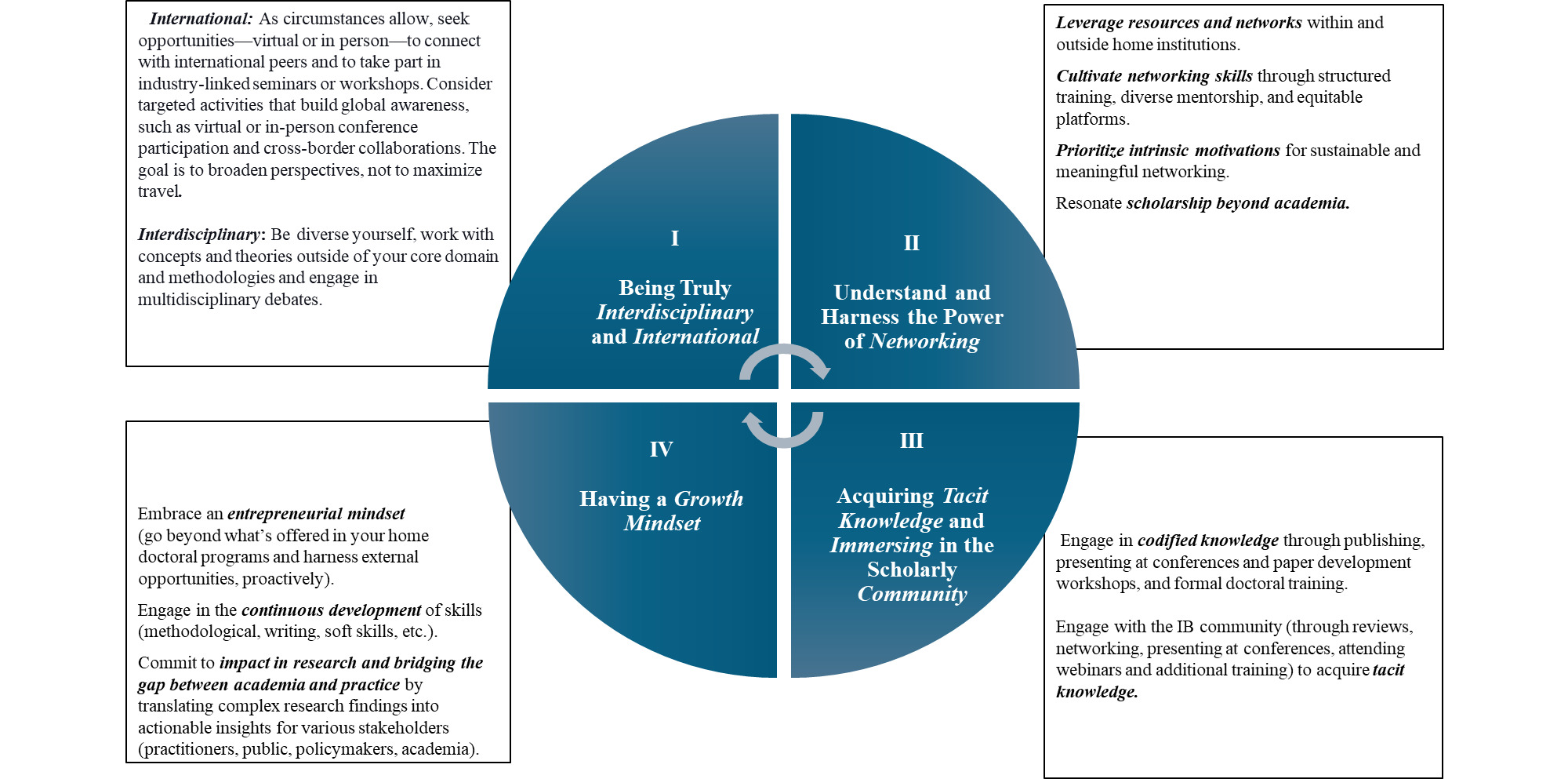
Doctoral education in IB evolves in tandem with the field’s growing dynamism and interconnectivity. Leveraging IB’s cross-border distinctiveness and interdisciplinary reach, we outline scaffolding strategies to help emerging scholars mobilize diverse resources and adapt their skill sets. This involves (1) connecting academic rigor with real-world relevance, (2) encouraging interdisciplinary collaboration, and (3) expanding meaningful international exposure. It also includes cultivating researchers who build global networks, engage in tacit learning through structured peer review, and enhance methodological rigor. Figure 1 summarizes these recommendations in an illustrative framework for developing well-rounded, internationally oriented IB scholars.

Many of these suggestions may be familiar to experienced researchers, but they are not always easy to identify, clearly stated, or well-integrated for students who are just starting, especially those with limited resources. Our objective has been to put these elements together into a comprehensive scaffolding framework that students can use to help them with their non-curricular PhD training. We hope these strategies will assist new IB scholars in finding their way through their PhD studies with more clarity and confidence, and that they will make a meaningful contribution to the growing global community of IB research.
Acknowledgments
We extend our gratitude to Professor Elizabeth Rose for her stellar editorial stewardship throughout the review process, and to the two anonymous reviewers for their constructive feedback and insightful comments, which significantly strengthened this manuscript. We are also deeply grateful to Professor Helena Barnard for her invaluable guidance on early versions of the manuscript. We further acknowledge Professors Tamer Cavusgil and Peter Buckley for inspiring several of the arguments developed here.
Additionally, we gratefully acknowledge the AIB-CIBER Doctoral Academy as an invaluable platform for emerging scholars, which brought this team together and provided opportunities and experiences reflected in this manuscript.
About the Authors
Katerina Boncheva is an international marketing and strategy scholar who recently completed her PhD at Cardiff University, UK. A graduate of the AIB-CIBER Doctoral Academy and recipient of the Jean Boddewyn Endowment Scholarship, her research explores how firms manage de- and re-internationalization amid shifting global conditions. She has published in International Marketing Review and Critical Perspectives on International Business.
Mimisha Gadhia is a PhD student in International Business at the University of Leeds, International Business Department, in the United Kingdom. She is also an alumna of the inaugural cohort of the AIB-CIBER Doctoral Academy. Her research interests focus on the internationalization of firms from emerging markets and on conducting qualitative research in emerging markets.
Theuns Mans completed his PhD at the Gordon Institute of Business Science, University of Pretoria, South Africa. His research focuses on the process of internationalisation, with a particular emphasis on how firms expand across borders from an emerging-market context. He is committed to advancing understanding in this field by examining the unique challenges, strategic pathways, and growth opportunities faced by emerging-market entrepreneurs. Theuns is alumnus of the AIB-CIBER Doctoral Academy.
Marleth Morales Marenco is a third-year PhD student in Management at the Culverhouse College of Business at The University of Alabama, USA, and an alumna of the inaugural cohort of the AIB-CIBER Doctoral Academy. Her research interest is focused on international new ventures.
Khaled Shukran is a Lecturer (Assistant Professor) at Sunway Business School, Sunway University, Malaysia and alumnus of the AIB-CIBER Doctoral Academy. His research focuses on subsidiary-headquarters relationships, particularly within emerging market contexts. He is committed to advancing this field by exploring new theoretical perspectives and practical implications. His work has been published in the Journal of Developing Areas, Academy of Management Proceedings, International Journal of Consumer Studies, Journal of Economic Studies, and AIB Insight.
Alexander Tonn is a final year PhD student in political economy at the University of St. Gallen, Switzerland and an alumnus of the inaugural cohort of the AIB-CIBER Doctoral Academy. His research interests lie at the intersection of political economy, policy and international business. Most recently, his work has been published in Critical Perspectives on International Business.