
Introduction
Five South Asian countries, including Bangladesh, India, the Maldives, Pakistan, and Sri Lanka, share direct access to the Indian Ocean. This strategic maritime position offers enormous potential for a blue economy — a sustainable development approach that can foster economic resilience, social inclusion, and responsible use of ocean resources (World Bank, 2017). Yet, this potential remains largely untapped, revealing a striking paradox at the heart of the region’s maritime wealth (Tisdell & Hazra, 2022).
Sri Lanka exemplifies this tension most clearly. As an island nation, it is endowed with a rich and diverse marine ecosystem, including an Exclusive Economic Zone (EEZ) of approximately 517,000 km2, a continental shelf of 30,000 km2, and a 1,585 km-long coastline featuring lagoons, estuaries, mudflats, and salt marshes. These waters sustain a vibrant fisheries sector, supplying more than half of the country’s per-capita animal protein and supporting the livelihoods of 3.6 million people (World Bank, 2021). Yet, despite this abundance, the sector contributes only 0.9-1.2% of national gross domestic product (GDP), while fisheries exports account for just over 2.3% of total annual earnings (Ministry of Fisheries Sri Lanka, 2024).
Why does such abundance fail to translate into economic impact? Among the reasons, overfishing and illegal, unreported and unregulated (IUU) fishing are significant factors. Overfishing occurs when stocks are harvested faster than they can naturally regenerate. As a key contributor to overfishing, IUU fishing includes illegal fishing in restricted zones, underreporting catches, and operating without proper licenses. These practices have significant ecological consequences, as they disrupt the replenishment of species and degrade marine biodiversity. Economically, they threaten the long-term maximum sustainable yield (MSY) of wild fish stocks. While these practices might provide short-term income for coastal communities, they ultimately undermine the long-term benefits that could be gained from ocean resources (Kularatne, 2020).
Although these impacts are felt locally, the drivers of overfishing extend far beyond Sri Lanka’s waters. Many pressures arise within fisheries’ global value chains (GVCs), where international demand for high-value species creates strong incentives for unsustainable harvesting. Yellowfin tuna, exported for raw sashimi, provides a telling example. Years of overexploitation led to its classification as overfished (‘red’) in the Indian Ocean in 2016. A new stock assessment in 2024 reclassified the stock as ‘green’, indicating a high probability of recovery. However, independent scientists and civil society groups have challenged the assessment’s methodology, and the true status of the stock remains contested. Similar patterns persist for other species, signaling that structural drivers of overfishing and IUU fishing remain unresolved (IOTC, 2023).
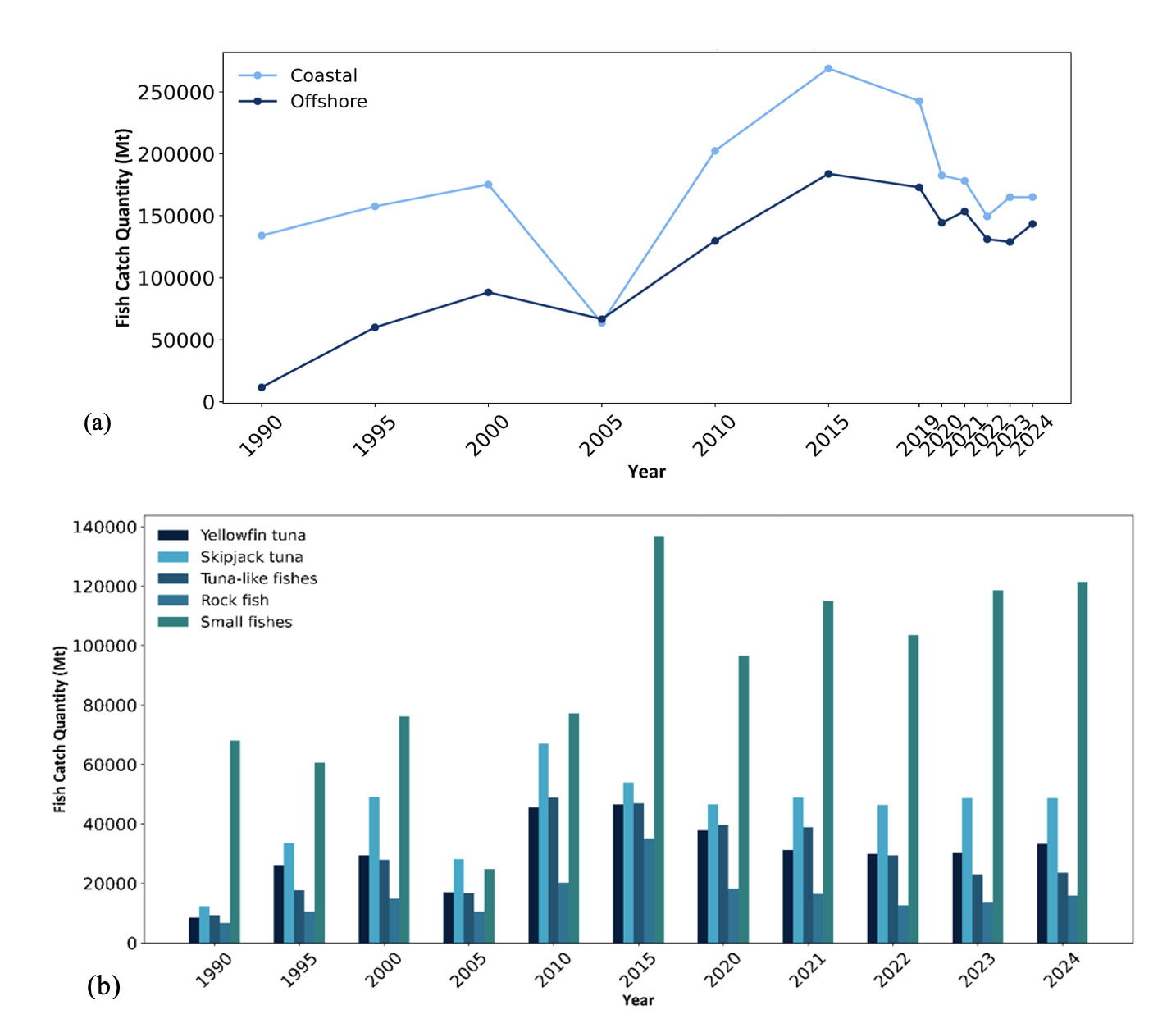
Figure 1 illustrates these tendencies. As shown in Figure 1(a), aside from the sharp drop in 2005 caused by the tsunami, marine catch has generally declined, particularly from 2015 onward. This trend is likely attributable to fish stock depletion resulting from overfishing. This pattern becomes even clearer when examining species-specific data in Figure 1(b). Yellowfin tuna, skipjack tuna, tuna-like species, and rockfish show declining catch levels from 2015 onward. In contrast, the impact on small fish appears minimal.
_in_sri_lanka_from_1990_to_2024__(a)_catch_by_coast.png)
These pressures are amplified by the common-pool nature of ocean resources, in which low-excludability and rivalrous consumption create strong incentives to race to fish (Ostrom, 1990). Furthermore, fish stocks do not respect national boundaries. Therefore, unsustainable practices in one country or within shared maritime zones can deplete stocks across the region. Destructive fishing in neighboring countries, such as India (e.g., Dudi, Collins, Nuno, & Karnad, 2025) and Bangladesh (e.g., Islam et al., 2017), therefore undermines not only their own fish stocks but also those of Sri Lanka (Kularatne, 2020), highlighting the transboundary nature of this challenge.
Understanding this paradox requires a multi-level analytical framework. This paper explores the drivers of overfishing across four interconnected levels: fisheries GVCs dynamics; fisher practices; national policy constraints; and regional governance gaps. By connecting these dots, the paper provides actionable insights for lead buyers, local fishing communities, and policymakers to move beyond subsistence and unlock a high-value blue economy. While our focus is on Sri Lanka, these findings resonate across other ocean economies, especially small island developing states (SIDS) that possess rich marine resources yet suffer from overexploitation by industrial fleets, market-distorting fisheries subsidies and limitations of international partnerships (Aquino, 2023). Therefore, this paper highlights the urgent need for coordinated multi-level approaches to protect marine resources, support the livelihoods of fishing communities, and foster sustainable blue economies globally.
Troubled Waters
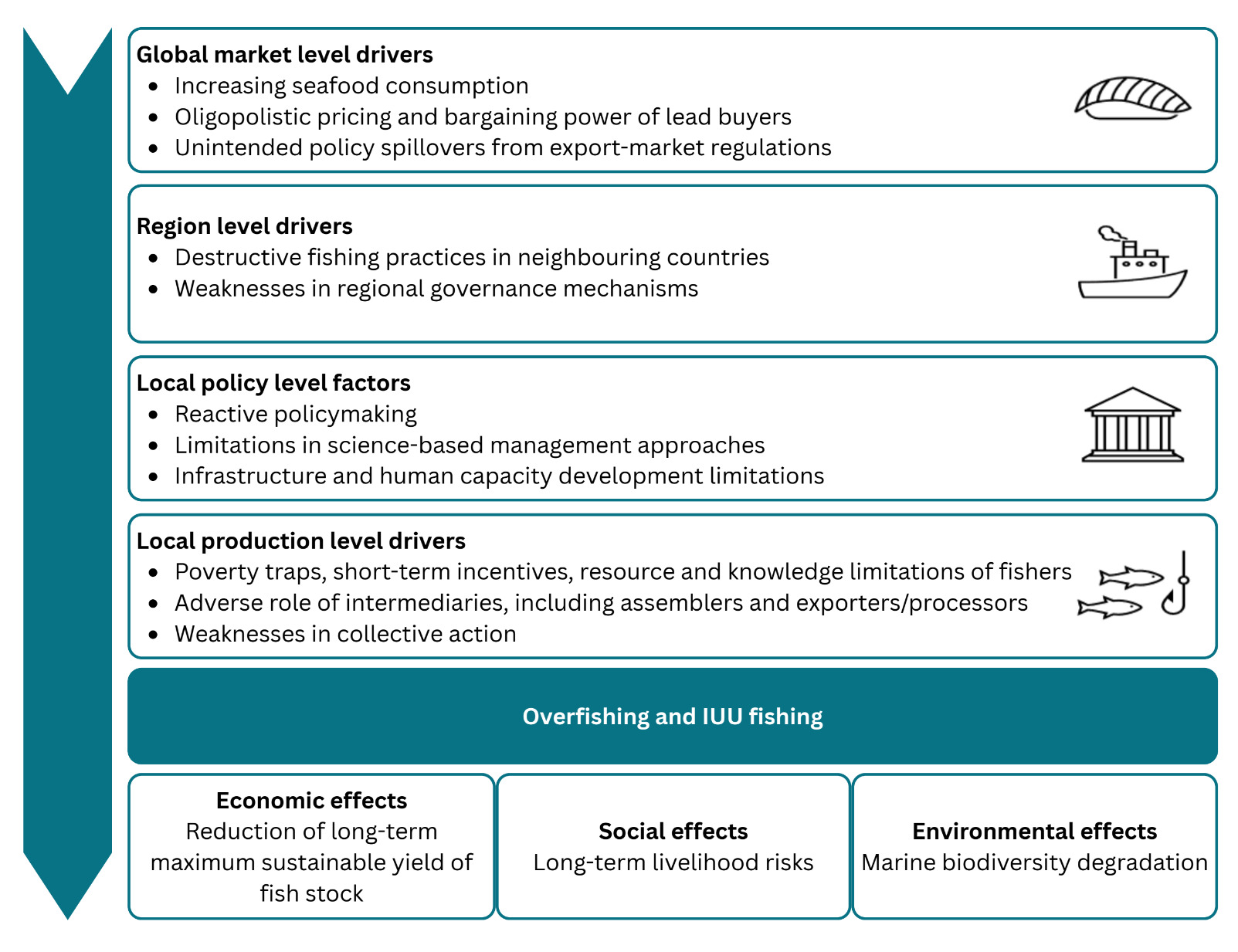
Figure 2 illustrates how actors and linkages within fisheries GVCs drive overfishing. We focus on the tuna sector (i.e., yellowfin, skipjack, and related pelagic species), as market dynamics and policy interventions differ across species. Tuna products account for the highest export value and volume of Sri Lanka’s total fish exports (Ministry of Fisheries Sri Lanka, 2024). Moreover, tuna is a highly migratory species, making them an ideal case to highlight the transnational stakes of fisheries management in South Asia.
Global Market-Level Drivers
Rising consumer demand in major export markets contributes to overfishing. Yellowfin and bluefin tuna have become premium products due to increasing sushi and sashimi consumption, while skipjack feeds the global canned tuna market. These global appetites push fishers into a race to fish, chasing the most in-demand species at the expense of others.
However, the real winners of this race are the lead buyers, including supermarkets, retailers, branded merchandisers, and other non-branded buyers. With oligopolistic pricing and the power to shift supply across regions, they set the rules of the game, pressurizing local exporters/processors and fishers to meet their demands, often at ecological and social cost (Havice & Campling, 2017). For example, slim profit margins frequently push fishers into taking excessive risks at sea and engaging in IUU fishing simply to make a living. Furthermore, limited coordination among lead buyers, local exporters/processors, and fishers exacerbates the issue, often leading to post-harvest losses. For instance, fishers lack a clear understanding of sustainability certifications and quality standards expected by lead buyers, such as those required for Marine Stewardship Council (MSC) certification and ISO 9001, which can reduce the market value of their catch.
Parallel to market pressures, international regulators in export markets wield significant influence over local practices through trade-based conditionalities. A prominent example occurred in 2015, when the EU issued a ‘red card’ to Sri Lanka for failing to meet international standards against IUU fishing, which led to a ban on seafood exports. While this top-down regulatory pressure successfully catalyzed institutional reforms and restored market access by 2016, it came at a high social cost (Kim & Lim, 2024). Particularly, fishing communities disproportionately bore the brunt of this transition, as they faced an immediate compliance shock. These fishers struggled to adapt to new gear regulations and reporting mandates, which, alongside a temporary reduction in fishing capacity, created severe disruptions to their livelihoods.
Insight 01: Global market demands and international regulatory pressures function as a double-edged sword. While they can incentivize sustainable fisheries, they can unintentionally drive overfishing by influencing the socio-economic vulnerabilities of fishers.
Local Production-Level Drivers
At the local level, overfishing is shaped by the choices and pressures faced by fishers, middlemen, exporters/processors, and fishing communities. In Sri Lanka, tuna is caught by one-day boats and multi-day fishing (MDF) vessels. While MDF boats account for most offshore catches, only about 16% of landings meet export-quality standards (World Bank, 2021). This shortfall stems from limited refrigeration capacity, outdated gear, inadequate onboard post-harvest facilities, and weaknesses in landing infrastructure. Furthermore, sustainable quota allocation relies on accurate catch data; however, poor reporting practices among fishers hinder the reliability of stock assessments. Compounding this issue are the limitations in adopting advanced technologies, such as vessel monitoring systems (VMS) and traceability protocols, which are instrumental in curbing overfishing and IUU fishing. Rising fuel costs introduce another layer of economic pressure, incentivizing fishers to maximize catch per trip. Collectively, these infrastructure limitations, knowledge gaps, and short-sighted survival strategies reinforce overfishing and IUU fishing (Collins et al., 2023).
At the intermediary level, the pressure on fishers is increased by the actions of the actors who connect them to the global market. These intermediaries include assemblers, such as fish collectors, boat owners, moneylenders, and raw material suppliers, who shape fishers’ access to capital and equipment, and exporters/processors who control access to international markets. Many of these actors exploit fishers during auctions by manipulating prices or highlighting quality defects to suppress purchase prices. This financial squeeze often pushes fishers to increase fishing effort or engage in IUU practices to compensate for income losses. At the community level, weak collective action exacerbates the problem. Although fisheries cooperatives exist, their capacity to coordinate data reporting, promote sustainable management practices, or ensure compliance with regulations remains limited (World Bank, 2021). Therefore, weaknesses in local governance structures at the intermediary and collective action levels undermine efforts to reduce overfishing and IUU fishing.
Insight 02: Local socio-economic challenges reinforce overfishing. Targeted interventions at the level of fishers, intermediaries, and fishing communities are essential.
Local Policy-Level Factors
Over the years, Sri Lankan policymakers have made significant progress in strengthening policy frameworks to tackle overfishing and IUU fishing. Key reforms include revising the Fisheries and Aquatic Resources Act, introducing satellite-based VMS for vessels operating in Sri Lankan waters and the high seas, issuing operational licenses and export permits, developing a National Action Plan to Combat IUU Fishing, ratifying major international agreements such as the UN Fish Stocks Agreement, and ensuring compliance with Indian Ocean Tuna Commission (IOTC) requirements.
However, many of these measures have been reactive responses to external pressures rather than the result of proactive policies grounded in science-based fisheries management. The development of evidence-based management practices faces significant obstacles due to infrastructural and institutional challenges, such as inadequate access to advanced technologies, limited capacity for data collection, and insufficient financial investment for stock assessments. These limitations not only impede national stock-rebuilding efforts but also weaken Sri Lanka’s ability to negotiate effective quotas at the IOTC (World Bank, 2021).
Insight 03: Strengthening legal frameworks alone is insufficient. Effective reform requires science-based management practices, data-driven methods, and investment in human capacity development.
Regional-Level Drivers
Destructive fishing practices in South Asia and the Indian Ocean adversely affect Sri Lanka’s fish stocks. In the Palk Bay, frequent incursions by South Indian fishers using bottom-trawling, a practice banned in Sri Lanka, have degraded marine ecosystems. Simultaneously, foreign fleets from the EU and Southeast Asia are criticized for using purse seine and bait-fishing methods that capture juvenile fish alongside adults, in contrast to the sustainable long-line methods used by Sri Lankan vessels. Efforts to address these practices are constrained by limited capacity to monitor foreign vessels, challenges in enforcing IUU fishing regulations and regional agreements, and the need to navigate complex geopolitical and diplomatic sensitivities (Kularatne, 2020).
To address these transboundary challenges, IOTC — the intergovernmental organization responsible for the sustainable management of tuna and tuna-like species in the Indian Ocean — has implemented initiatives such as binding catch limits and stock-rebuilding plans. However, persistent governance controversies continue to undermine their efficacy. Continuous disputes revolve around the adoption of bycatch reduction measures, the fairness and transparency of quota allocation (which are often complicated by inconsistent data and reliance on historical catch records), and the uneven compliance and enforcement across member states. For example, the Sri Lanka Multi-Day Boats Association argues that the quota system disproportionately advantages industrial foreign fleets, many of which use destructive fishing methods. In addition, the limited representation of small-scale fishers in IOTC decision-making reduces inclusiveness.
Insight 04: National policies alone cannot promote sustainable fisheries. Regional cooperation and inclusive transboundary governance mechanisms are essential.
Turning the Tide
Building on the above four insights, this section outlines actionable insights to curb overfishing and IUU fishing.
Align Global Market Incentives to Sustainable Fishing Practices
As consumers, lead buyers, and regulators in export markets shape the coordination of fisheries GVCs (Insight 1), they play a pivotal role in promoting sustainability and accountability. Lead buyers can reduce incentives for unsustainable practices by establishing long-term contracts and stable partnerships with exporters/processors and fishers. Further, market-based tools such as chain-of-custody standards enhance accountability by requiring actors across the fisheries GVCs to provide traceability information, including species, gear and vessel identity, fishing location, and bycatch data. Complementing this, sustainability certifications such as MSC and Friend of the Sea can help reduce ecological impacts by promoting independent auditing. To support adoption, lead buyers, regulators, and third-party organizations should facilitate training, knowledge transfer, and collaborative partnerships (World Bank, 2021). Where full compliance with international standards is challenging, developing national voluntary sustainability labels can offer a credible pathway to signal responsible practices.
Empower Fishers as Custodians of Oceans
Empowering fishers as ocean custodians is key to reducing overfishing and IUU fishing (Insight 02). Enhancing their quality of life through livelihood diversification, capacity-building initiatives, and stronger social safety nets helps ease income insecurity that drives risky practices. Innovative business models, such as value-addition from bycatch, plastic upcycling, and regenerative aquaculture, can increase economic opportunities. Providing financial incentives to upgrade gear, vessels, and onboard facilities can help reduce post-harvest losses and bycatch. Community-based resource management practices can strengthen collective stewardship by integrating indigenous ecological knowledge into scientific practices. For example, promoting citizen science programs that integrate fishers’ observations with scientific data is a cost-effective way to improve stock assessments.
Embed Science-Based Approaches into National Policies
Policymakers need to strengthen science-based management practices (Insight 03). This begins with increasing investment in research and development to generate reliable evidence for policy decisions. For example, scientific studies are essential for identifying declining stock trends, quantifying bycatch mortality, and mapping areas vulnerable to habitat degradation, providing the empirical evidence needed to inform fishing-gear policies. Furthermore, the development and testing of scientific research should be conducted collaboratively with fishers. This participatory approach not only enhances the practicality of solutions but also fosters trust and ownership, making these approaches more effective than compliance-driven measures, such as gear bans. Funding the adoption of digital tools, such as electronic logbooks, automated monitoring systems, and digital inspection platforms, will help reduce data fabrication in stock assessments. Investment in human capital is essential. Strengthening national capacity in environmental monitoring, scientific research, and stock-assessment methodologies will enable Sri Lanka to design more robust fisheries management strategies. Given Sri Lanka’s financial challenges as a developing country, forming partnerships with international donors, intergovernmental organizations, and foreign aid programs will be instrumental to scale these institutional upgrading efforts.
Promote Regional Cooperation
To address the challenges arising from the transboundary nature of marine resources (Insight 04), Sri Lankan policymakers can utilize the country’s strategic location and recent diplomatic momentum to advocate for a multilateral governance framework. Strengthening regional cooperation is crucial to shift the global narrative toward the vulnerabilities of the Indian Ocean and mobilize the technical and financial support necessary for systemic reforms. Within the IOTC, Sri Lanka can adopt a more proactive role by influencing regional action plans, promoting collaborative research, initiating joint stock-assessment efforts, and advocating for fair and transparent conflict-resolution mechanisms. Furthermore, since IUU fishing poses a regional challenge, South Asian policymakers need to tackle it through coordinated efforts. This includes increasing joint monitoring and surveillance activities across EEZ boundaries and reinforcing a shared regional code of conduct for sustainable fishing practices to diminish the enforcement gaps that illegal actors exploit.
Concluding Remarks
Overfishing and IUU fishing undermine the potential for a sustainable blue economy in South Asia, particularly for island nations such as Sri Lanka. The drivers of these challenges are deeply systemic, emerging from an intersection of socio-economic pressures, GVC dynamics, national policy constraints, and regional geopolitical complexities. Achieving a sustainability transition within the sector necessitates more than fragmented or short-term interventions; it demands a multi-level strategy that integrates GVC accountability, fisher empowerment, policy reforms and regional cooperation. Beyond South Asia, these insights are highly relevant to other SIDS, where artisanal fishing communities endure social, economic, and ecological harms, often driven by the exploitative practices of a small number of powerful actors. Therefore, reversing this trajectory from extraction to stewardship depends on moving decisively away from a race to fish and toward a shared commitment to protecting ocean health and sustaining the livelihoods of the communities that depend on it.
About the Authors
Denanjalee Gunaratne (PhD, University of Glasgow, United Kingdom) is a postdoctoral researcher at LUT University, Finland. Her research explores the intersection of sustainability and international business, with particular interests in environmental and social sustainability within global value chains. She also focuses on the role of Industry 4.0 technologies, business model innovation, and strategies for facilitating the upgrading of developing countries.
Imali Udeshika Manikarachchige is a Leverhulme Doctoral Scholar at the University of Southampton, United Kingdom. She has over ten years of experience as an educator and a researcher in the field of marine and maritime affairs. Her specialization encompasses marine sciences, coastal communities, marine environmental management, ocean governance, and the sustainable blue economy. Her current research focuses on understanding the dynamics of oceans as socio-ecological systems and how to adopt systems thinking to mitigate anthropogenic influences that compromise ocean sustainability.
Hashan Niroshana Kokuhennadige (PhD, University of Southampton, United Kingdom) is a Senior Marine Environmental Scientist at Fugro GB Limited. He earned his doctorate in Ocean and Earth Sciences from the University of Southampton. His research focuses on oceanic carbon dynamics across diverse marine environments, the impacts of anthropogenic CO2 invasion, the behavior of oxygen minimum zones, nutrient cycling, and the broader consequences of marine pollution.