

Introduction
In an era of increasing geopolitical instability, multinational corporations (MNCs) face unprecedented challenges as they operate across diverse cultural and political contexts. The Middle East exemplifies a region where political sensitivity and consumer activism converge, creating a high-stakes environment for global brands.
The ongoing conflict represents one of the most devastating episodes in a long history of clashes between Israel and Palestinian groups, reigniting on October 7, 2023. On that day, Hamas militants infiltrated Israel, resulting in the deaths of over 1,200 individuals, including approximately 800 civilians, 346 Israeli soldiers, and 66 police officers, along with nearly 250 hostages taken (Kane, 2023). In retaliation, Israel initiated military operations with the stated aim of dismantling Hamas, securing the hostages’ release, and preventing future attacks. However, the scale of Israel’s military response has precipitated a severe humanitarian crisis in Gaza.
As of December 2025, Israeli military operations in Gaza have resulted in the deaths of more than 71,271 Palestinians; a majority of those killed are women and children (Al Jazeera, 2025; Associated Press, 2026). Thousands remain missing under rubble, and nearly all of Gaza’s 2.3 million residents face repeated displacement (Al Jazeera, 2025).
The extensive destruction of infrastructure and shortages of food, water, and medical supplies have led human rights groups, including Israel’s B’Tselem, to accuse Israel of collective punishment and even genocide (B’Tselem, 2025). The crisis has deepened, with international agencies warning of famine conditions in Gaza (World Food Programme, 2025). The toll of the war has sparked outrage and condemnation, heightening moral and reputational dilemmas for MNCs as calls for boycotts increase, forcing companies to carefully balance market interests and ethical considerations.
The situation remains deeply polarized: Israel’s security concerns and Palestinian suffering both shape global narratives and fuel consumer activism. This polarization has created a complex environment for MNCs, which face pressure from both sides. In Western markets, pro-Israel stakeholders, including policymakers, investors, and advocacy groups such as the Anti-Defamation League, have urged companies to support Israel or avoid legitimizing boycotts, framing them as antisemitic activism (Jewish Telegraphic Agency, 2025). By contrast, in Arab and Muslim-majority markets, as well as among pro-Palestinian activist communities globally, firms have encountered boycotts due to alleged ties with Israel and perceived corporate complicity.
To explore how MNCs respond in such politically charged contexts, this paper examines the cases of Starbucks and Carrefour and integrates insights from the literature to identify four actionable strategies. The analysis covers October 2023 to August 2025, a period marked by intensified conflict, severe humanitarian crisis, widespread displacement, and escalating boycotts.
Because the firms examined have diverse governance structures, especially master franchisee setups, their responses to boycott pressures often do not stem from a single organizational level. In these cases, responses can come from corporate headquarters (HQ), regional franchise partners, or the interaction between them. Therefore, this study considers corporate responses as system-level outcomes influenced by governance arrangements and local embeddedness, rather than actions solely originating from HQ.
Theoretical Background: Corporate Strategies for Responding to Boycotts
Boycotts have long empowered consumers to demand corporate accountability on economic, political, and social issues (Klein, Smith, & John, 2004). Such actions are often motivated by perceptions of unethical conduct or human rights concerns and can impose significant financial and reputational costs on firms. In politically sensitive environments, boycott movements are frequently amplified through digital platforms, accelerating consumer mobilization and encouraging shifts toward alternative brands (Abosag & Farah, 2014).
The existing literature on corporate responses to boycotts, corporate diplomacy, and political risk management offers a valuable foundation for understanding how firms navigate these crises (Ettenson & Klein, 2005; King, 2008). Corporate responses to boycotts typically fall into four distinct categories: defensive denial, corrective action, strategic adaptation, and proactive measures.
Defensive denial entails rejecting the legitimacy of a boycott, often when companies view allegations as unfounded or exaggerated; however, this approach can backfire if it is perceived as insincere or dismissive (Ettenson & Klein, 2005). Corrective action involves addressing stakeholder grievances through revised practices or public commitments and is often adopted when boycott pressure escalates or attracts significant media attention (King, 2008). Strategic adaptation reflects a longer-term realignment of operations or CSR activities to better align with stakeholder expectations, with failure to adapt risking perceptions of corporate hypocrisy (Wagner, Lutz, & Weitz, 2009). Finally, proactive measures involve engaging with social issues before they escalate into boycotts (Parcha & Westerman, 2020).
Another important concept in politically charged environments is what this paper refers to as a “halo brand”, a locally or regionally embedded brand that carries cultural legitimacy and consumer trust, especially in host markets. While the term “halo effect” is well established in branding literature to describe how positive perceptions extend across a brand’s portfolio (Han, 1989), this paper extends the concept to describe local brands or franchisee-operated entities that act as reputational buffers for MNCs during geopolitical crises. In franchise-heavy regions such as the Middle East, these halo brands can be particularly effective in insulating global brands from consumer backlash tied to perceived foreign political stances.
Lessons from Corporate Responses to Boycotts
We conducted a focused analysis of two companies, Starbucks and Carrefour, assessing their responses using the four-category typology discussed above. These globally recognized brands were selected due to the significant backlash they faced and their varied response strategies, offering valuable insights into how MNC responses may unfold across different organizational levels. Their different home markets (Starbucks from the U.S. and Carrefour from France), industries (food and beverage vs. retail), and governance structures, including the use of master franchisee arrangements in the Middle East, provide complementary perspectives on corporate responses to politically driven boycotts.
Starbucks: Navigating Dual Pressures
Starbucks faced pressure from both pro-Palestinian and pro-Israel activists, navigating divergent expectations in its home market (the U.S.) and across the Middle East and North Africa (MENA). In the U.S., backlash followed a pro-Palestinian statement issued by the company’s labor union on October 9, 2023, prompting some U.S. officials to call for boycotts in solidarity with Israel. Starbucks quickly filed a lawsuit against the union to distance itself, insisting that the statement did not represent the company’s stance (Durbin, 2023).
Subsequently, in many host markets and even in the home market, pro-Palestinian activists targeted Starbucks as part of broader boycott initiatives against brands perceived to be linked to Israel. Social media has played a pivotal role in amplifying these calls, with viral campaigns urging consumers to avoid Starbucks.
This dual pressure placed Starbucks in a precarious position, forcing it to navigate conflicting expectations across its markets. In response, the company emphasized neutrality, clarifying that it had not contributed to any government or military operations, condemning violence against civilians, and highlighting humanitarian initiatives such as meal donations in Gaza through World Central Kitchen (Starbucks, 2023a). It also sought to counter misinformation on social media, distancing itself from external statements, including those made by its U.S. union (Sherman, 2023).
Taken together, these actions reflect the defensive denial strategies. Prior research cautions that such approaches can exacerbate consumer backlash when they are perceived as insincere or evasive (Ettenson & Klein, 2005). In the Starbucks case, continued public skepticism and sustained boycott pressure suggest that denial-based messaging did little to address stakeholder concerns, leaving the firm largely reactive. This pattern underscores the limitations of defensive denial as a sustainable long-term strategy for managing reputational crises.
In its MENA host markets, Starbucks operates through a licensing agreement with a Kuwaiti private family business, the Alshaya Group, which has served as its master franchisee in the Middle East since 1999 (Starbucks, 2023b). Following a series of boycotts in 2023, Alshaya considered selling its minority stake in Starbucks franchises amid financial uncertainty linked to geopolitical tensions, before suspending these plans in early 2025 as customer activity stabilized (Yahoo Finance, 2024). During this period, Alshaya announced more than 2,000 job cuts in 2024, citing “challenging trading conditions” amid the Gaza war and related boycott pressures (Reuters, 2024).
Despite Starbucks’ visible franchisee relationship and local engagement, its global brand identity overshadowed regional ties during the crisis, leaving the firm vulnerable to reputational backlash. The case illustrates that in politically charged environments, consumer perceptions tied to a brand’s perceived national origin may outweigh local ownership or management structures in shaping boycott behavior.
Carrefour: Exit by HQ, Adaptation by Franchisee
Carrefour, headquartered in France, operates globally through a mix of direct ownership and franchising. In the Middle East, Carrefour’s presence has been managed since 1995 by Majid Al Futtaim (MAF), a UAE-based conglomerate with exclusive rights to operate the brand in 12 regional markets (Majid Al Futtaim, 2025).
In Jordan, Carrefour faced sustained boycotts as consumers linked the brand to its French origin and alleged support for Israel. Palestinian activists accused the company of supplying food to the Israel Defense Forces, allegations that Carrefour denied (Al-Dabisiyyeh, 2024). Despite this denial, consumer pressure intensified, leading MAF to announce the closure of Carrefour Jordan on November 4, 2024 (Trendtype, 2024). Shortly thereafter, MAF launched Hypermax, a new Arab grocery chain that retained Carrefour staff and facilities while replacing the French brand with a culturally resonant local identity (Trendtype, 2024).
Overall, these developments indicate that Carrefour’s response to boycott pressures involved HQ-level withdrawal from select markets, while MAF, as the franchisee, pursued localized adaptation to maintain legitimacy and operational continuity. This pattern highlights the layered nature of franchise arrangements, in which HQ may divest while local partners retain discretion to rebrand and respond to consumer expectations. A similar scenario played out in other Middle Eastern markets, such as Oman, Bahrain and Kuwait, where MAF rebranded Carrefour stores under the Hypermax banner (Majid Al Futtaim, 2025).
Generally, the case illustrates how responses to boycott pressures can be distributed across organizational layers, combining HQ-level divestment with franchisee-led strategic adaptation rather than relying on centralized action alone.
Mapping Corporate Response to the Four-Strategy Framework
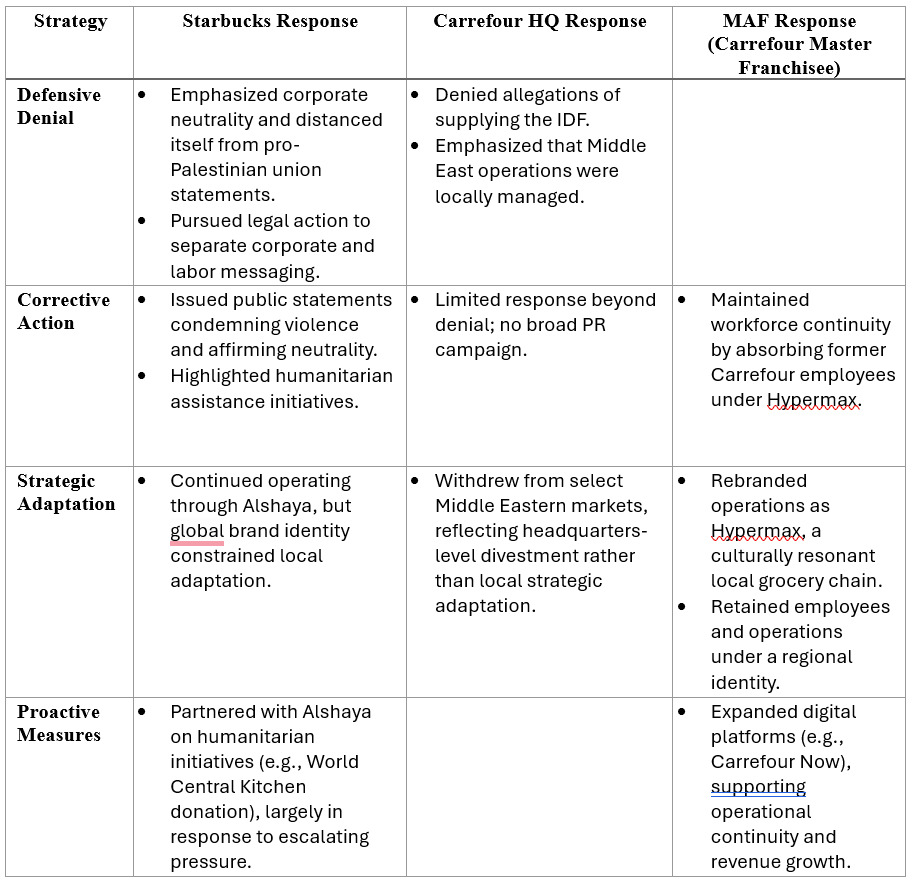
The table below maps the observed responses of Starbucks and Carrefour to an established four-category typology of corporate responses to boycotts, highlighting important contrasts in how different elements of these strategies were selectively deployed across cases and organizational levels.
Starbucks primarily relied on defensive denial, distancing itself from politically charged statements and emphasizing neutrality, while engaging in limited corrective action and exhibiting few signs of deeper strategic adaptation. By contrast, the Carrefour case illustrates a system-level response in which HQ-level withdrawal was accompanied by franchisee-led strategic adaptation. Through its master franchisee, MAF, the response extended beyond denial to include proactive measures such as the launch of a culturally aligned local brand, Hypermax. While both companies operated through regional franchisees, the Carrefour–MAF case more clearly demonstrates how locally embedded partners can leverage alternative branding strategies to preserve legitimacy and continuity in host markets.
Actionable Recommendations for Managing Boycotts and Corporate Reputation
The comparative cases of Carrefour and Starbucks highlight four strategic approaches that MNCs can use to navigate boycotts and reputational crises.
Defensive Denial: Use Sparingly and Strategically
Defensive denial can offer immediate reputational distancing, but only if it is backed by credible evidence and communicated consistently across markets. Starbucks’ experience shows that when denial is perceived as insincere, it intensifies backlash.
The Starbucks case suggests that defensive denial is most viable in the early stages of a boycott, when allegations are rapidly spreading across markets, and local operators have limited discretion to act independently. However, firms should treat denial as a short-term containment strategy and reassess quickly if consumer pressure persists.
Corrective Action: Communicate with Clarity and Empathy
When backlash occurs, swift corrective measures are essential. Starbucks’ $3M joint donation with Alshaya to World Central Kitchen illustrates the potential of corrective action, but inconsistent messaging limited its impact. Corrective strategies must combine clarity, empathy, and consistency across geographies. In addition, corrective action is most effective when material support is paired with locally credible messengers, particularly in franchise-based systems where HQ statements alone may lack legitimacy.
Strategic Adaptation: Align Business Models with Market Sensitivities
Strategic adaptation requires aligning business models, branding, or operations with host-market expectations. Carrefour’s withdrawal from Jordan and other Middle Eastern markets contrasted with its franchisee MAF’s pivot to Hypermax, a culturally resonant brand that preserved legitimacy. However, such strategic adaptation becomes feasible when local partners possess contractual autonomy, strong market embeddedness, and the ability to decouple operations from a contested global brand. In such contexts, adaptation may occur at the franchisee level even when HQ opts for market exit.
Proactive Measures: Integrate CSR and Stakeholder Engagement
Proactive CSR and sustained stakeholder engagement are the most sustainable strategies. The Starbucks–Alshaya case illustrates how visible humanitarian initiatives can help reinforce legitimacy, but the cases also caution against reactive or symbolic commitments once a crisis has escalated. For CSR to be truly effective, it must be embedded in broader governance practices, including early monitoring of ethical and reputational risks, evolving boycott discourse, transparent supply chains, and clearly defined response protocols that balance franchisee flexibility with HQ oversight. Without these foundations, CSR initiatives implemented after a crisis may seem insincere or opportunistic, risking long-term trust even if they improve short-term reputation gains.
Conclusion
The Carrefour and Starbucks cases demonstrate different ways organizations respond to boycotts, varying in both their approach and structure position. Viewed through an established four-strategy typology, the cases highlight how multinational responses to consumer activism may be selectively deployed rather than uniformly applied across firms or contexts.
Carrefour’s withdrawal from Jordan and other Middle Eastern markets reflected HQ-level divestment in response to sustained consumer backlash. At the same time, its franchisee, MAF, preserved market presence and legitimacy by rebranding operations under the locally resonant Hypermax brand. This divergence highlights the multi-layered nature of franchise-based MNC structures, where local partners might pursue strategic adaptation even if the global HQ chooses to exit.
By contrast, Starbucks maintained a centralized defensive approach that emphasized neutrality and a global messaging strategy. Although the company highlighted its long-standing partnership with Alshaya, this relationship was largely overshadowed by the global brand, limiting its ability to buffer reputational risks.
Ultimately, MNCs must recognize that geopolitical crises and consumer activism are enduring strategic challenges rather than temporary disruptions. Effective responses require moving beyond short-term damage control toward context-sensitive strategies that combine transparent communication, proactive CSR, and the strategic use of local partnerships to build long-term resilience.
Acknowledgments
The author expresses sincere appreciation to AIB Insights editor Professor William Newburry and the two anonymous reviewers for their thoughtful and constructive feedback throughout the review process.
The author used Grammarly and ChatGPT to proofread and check grammar in the final manuscript.
About the Author
Mamoun Benmamoun, Ph.D., is an Associate Professor of International Business and Director of Accreditation at the Richard A. Chaifetz School of Business, Saint Louis University. His research examines the intersection of international business, geopolitics, technology, and public policy, with particular interests in multinational enterprise strategy, digital localization, and AI-driven decision-making. His work addresses how global firms navigate political risk, consumer activism, and regulatory pressures across markets. He has extensive experience in applied statistics, economics, and digital technology development and teaches interdisciplinary courses integrating international business, analytics, geopolitics, and AI.