
Introduction
Multinational corporations (MNCs) come in various stripes. Many traditional MNCs from developed countries expanded abroad at a time when opportunities in the home country were plentiful and competition abroad limited (Dunning, 1988). They often developed and honed their firm-specific advantages at home (Porter, 1990) and then deployed them internationally, sometimes sequentially entering countries at progressively greater psychic distance (Johanson & Vahlne, 1977). Prior literature has proposed two other types of MNCs: Born globals (Oviatt & McDougall, 1995) and Springboard MNCs (Luo & Tung, 2018). Born globals enter several countries in a short period of time at a young age. In contrast, Springboard MNCs, which originate in developing countries, deploy resource- and skill-intensive strategies, such as innovation and acquisitions (Luo & Tung, 2018). The three types of MNCs mentioned above differ in several respects but also share one similarity: they started selling in their home markets before venturing abroad.
In this paper, we propose a new type of MNC — Leaping MNCs — that begin by selling their products or services internationally without ever selling in their home country. Unlike firms such as Singapore Airlines and Emirates Airlines, which go overseas to address the lack of demand in their home countries, Leaping MNCs deliberately and strategically choose not to sell in their home countries. Transsion, a key exemplar in our inductive analysis, has achieved sales of US$ 9.6 billion (2024) without selling in China, its home country (Yicai Global, 2025). As shown in Table 1, Leaping MNCs also differ from Born globals and Springboard MNCs in several important ways.
Like born globals and Springboard MNCs, the emergence of Leaping MNCs can be attributed to a combination of strong push and pull forces. The intense rivalry in the home country constitutes the push force, and the opportunity to capitalize on the home-country ecosystem by internationalizing into underserved markets serves as the pull force (Porter, 1990). The entrepreneurial and visionary top managements of these firms recognize the salience of the pull force, even if it means adopting a multifaceted internationalization strategy to overcome their liability of foreignness.
In the next section, we discuss the evolution and key strategies of our exemplars, with a focus on Transsion. We then specify our four-stage LAAD model before concluding with our recommendations for managers.
Transsion: An Exemplar
Transsion was founded in Shenzhen, China, in July 2006 as Tecno Telecom Ltd by George Zhu and his business partner. Despite the large demand for phones in its home market, it initially sold its Tecno-branded mobile phones in Nigeria and South Asia but changed its sales focus to Africa exclusively in 2008 (Rest of World, 2020). By avoiding the intense rivalry among well-established global and local competitors in China, Transsion was able to conserve its limited resources.
Transsion initially sourced its feature phones from China, leveraging the country’s efficient supply chain (Wang, Zhao, & Velamuri, 2020). While it continues to source a large proportion of its phones from China, it now also sources from other countries. To leverage the large number of highly skilled yet low-cost engineers in China, its first two R&D centers were established in China and Hong Kong, though it now has one in India and as many as three in Africa.
Transsion’s phones are not only priced at low levels, between US$20 to US$200 (Wang et al., 2020) but also include several localized features such as long-lasting batteries that can be charged quickly, cameras that account for darker skin tones of its African customers, and keypads for several African languages. Transsion has developed multiple apps featuring music, games, and short videos, which, again, align with African users’ preferences. The apps are also pre-loaded on Transsion phones to address the slow network speeds in Africa.
Transsion’s strategic adaptations include developing applications in collaboration with local engineers and entrepreneurs and employing nearly 2,000 local staff at its factory in Addis Ababa (2011), the first mobile phone manufacturing facility in Africa. It has also created Carlcare, a service network spanning Africa’s vast geography, earning it a place among the most admired brands in Africa.
Since Africa was a very psychically distant market for many of its rivals (Reuter, 2025), they did not undertake a similar degree of strategic adaptation, and Transsion quickly became one of the top 3 players by unit sales by 2010 (Wang et al., 2020). To cater to additional customer segments, Transsion expanded its product portfolio to include the Itel and Infinix brands of mobile phones with enhanced features. It expanded further into making and selling accessories and appliances in 2015. Recognizing a gap in the offerings of global players for African consumers, Transsion introduced Boomplay, a music streaming service that has attained a market-leading position (Wang et al., 2020). Based on a deep understanding of local customer needs, it diversified its product line to include other appliances, such as an electric cooker that can make swallow, a popular dish in many African countries. In 2024, Transsion sponsored the 34th African Cup of Nations and pledged to refurbish 100 community football pitches across Africa, earning goodwill among several stakeholders. Even its promotional messages downplay its Chinese origins to claim: We are African. For a company with a lower brand profile than industry giants such as Apple and Samsung, its Tecno brand ranked among the most admired brands in Africa (Kr-Asia.com, 2025).
Transsion leveraged its financial, knowledge (e.g., about competing in developing countries), and technical (e.g., adapting product designs) resources accumulated through successful (and profitable) operations in Africa, to enter other developing countries (DigiTimes Asia, 2024). Despite a late entry (2019), it is among the leaders in India (Rest of World, 2024). It also holds leading market shares in Pakistan and Bangladesh, both populous developing countries, and the Philippines, where it holds a 37% share (36kr, 2025). In Latin America, it was the 2nd-ranked player in 2024 (Equal Ocean, 2025).
In 2024, Transsion shipped 201 million phones, ranking third in market share and fourth in smartphone sales. It had achieved sales of CNY 68.71 billion (approximately USD 9.6 billion), net income of CNY 5.54 billion (USD 0.76 billion), and a market capitalization of CNY 120.14 billion (USD 16.5 billion) (Yicai Global, 2025).
Although we discussed Transsion’s strategy and outcomes in detail, there are other examples of Leaping MNCs. Shein is a Chinese player that sells in many countries, but not in its home country. Kilimall, a company founded by an ex-Huawei employee, has established a prominent e-commerce platform in Africa (Tech in Asia, 2019). Two Indian firms can also be classified as Leaping MNCs: Nihilent Technologies, a global consulting and solutions integration company with a Pan-African presence, and Maser, which sells budget-friendly consumer electronics appliances to consumers in the Middle East and Africa.
A Four-Stage LAAD Model for the Emergence of Leaping Multinationals
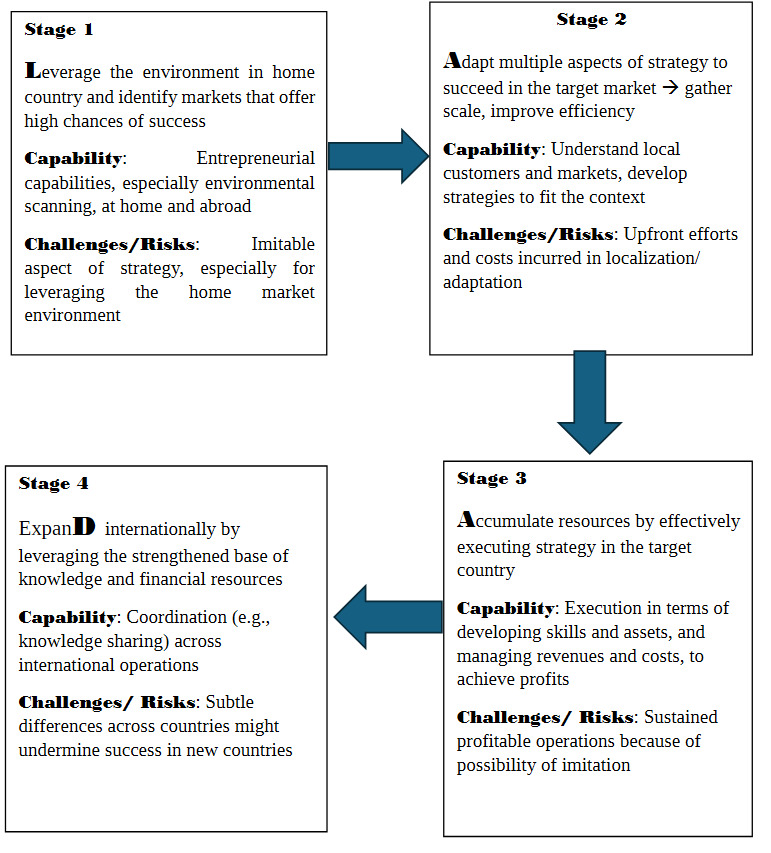
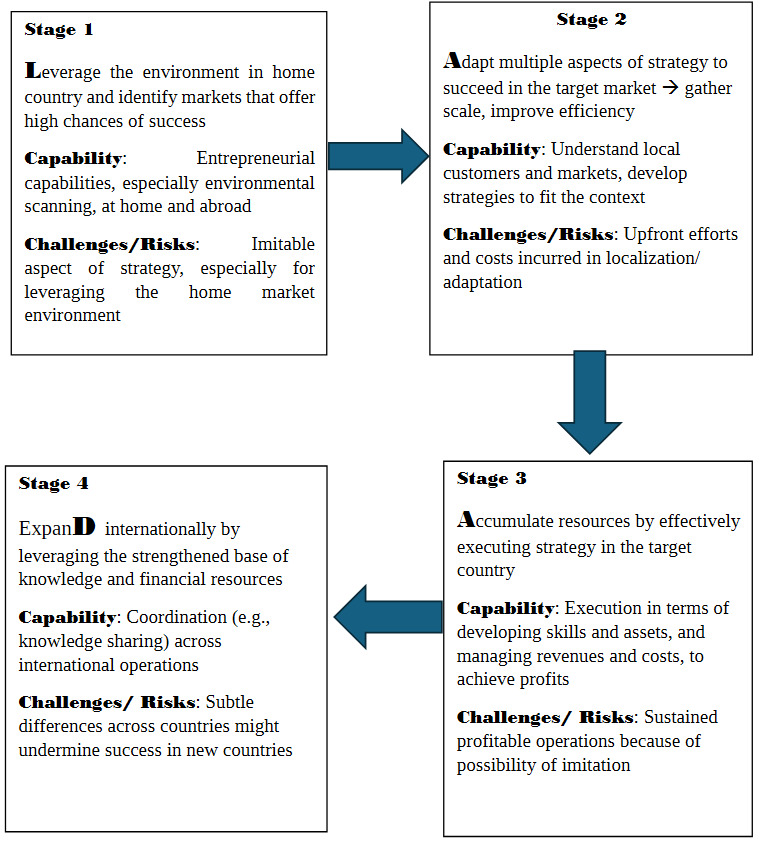
Below, based on inductive analyses of Transsion and other Leaping MNCs, we propose the four-stage LAAD model (see Figure 1) that can help scholars understand the emergence and evolution of these firms, followed by recommendations for managers aspiring to build Leaping MNCs.
Stage 1
Leverage the home country diamond to develop a competitive product or service for target countries
Leaping MNCs leverage home-country conditions, such as lower direct and indirect labor costs (e.g., Nihilent’s product development in India) and/or efficient supply chains (e.g., Transsion, Shein, and Kilimall sourcing from China). Deep knowledge and extensive networks of their founders are key factors behind successful leveraging. George Zhu, the founder of Transsion, worked for 12 years with Ningbo Bird, a leading mobile phone company in China at the time, and spearheaded its international expansion in Africa and other countries. LC Singh, the founder of Nihilent, had more than 25 years of experience in the Information Technology industry, including a few years as President and CEO of a leading Indian firm.
Stage 2
Adapt multiple aspects of strategy to suit the target country’s environment
Many multinationals undertake product adaptation (Bartlett & Ghoshal, 1989), but Leaping MNCs often go well beyond by adapting several aspects of their value chain. As discussed in the previous section, Transsion developed localized products, established manufacturing facilities in host countries, launched local brands at context-appropriate pricing, undertook corporate social responsibility programs, and provided excellent logistics (for fulfilment in infrastructurally-challenged host countries) and after-sales service.
Stage 3
Accumulate resources by effectively executing their strategy in the target country
Since they often focus on underserved countries with limited demand potential and purchasing power, Leaping MNCs face challenges in accumulating financial resources. However, there are two compensating factors. First, because host countries may be less attractive to traditional multinationals, Leaping MNCs may become leaders in their chosen geographic markets, thereby achieving economies of scale. Transsion commanded a market share of as much as 40% in Africa in 2023 (DigiTimes Asia, 2024). Second, the costs of operations, such as staff salaries and rentals, may be lower in these countries as well (Tech in Asia, 2019), improving the profitability of Leaping MNCs. Additionally, the challenging host-country environments offer rich potential for building learning and knowledge resources relevant to competing in other countries.
Stage 4
ExpanD internationally by leveraging a strengthened base of knowledge and financial resources
Leaping MNCs can further internationalize into other countries with similar environmental characteristics by leveraging their financial and knowledge resources. As noted earlier, by 2025, Transsion had become a leader in several populous countries such as Pakistan, Bangladesh, and the Philippines, where its products and strategy were well-suited to the local environments. The critical challenge in international expansion is to share expertise across national boundaries while also accommodating local realities (Bartlett & Ghoshal, 1989). Leaping MNCs’ initial success in internationalization may help them attract talent to effectively adapt their strategies in the countries they enter.
Recommendations for Firms Managers Aspiring to Build Leaping MNCs
Our analysis of several exemplars suggests that becoming a Leaping MNC may be a feasible strategy for aspiring MNCs. In Table 2, we list specific recommendations for each stage of our proposed LAAD model. Below, we identify the common threads running through the various recommendations.
Vision to internationalize is the starting point of the development of Leaping MNCs. In this regard, Leaping MNCs are like Born globals, whose top management also aims to internationalize their firms from the early stages of their development (Oviatt and MacDougall, 1995). Sometimes this vision also includes a focus on doing good, as in the case of Yang Tao, the founder of Kilimall, who aimed to improve African consumers’ quality of life by offering products at affordable prices through its e-commerce platform (Tech in Asia, 2019). Top managers of Leaping MNCs must couple this vision with entrepreneurial skills to identify and successfully serve challenging markets, as the path to internationalization without a home-market presence may be long and strewn with setbacks (Nittymie et al., 2024; Reuter, 2025). In the cases we studied (e.g., Transsion, Nihilent, and Kilimall; Falcão, Silva-Rêgo, & Cruz, 2024), the top managers were simultaneously knowledgeable about leveraging their home country’s characteristics and entrepreneurial in conceiving and implementing strategies appropriate for target countries.
Hiring local staff is another common thread across several recommendations in Table 2 and is especially critical for expansion beyond the initial markets. Not only must the hired staff believe in internationalization, but they must also have scanning capabilities and a learning mindset. Arif Chowdhury, originally from Bangladesh and a core member of Transsion’s top management team, serves as a good example in this regard.
Developing a culture that embraces strategic challenges can help a Leaping MNC sustain momentum in its international expansion (Nittymies et al., 2024). Two factors are critical to the development of the culture: hiring local staff with the appropriate mindset, as noted above, and top management implementing incentive systems that reward two key behaviours: exploring new strategies, whether to serve new markets or segments, and openness to sharing expertise and knowledge with sister units.
Finally, like other MNCs, knowledge sharing is critical to Leaping MNCs as well. But, given their young age and the varied environments they might encounter in internationalization, Leaping MNCs should treat effective knowledge sharing as an imperative.
In conclusion, we have proposed Leaping MNCs as a new type of MNC that arises in response to the push-and-pull forces faced by several developing-country MNCs. To become Leaping MNCs, top management must have a vision and entrepreneurial skills, and the organization must develop implementation skills that balance the exploitation of existing knowledge and financial resources while accommodating local realities.
About the Authors
Nitin Pangarkar is a faculty member at the NUS Business School, National University of Singapore. His research interests span strategy and international business disciplines. He has published more than 50 papers in reputable journals, including the Journal of Management Studies, the Strategic Management Journal, and the Journal of World Business. He is the (co)author of three books published in multiple editions and languages, has published more than 100 managerial articles, and has commented on business events in numerous media outlets.
Naveen Kumar Jain teaches international business at Augustana College in Rock Island, Illinois. He has published many papers in leading international business journals on topics such as internationalization speed, offshoring, and performance implications of multinationality. His experience of living and working in various parts of the world enriches his academic knowledge and informs his pedagogy.