
Introduction
International business (IB) programs play an increasingly important role in business school differentiation and student recruitment. This is particularly the case for bespoke, partnership-based study abroad and student mobility initiatives developed through international institutional collaborations. At the same time, these programs face growing sustainability challenges as institutions navigate geopolitical uncertainty, intensified global competition for students, resource constraints, and frequent leadership turnover. Recent discussions in AIB Insights have emphasized the importance of adaptive and innovative approaches in international business education (Fletcher & Calixto, 2025), underscoring the need for frameworks that help institutions sustain impactful programs over time.
A recurring vulnerability arises when founding program champions and key partners depart: while Memoranda of Understanding (MOUs) detailing the formal level of mutually agreed obligations often remain valid, the underlying informal mechanisms that enable programs to function in practice, referred to here as “IOUs”, are frequently lost. Across program types, these IOUs typically take four interrelated forms: interpersonal relationships, operational memory (documentation), role redundancy and succession capacity, and proportional institutional support. These help shape whether programs absorb disruption or unravel during periods of change. Taken together, these four forms of IOUs represent recurring sustainability mechanisms that help explain how international business programs retain coordination capacity during leadership transitions and other disruptions. Awareness of them helps provide a diagnostic lens that may be applied across programs of differing size, geography, and institutional origin.
Prior research emphasizes the importance of leadership succession, organizational learning, and knowledge transfer in sustaining complex initiatives (Giambatista, Rowe, & Riaz, 2005; Scheirer, 2005). In international education contexts, these challenges are amplified by cross-border coordination, regulatory variation, and reliance on interpersonal trust (Knight, 2015; Waterval, Frambach, Driessen, & Scherpbier, 2015). Similar concerns regarding institutionalization and faculty-driven vulnerability have recently been noted in an AIB Insights article on virtual exchange initiatives in IB education (Dakhli, Alencar De Farias, & Wang, 2025), reinforcing the importance of distributed leadership and sustained institutional support. IB programs operating with limited succession planning and uneven institutional support are particularly exposed when key champions exit or external conditions shift. Throughout the article, “program champion” refers to individuals who initiate, sustain, and assume leadership roles in international programs over time.
This article examines three international business programs at a regional comprehensive university in the United States that experienced different outcomes following disruption: one program successfully recovered after a multi-year suspension, one collapsed following the departure of its founders, and one faced near-termination before renewal through strategic redesign. The cases vary in duration, geography, scale, and degree of institutionalization. Rather than presenting these cases as exhaustive, I use them as contrasting examples to explore how disruptions interact with interpersonal relationships, documentation practices, resource allocation, and institutional commitment across situations where sustainability practices were absent, partially present, or actively strengthened.
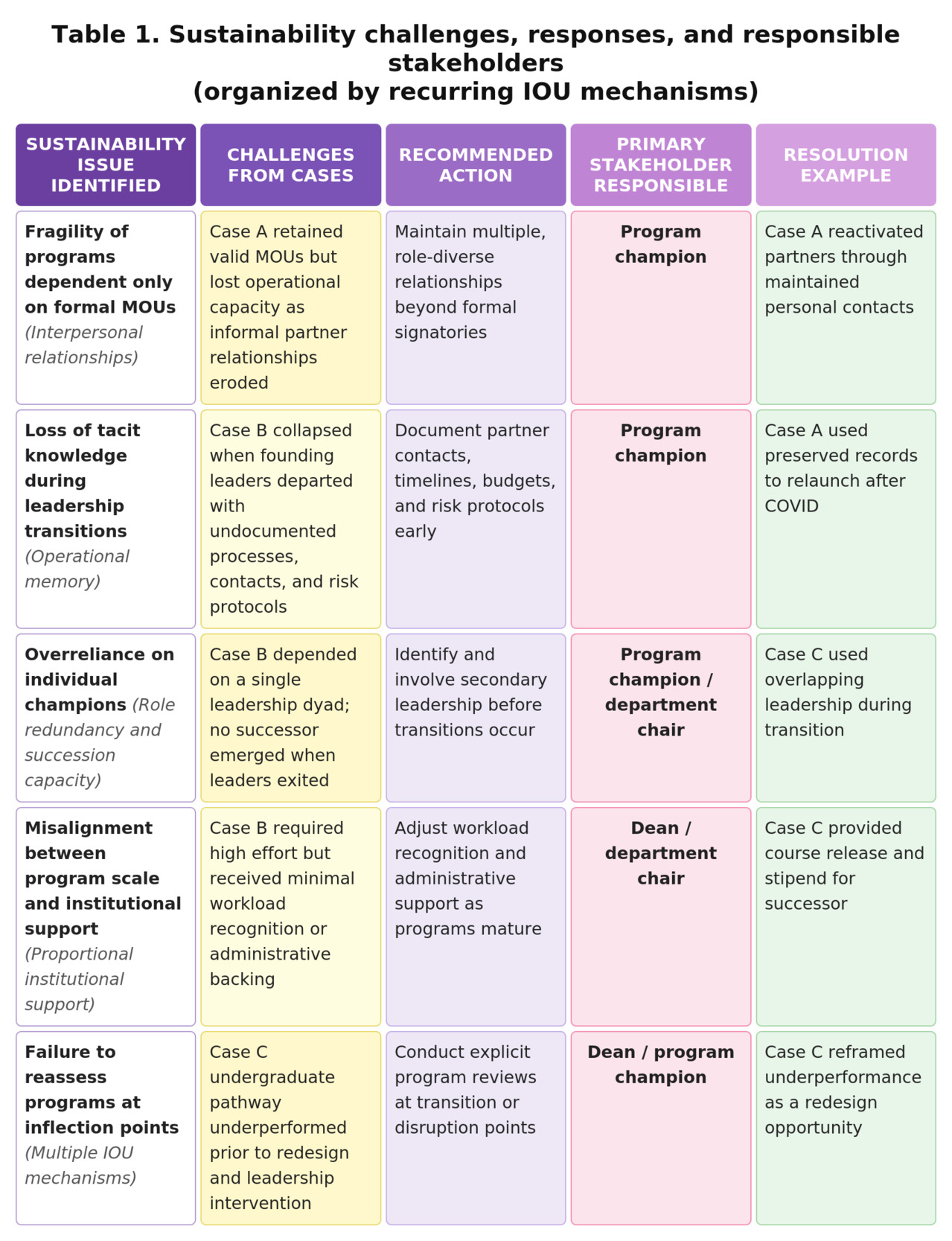
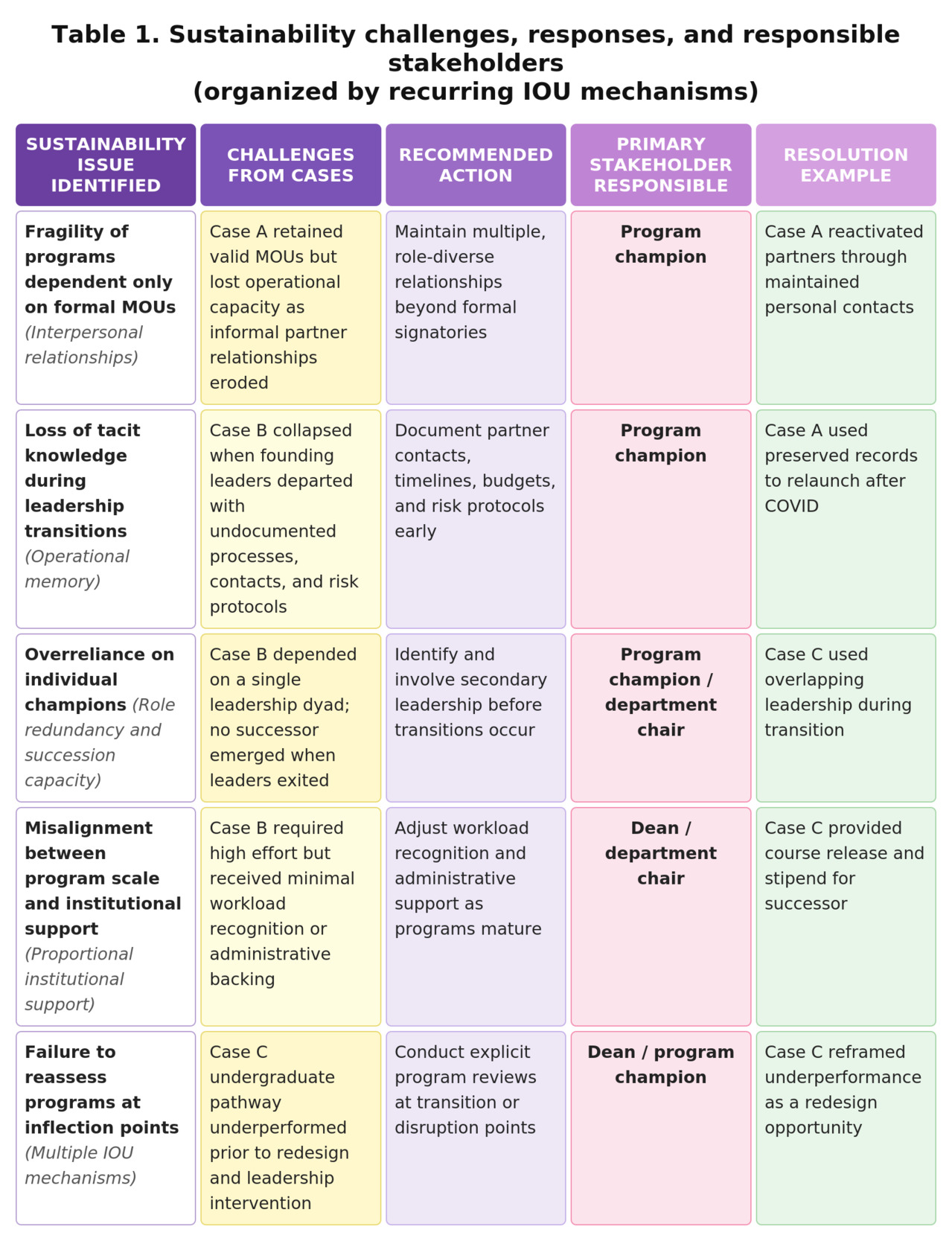
From these cases, I develop a challenge-response table and two practitioner-oriented diagnostic frameworks. The table summarizes the challenges faced, responsible party, and suggested action. Next, a program evolution disruption model highlights recurring conditions and decision points encountered as IB programs confront internal and external disruption. Finally, a resource alignment framework illustrates how mismatches between program maturity, leadership demands, and institutional support increase vulnerability during transitions. These tools are not intended as prescriptive templates or universal laws. Instead, they offer administrators and program champions a structured way to diagnose risk, anticipate transition challenges, and align support with program needs.
Three Contrasting Cases
Case A: Recovery Through Relationship Maintenance and Documentation
Case A involved a ten-week, faculty-led summer program in Taiwan combining language instruction, industry and government site visits, and short-term corporate internships. MOUs were signed with a partner university as well as several supporting industry and government partners. The program targeted upper-division undergraduate business students and enrolled eight students in 2018 and twelve in 2019. Language instruction was tailored to student level and emphasized cultural immersion rather than fluency, particularly in preparation for site visits and internships. The internships were structured as supervised project-based placements coordinated through host organizations. In several cases, these placements led to further employment.
In March 2020, Taiwan closed its borders due to COVID-19, suspending the program for nearly three years. During this period, operational capacity eroded: several corporate partners discontinued internship participation, key government liaisons retired, a logistics staff left the partner institution, and new administrative leadership was appointed on both sides. Although the MOU remained valid, many of the informal commitments and much tacit operational knowledge was lost.
During COVID, the founding champion conducted a contact audit to identify active and committed partners. From this base, they maintained regular contact with these partners and preserved and shared detailed records from prior cohorts, including partner contacts, budgets, schedules, and risk protocols. The US program champion then identified a new co-champion in the partner institution and quickly began reactivating interested former partners and identifying new ones. When borders reopened in 2023, this groundwork enabled rapid reconstruction of the partner network essential to the program. The program also formalized practices including an operational manual, regular off-season partner communication, cross-training of a secondary program champion, and a dedicated operations manager role. The program has since resumed annual operations over the past three years.
Core lesson: Recovery following prolonged disruption was enabled not by the MOU itself, but by reinforcing interpersonal relationships, documentation, and operational memory.
Case B: Collapse Following Leadership Exit
Case B was an alternative spring break program launched in 2015 that combined service learning with business site visits in several Central American countries including Costa Rica and Guatemala. An MOU was signed with a private service provider who helped with site logistics and visits. The program selected ten to twelve business students annually from a competitive pool and relied on external sponsorships to subsidize costs. Program leadership, fundraising, and execution were concentrated in two individuals: an untenured assistant professor who founded the program and their adjunct spouse.
From inception, the program operated under a pure program champion entrepreneurship model. No dedicated budget line existed, administrative support was minimal, and operational knowledge, including partner contacts, budgeting practices, and annual timelines, remained unshared. Although the program was successful in its early years, this success did not trigger increased institutionalization or succession planning. Faculty workload recognition was limited despite the substantial annual effort required to execute the program.
In August 2019, both program leaders accepted positions elsewhere. Their departure occurred just as planning for the next cohort required partner coordination. With no overlapping leadership transition, no documentation, and no identified successor, the program faced an immediate leadership vacuum. This was further exacerbated by a change in the chair and dean during this time. New department leadership was unable to recruit a replacement program champion due to the substantial time commitment and lack of clarity regarding expectations and incentives. The program was cancelled and formally discontinued in 2022.
Core lesson: Program collapse resulted not from declining demand or partner disengagement, but from structural vulnerability created by reliance on individual champions without role redundancy or proportional institutional support.
Case C: Renewal Through Strategic Embedding and Redesign
Case C began in 2017 and focused on a newly launched 2+2 undergraduate pathway with two years at the partner institution with the option of two more in the US resulting in a US degree. This was agreed upon as an MOU addendum and built on a long-standing partnership with Vietnamese university which had evolved into a successful Executive MBA (EMBA) program that generated consistent revenue and strategic value. Unlike the EMBA, the undergraduate program underperformed due to high costs compared to the home university and a choice to spend four years at the home university at much lower cost for a Vietnamese degree or to go abroad.
By 2022, the 2+2 undergraduate pathway faced termination as the founding program champion retired, regulatory conditions changed, and the governing MOU expired. Rather than discontinue the program, institutional leaders reframed the challenge as one of redesign rather than failure. Both deans viewed the partnership holistically and committed to renewal. The undergraduate pathway was restructured to push targeted students into completing their degrees abroad rather than at home, a modest scholarship was introduced, senior leaders engaged directly, and leadership transition was managed through training and workload recognition for a committed new champion. Enrollment subsequently increased and the 2+2 is now attracting multiple students.
Core lesson: Programs embedded within broader strategic relationships that restored relational continuity and shared ownership can survive near-termination when leaders are willing to redesign program models and manage leadership transitions deliberately.
What the Cases Reveal about Program Sustainability
Before introducing the diagnostic frameworks, this section synthesizes the recurring sustainability mechanisms revealed across the three cases. Although the cases differ in context, they reveal common failure points: dependence on tacit coordination, partner turnover, and institutional handoffs that formal agreements alone cannot manage.
Diagnostic Frameworks for Program Sustainability
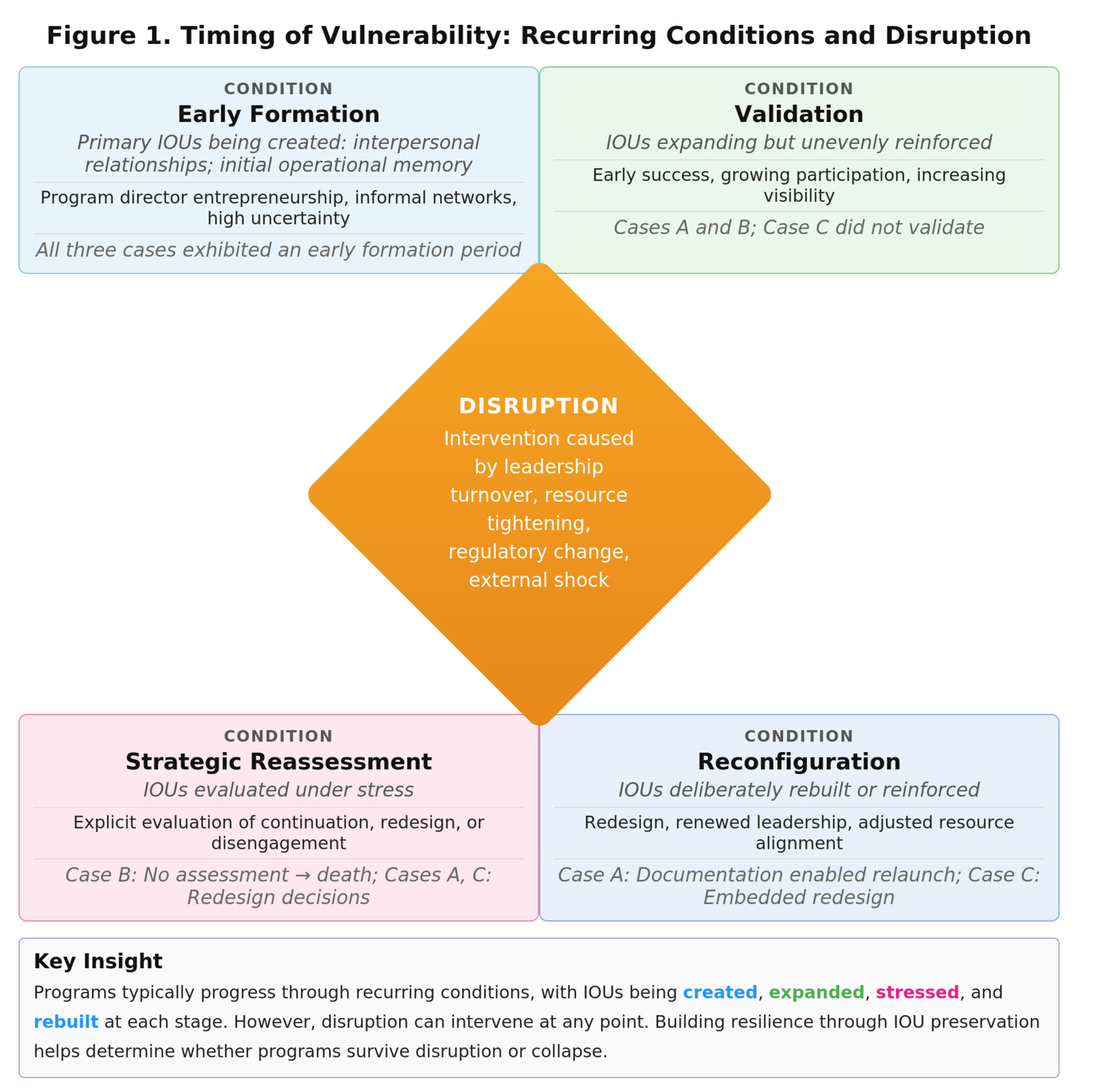
While the challenge-response table identifies recurring sustainability mechanisms and points of intervention, it does not capture when or how these mechanisms become consequential. The first diagnostic framework addresses this temporal dimension by situating the four IOU mechanisms within a program’s evolution and periods of disruption. From an IOU perspective, this framework highlights when interpersonal relationships, operational memory, role redundancy, and institutional support are most likely to be created, strained, or lost over a program’s evolution.
Figure 1 summarizes recurring conditions observed across the three cases rather than a universal or linear lifecycle. Programs may enter, revisit, or exit these conditions in different sequences depending on leadership transitions, institutional support, and external disruptions. The figure is intended as a diagnostic aid to help practitioners anticipate when the sustainability challenges summarized in the challenge-response table are most likely to emerge.
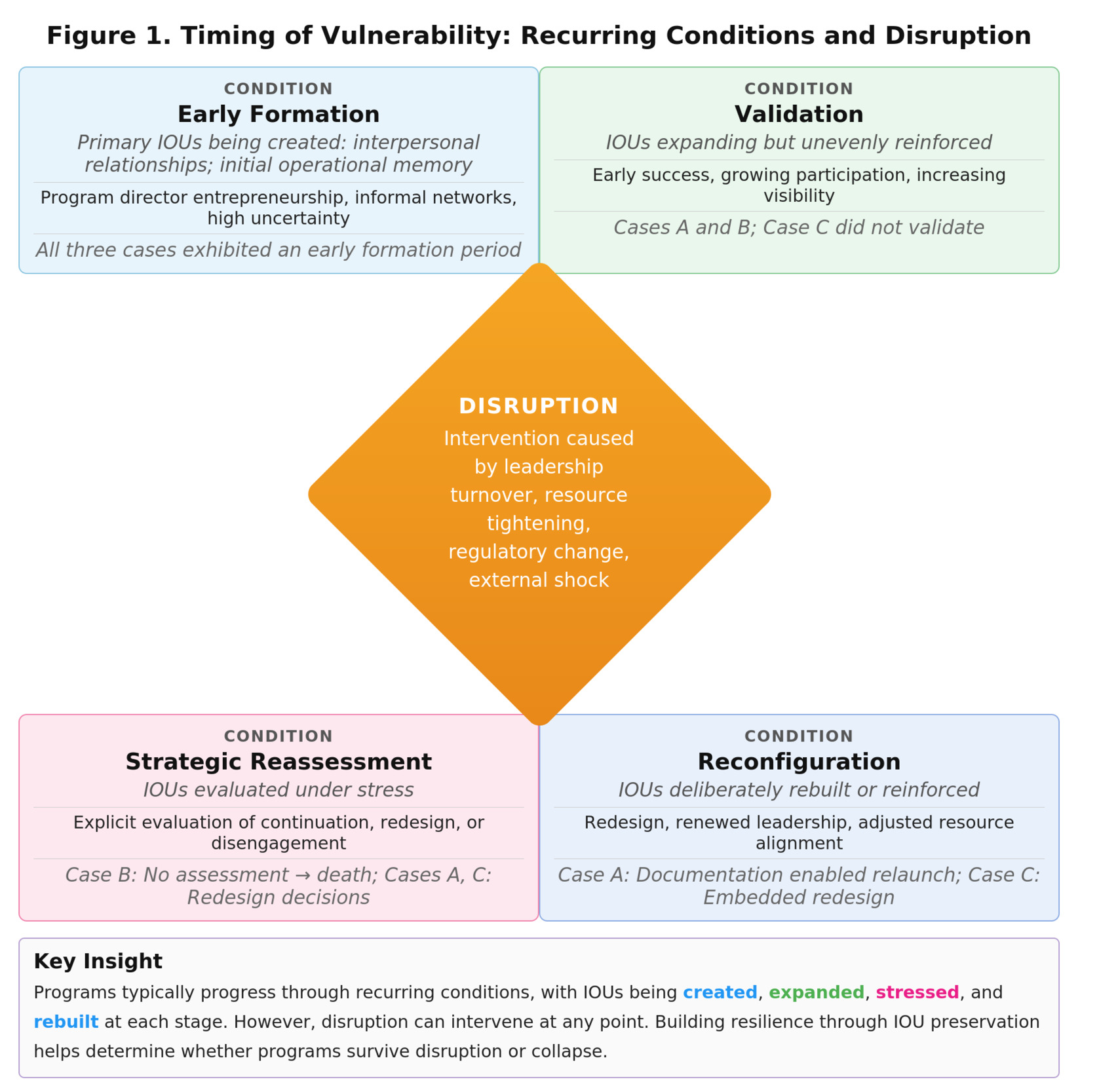
Across the cases examined, three recurring conditions were associated with different moments of program development and early success. Early formation reflects periods of program champion entrepreneurship in which founding champions work with limited supporters and resources to navigate regulatory and organizational structures under conditions of high uncertainty. During validation (observed in Cases A and B), programs may experience moments of early success, when student participation grows, partner engagement increases, and perceived program value rises, often reducing attention to longer-term sustainability risks. Case C, by contrast, did not experience these early dividends as weak student demand and a temporary leadership vacuum limited the development of key IOU mechanisms, particularly interpersonal relationships and role redundancy, during its initial formation.
Disruption functions not as a discrete stage, but as an intervening event that stresses one or more IOU mechanisms. Such disruptions include leadership turnover, partner changes, regulatory shifts, or external shocks such as COVID-19. Disruption is consequential precisely because it exposes weaknesses in one or more IOU mechanisms. This most commonly includes undocumented processes, over-reliance on individual champions, or fragile relational continuity. If redesign is needed, active intervention follows with reconfiguration, renewed leadership structures, and adjusted resource alignment intended to restore or sustain program viability.
In all three cases, preparation during earlier conditions, particularly documentation, relationship diversification, and shared ownership, was associated with greater resilience when disruption occurred. Case A benefited from relationship maintenance and documentation during COVID, while Case B lacked such preparation. Case C benefited from embedding the vulnerable program component within a broader strategic partnership.
Used diagnostically, the recurring conditions framework helps practitioners anticipate where disruption is most likely to have consequential effects and when targeted intervention may be required, rather than assuming programs move predictably through a fixed sequence.
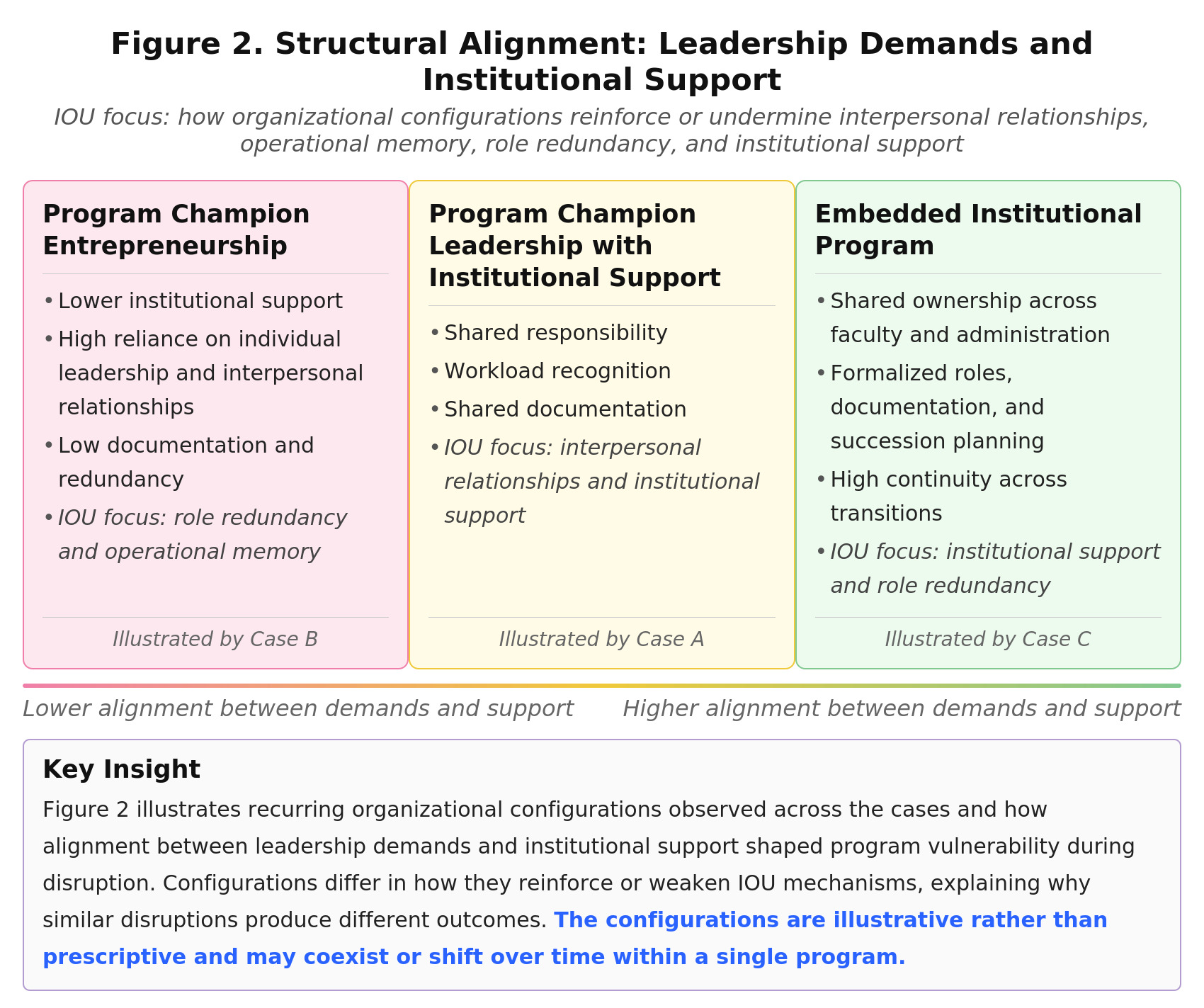
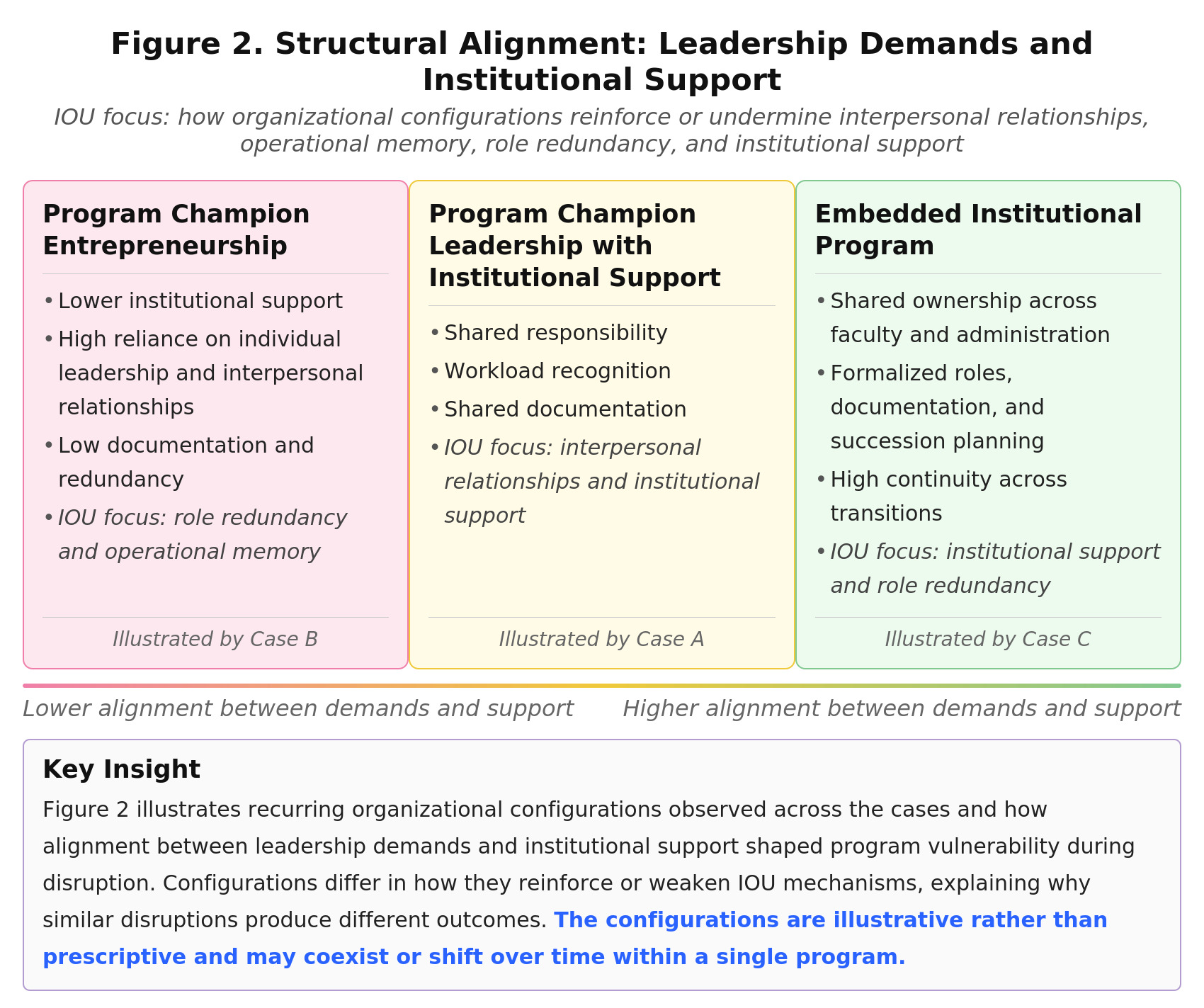
The structural alignment framework explains how different organizational configurations either reinforce or undermine the four IOU mechanisms. These configurations may coexist or shift over time within a single program.
Programs characterized by program champion entrepreneurship rely heavily on individual initiative and informal coordination. In IOU terms, this configuration concentrates relational continuity and operational memory in individuals, leaving role redundancy and institutional support underdeveloped. In such configurations, continuity depends on the presence and availability of the champion’s tacit knowledge, relationships, and decision authority. As illustrated by Case B, this model can enable rapid program launch and early success, but can also become highly vulnerable during disruption or leadership transition when documentation, succession planning, and institutional backup are absent.
Programs exhibiting program champion entrepreneurship with institutional support combined initiative with workload recognition, administrative assistance, and emerging documentation practices. In Case A, this configuration supported recovery following disruption when combined with relationship maintenance and operational documentation, though continued sustainability remained sensitive to program champion continuity.
Programs that were embedded within broader institutional structures benefited from shared ownership, clearer role definition, proportional resource allocation, and deliberate leadership transition planning in these cases. However, programs with high levels of institutional support but unclear program champion roles can remain vulnerable if leadership responsibilities are not clearly assigned and supported, underscoring that alignment, not institutionalization alone, shapes resilience. In Case C, embedding the vulnerable undergraduate pathway within a strategically valued partnership with a motivated program champion enabled redesign and renewal rather than termination.
In diagnostic terms, sustainability outcomes varied according to whether resource alignment supported interpersonal continuity, preserved operational memory, enabled role redundancy, and scaled proportional institutional support appropriately at critical moments. Used diagnostically, the resource alignment framework helps practitioners assess whether program demands and available support are appropriately matched when the sustainability challenges summarized in the challenge-response table arise.
Recommendations for University Administrators
Across the cases, program sustainability depended less on the presence of formal agreements than on institutional readiness for leadership change. Three priorities emerge.
Align Institutional Support with Program Demands
Administrators influence outcomes by aligning workload recognition, funding, and administrative support with leadership demands. Misalignment proved a central vulnerability across cases, echoing recent work on faculty development programs that identifies organizational support and faculty knowledge-building as key drivers of sustainability (Avendano, Usta, & Kundu, 2026).
Institutionalize Operational Memory and Succession Planning
Requiring documentation of partnerships, processes, and decision histories before leadership transitions occur reduces fragility. Embedding succession planning into regular program review cycles, rather than waiting for disruption, strengthens continuity.
Reassess Programs at Strategic Inflection Points
Treating IB programs as a portfolio rather than isolated initiatives enables shared infrastructure and proportional investment. Conducting explicit reviews during growth, stagnation, or leadership turnover helps prevent avoidable collapse.
Recommendations for Program Champions
Program champions play a central role in program creation and early success, but the cases demonstrate the risks of concentrating knowledge and responsibility in specific individuals. Three lessons stand out.
Distribute Relational Ownership Early
Programs were more resilient when leaders cultivated multiple partner relationships beyond a single individual. Involving secondary faculty or administrators before transitions occurred reduced dependence on founders and strengthened relational continuity.
Document before Disruption
Operational knowledge should be recorded and shared rather than held informally. Case A illustrates how partial documentation reduced recovery costs, while Case B highlights the consequences of knowledge concentration.
Anticipate Transition Rather Than React to It
Moments of growth, underperformance, or leadership change should trigger strategic reassessment. Proactive attention to role redundancy and institutional alignment improved resilience.
Conclusion
International business programs often originate through entrepreneurial program champion initiative, yet their long-term value depends on surviving leadership transitions and external disruption. Analysis of three contrasting cases shows that outcomes were shaped less by formal agreements than by preparation undertaken before disruption. This included documentation, alignment between leadership demands and institutional support, and how well programs were embedded within broader strategic relationships.
Taken together, the findings suggest that IB program sustainability hinges less on program format or origin than on how effectively institutions preserve and renew the four IOU mechanisms across disruptions. These patterns are consistent with prior research on program sustainability, which emphasizes that endurance depends on the ongoing fit between program demands, leadership capacity, and organizational support rather than adherence to a single optimal model (Scheirer, 2005). Framed diagnostically, the article offers institutions a structured way to anticipate vulnerability before disruption escalates.
Acknowledgments
My deepest thanks to AIB Insights editor William Newburry and the anonymous reviewers for their thought-provoking and constructive suggestions, to colleagues at CUIBE where this idea originated, and to our many steadfast global partners throughout the years for laying the groundwork.
About the Author
Dr. Jack Marr is a Clinical Associate Professor of International Business and Global Programs Director at Boise State University’s College of Business and Economics. Jack has over 20 years of program building experience including founding New York University’s Stern School of Business at their Shanghai campus. His research centers around building sustainable, global, talent-centric clusters. Previous to academics, Dr. Marr was a McKinsey consultant and USDA research director in China and business development director for the State of Missouri in Japan.