
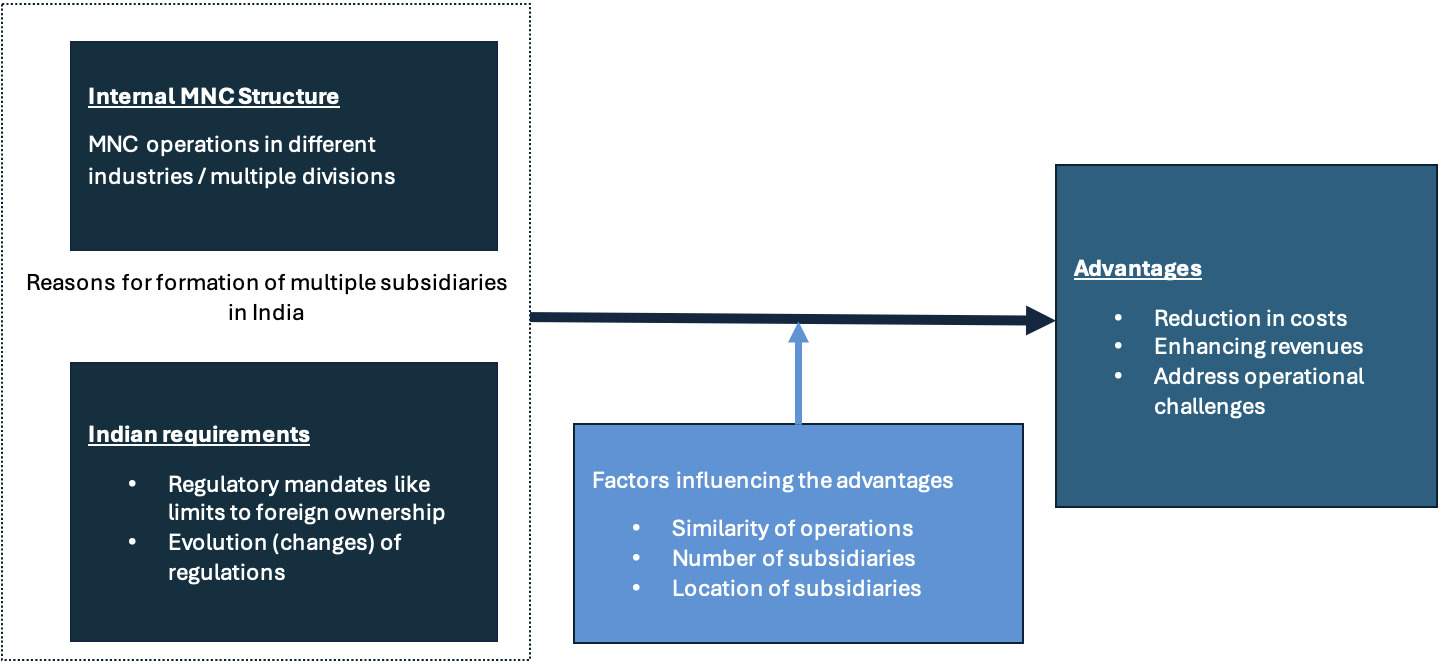
In a large and diverse country like India, characterized by changing regulations and regional differences in legal enforcement, institutional effectiveness, buyers, and suppliers, we observe that multinational corporations (MNCs) often have multiple subsidiaries, rather than a single national subsidiary. Each of the subsidiaries tends to manage a key part of the MNC’s overall portfolio operations.
For example, P&G in India operates Procter & Gamble Hygiene and Health Care Limited (a publicly listed subsidiary focused on healthcare and feminine hygiene) and Gillette India Limited (which produces razors, blades, and shaving products). The MNC’s India operations also include Procter & Gamble Home Products Private Limited (a wholly-owned subsidiary handling fabric and hair care), and Procter & Gamble Health Limited (formerly Merck India Limited, acquired by P&G when it purchased Merck KGaA’s consumer health business) (Source: CMIE Prowess).
Based on P&G’s example above, the first reason an MNC may establish multiple subsidiaries in a host country like India is the MNC’s internal operating structure. That is, some subsidiaries may be formed through global acquisitions, as illustrated by P&G’s global acquisition of Gillette. Furthermore, an MNC’s multidivisional and/or diverse operations across different industries or market segments may result in multiple subsidiaries, with each subsidiary internally reporting to a specific division or business unit.
In India, Siemens operates through several subsidiaries, each managed by its respective business unit. Even after Siemens AG was restructured into three independent companies, the group retained separate subsidiaries under these new entities and other business units. For instance, according to Siemens’ business overview available on their corporate website, Siemens Energy AG oversees Siemens Energy India Limited, while Siemens Healthineers AG manages Siemens Healthcare Private Limited (in India). Siemens AG’s Financial Services global division maintains Siemens Financial Services Private Limited (in India); Digital Industries global division manages the Siemens Industry Software (India) Private Limited; Mobility global division manages Siemens Rail Automation Private Limited (in India).
The examples above focus on MNC-related factors that lead an MNC to establish multiple subsidiaries in India. The second rationale pertains to the host country’s characteristics and requirements. Indian regulatory requirements often mandate the formation of multiple subsidiaries. For example, when AIG entered India in 2000-2001, Indian regulations mandated two independent companies: one for general insurance (Tata AIG General Insurance Company Limited) and another for life insurance (Tata AIA Life Insurance Company Limited, which later became Tata AIA Life Insurance Limited) (Source: Tata AIG Corporate website)
Once multiple subsidiaries are established, the question is whether there are benefits to operating these subsidiaries in India. Specifically, the question arises: What are the advantages of establishing multiple subsidiaries in a host country like India?
Researchers have found that the presence of multiple subsidiaries is positively associated with the performance of the individual units (e.g., Xu, Huang, & Pan, 2019). This is likely due to shared operating assets, technologies, and processes (Sewak & Sharma, 2020), as well as access to larger pools of knowledge and both business and political networks (e.g., Garg, Sewak, & Sharma, 2022).
But from a managerial perspective, we must examine the following questions to understand an MNC’s operations when it has multiple subsidiaries in India:
-
What are the advantages of establishing multiple Indian subsidiaries?
-
What factors influence the advantages of having multiple subsidiaries in India?
In Table 1, we highlight the managerial implications and examples from MNCs with multiple subsidiaries in India. We discuss the above two questions in detail in the ensuing discussion.
Advantages of Having Multiple Subsidiaries in India
In situations where the MNC has multiple subsidiaries in a host country, the subsidiary and MNC leadership can create opportunities and incentivize knowledge exchange between subsidiaries via managerial networks, which can be formal (e.g., joint task forces, cross-business-unit teams) or informal (e.g., social events, get-togethers). This enables the MNC to accumulate experience and knowledge that can be shared among subsidiaries and the parent (Garg et al., 2022), thereby enabling the MNC and its subsidiaries to reduce costs, increase revenues, and address operational challenges.
Reducing Costs
Multiple subsidiaries belonging to the same MNC in India can share an enterprise resource planning (ERP) system or recruitment and training resources to cut costs. Similarly, these subsidiaries could share personnel in legal, finance, human resources, and IT functions, making these resources more cost-effective. This enables the MNC to gain from economies of scale by reducing support-function expenses, thereby potentially positively affecting subsidiary performance.
Additionally, in India, like many emerging markets, business contracts are established and enforced through social and personal relationships of the managers rather than using legal actions and judicial enforcement. An MNC with multiple subsidiaries in India, each with its own local networks of businesses and political ties, may share these networks and knowledge with its sister subsidiaries (Xu, Huang, & Pan, 2019). Such sharing can help lower the costs of searching for knowledge and resources, potentially enhancing the MNC’s overall country-level performance.
Enhancing Revenues
A MNC subsidiary could support the sister subsidiary’s operations with technological assets (Wu, Strange, & Shirodkar, 2022), reputational benefits, supplier and distribution networks, and nuanced cultural knowledge. This may help the sister subsidiary to enhance its revenues. While this is important in any market, it is especially vital in a country like India, where relationships and trust are crucial in business dealings. For example, legal recourse for contract enforcement in India is often lengthy and time-consuming (Lamin & Ramos, 2016). This may result in subsidiaries preferring to work with a sister subsidiary’s recommended business partners.
Furthermore, sister subsidiaries can open doors for each other through cross-selling. They may also share market knowledge about sales channel partners, distribution, and media networks (Garg et al., 2022). Market insights from one subsidiary can help another to adapt products to Indian conditions and/or modify internal routines to meet local requirements. In this manner, sharing know-how and connections may help broaden each subsidiary’s opportunities and create pathways to improve existing products/services or develop new ones.
The enhanced market knowledge accumulated across multiple subsidiaries may also enable the MNC to anticipate and manage changes in the marketplace (Garg et al., 2022), as well as adapt products to local needs (Crespo, Lages, & Crespo, 2020), supporting market expansion. This may result in increased overall country-level revenues for the MNC.
Addressing Operational Challenges
Multiple subsidiaries offer strategic flexibility, allowing the MNC to respond to competition and regulatory uncertainty, and to carry out major corporate actions—such as entering or exiting a business—or making local or global acquisitions or divestitures without disrupting overall country operations. They also enable the MNC to work with different local partners with varying ownership stakes, helping it gain local resources and comply with local regulations.
This approach should help the MNC to reduce operational risks, such as preventing the spillover of key technologies to the local partner. For example, when Cummins decided to focus on manufacturing, it partially divested its stake in KPIT Technologies Limited (then KPIT Cummins Infosystems Limited) in 2012 without disrupting its overall engine business (Source: Cummins India corporate website). It also partnered with Tata to manufacture engines for Tata Motors through Tata Cummins Private Limited but kept its overall engine and generator business under Cummins Limited in India, thereby potentially protecting its knowledge and preventing spillovers.
Thus, multiple subsidiaries may help an MNC collaborate with various partners by providing strategic flexibility and knowledge of social and business relationships, as well as market knowledge. This may enable the MNC to access India-specific resources and capabilities that might not otherwise be available. For example, knowing key industry players, regulatory and financial institutions such as governmental agencies and banks, as well as knowledge centres, can open doors to sales, financial, legal, and other partnerships with universities, suppliers, or opinion leaders in the marketplace.
Factors Influencing the Advantages of Having Multiple Subsidiaries in India
Similarity of Operations
Similarities in subsidiaries’ activities and/or industries of operation create similarities in operations, suppliers, buyers, and applicable regulations, which, in turn, promote cooperation and facilitate knowledge transfer regarding practices and strategies (Wu et al., 2022). These similarities in operations also lower search costs for subsidiaries by facilitating partnerships with buyers and suppliers. Additionally, similar operations can help improve access to resources in India; for example, Unilever purchases media (for advertisements) and then distributes it across all its brands, thereby reducing overall costs (BARC, 2025).
Number of Subsidiaries
Having multiple subsidiaries can enhance the performance of each subsidiary, irrespective of the similarities or dissimilarities in their operations. However, as the number of subsidiaries increases, the costs related to coordination, resource sharing, and knowledge exchange also rise (Sewak & Sharma, 2020). Too many subsidiaries might make it difficult for subsidiary managers to dedicate the necessary time and resources to communicate and share knowledge about specific opportunities with other sister subsidiaries. This could negatively impact individual subsidiary performance in the host country. Additionally, as the organization expands, establishing and maintaining managerial networks becomes more challenging. Hence, MNC and subsidiary leaders need to determine the number of subsidiaries that allows for effective knowledge sharing and the necessary operational flexibility. Statistical analyses in a large sample of MNCs in multiple host countries also indicate that as the number of subsidiaries an MNC operates in a host country increases, the likelihood of subsidiary shutdowns rises (Nguyen & Shirodkar, 2026). For example, MNCs such as Unilever, Siemens, and Colgate in India have consolidated their operations by merging subsidiaries over time (Source: CMIE Prowess).
Location of Subsidiaries
The geographical location of subsidiaries within India affects costs related to coordination activities, information exchange, and transportation of goods between subsidiaries (Sewak & Sharma, 2020). Co-locating in the same city can eliminate city entry tariffs and reduce transportation expenses. The ease of information exchange between subsidiaries depends on how well managers can communicate and share information. Modern communication technologies can lower these costs; however, physical distance can still impact communication and, more importantly, relationship-building between managers. As a manager working in a subsidiary located in one part of a large country, such as India, may find it difficult to schedule a regular in-person meeting with managers of a sister subsidiary located in a different part of the country. However, placing subsidiaries in the same city may increase the likelihood of managerial interactions (Sewak & Sharma, 2020). In this regard, it is not surprising that after the acquisition, P&G moved Gillette India’s office from Gurgaon (near Delhi) to Mumbai, where P&G’s other subsidiaries were already located.
By locating multiple subsidiaries in the same city and/or region in India, the MNC can improve the exchange of region-specific knowledge among subsidiaries regarding suppliers, customers, and local institutions such as health and labour inspectors. Therefore, co-location may promote asset sharing, reduce costs, increase efficiency, and enhance coordination and knowledge sharing. This may positively influence the performance of multiple subsidiaries and the MNC.
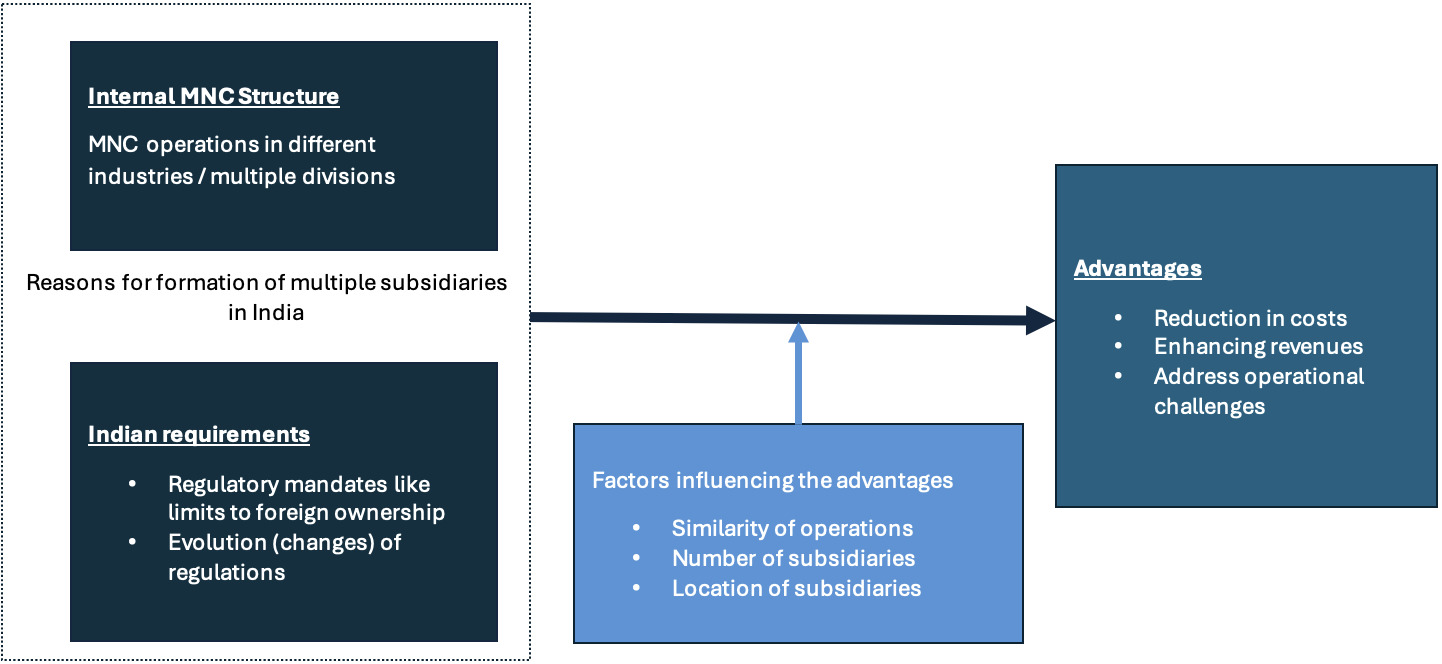
In sum, MNCs may operate multiple subsidiaries to mimic their internal organization, or they may be required to do so by Indian regulations. However, they must establish managerial networks and consider the similarities, numbers, and locations of these subsidiaries to enhance subsidiary performance. See Figure 1 for a diagrammatic summary.
Conclusion
Operating multiple subsidiaries in a host country like India can be a powerful strategic choice, but it requires deliberate managerial action. Multiple subsidiaries can help MNCs reduce costs, increase revenues, and manage operational risks by sharing resources, knowledge, and local networks. However, these benefits are not automatic. Managers must carefully consider the number, similarity, and location of subsidiaries and actively invest in managerial networks to enable coordination and knowledge exchange. Multiple subsidiaries should not be viewed merely as a structural outcome of regulation or growth, but as a strategic lever that, when well-managed, can strengthen an MNC’s overall performance in a dynamic country like India.
Acknowledgements
We are grateful to our editor, Prof. Elizabeth Rose, and two anonymous reviewers for their time, insight, and valuable suggestions that helped improve the clarity and appropriateness of this work.
About the Authors
Garima Garg, PhD, is a Lecturer in International Business at the Newcastle University Business School, Newcastle University, UK. Her research examines three aspects of organizational learning: the mechanisms firms use to learn, the types of knowledge they learn, and the internal and external sources they draw on when entering unfamiliar and dynamic environments. Her work has been published in the International Business Review, Academy of Management Proceedings, and International Journal of Knowledge and Learning.
Mayank Sewak, PhD, FHEA, is a Lecturer in International Business at the Newcastle University Business School, Newcastle University, UK. His research focuses on multinational enterprise strategy and management, with a particular interest in headquarters-subsidiary relationships and local knowledge for subsidiaries in emerging markets. His research has been published in the Journal of International Management, International Business Review, and Management International Review.