
Introduction
From the year 2022 onwards, Sri Lanka, faced dual problems of a Balance of Payment (BOP) crisis and a sovereign debt crisis due to unsustainable borrowings by successive governments since independence in the year 1948, that resulted in an economic crisis (International Monetary Fund [IMF], 2023). The BOP crisis led to the depletion of foreign exchange reserves which resulted in a state where the Sri Lankan government could not pay for essentials such as petroleum imports (resulting in lengthy queues in front of fuel stations), essential food items, medicine, and coal for power generation. Moreover, the economic crisis led to the imposition of import restrictions, lengthy power disruptions that spanned over 16 hours daily, high inflation and increased taxation from individuals and institutions. Unable to cope with the uncertainty and complexity of the economic crisis brought business operations and daily life to a halt, resulting in one of the most severe and far-reaching crises in Sri Lanka’s history. The economic crisis disrupted the supply chains of multinational enterprises (MNEs) and it created the need for MNEs to withstand these disruptions to ensure their continuous survival.
In general, supply chain resilience is referred to as the ability of supply chains to withstand and recover from any disruptions caused (Cinti, Marcone, Sabatini, & Temperini, 2024; Li, Li, Yang, & Tian, 2025). Several studies have focused on supply chain resilience of local as well as multinational companies. Some studies have looked into supply chain resilience in terms of the responses made by MNEs (Cinti et al., 2024), novel effectuation strategies adopted by MNEs (Li et al., 2025), recovery actions implemented by MNEs (Holgado & Niess, 2023) and the use of social capital by MNEs to ensure supply chain resilience (Gölgeci & Kuivalainen, 2020) while others have focused on the impact of policy changes on the supply chain resilience of MNEs (Free & Hecimovic, 2021). However, these studies seem to have mainly focused on MNEs operating in developed nations which are better connected to global value chains and have better resources and capabilities in managing crises. Sri Lanka is a South Asian nation with numerous institutional challenges from a judiciary vulnerable to political interventions, rigid labour laws, economic instability, etc. (Heritage, 2024). The South Asian institutional environment is starkly contrasting to the institutional environment of developed markets that most developed MNEs are familiar with in their home countries. However, studies have overlooked MNE resilience strategies within supply chains in developing markets, including the South Asian context. Thus, the main objective of this paper is to explore MNE resilience within supply chains in Sri Lanka amidst the economic crisis. Accordingly, this article would contribute by providing actionable recommendations towards managers of MNEs in adopting supply chain resilience strategies in a South Asian context.
Using previous studies as the foundation to understand experiences of a firm during a crisis, interviews were conducted with selected MNEs. The information gathered from the MNEs through interviews was then compiled into a framework capturing the adaptive nature of MNEs in a crisis environment.
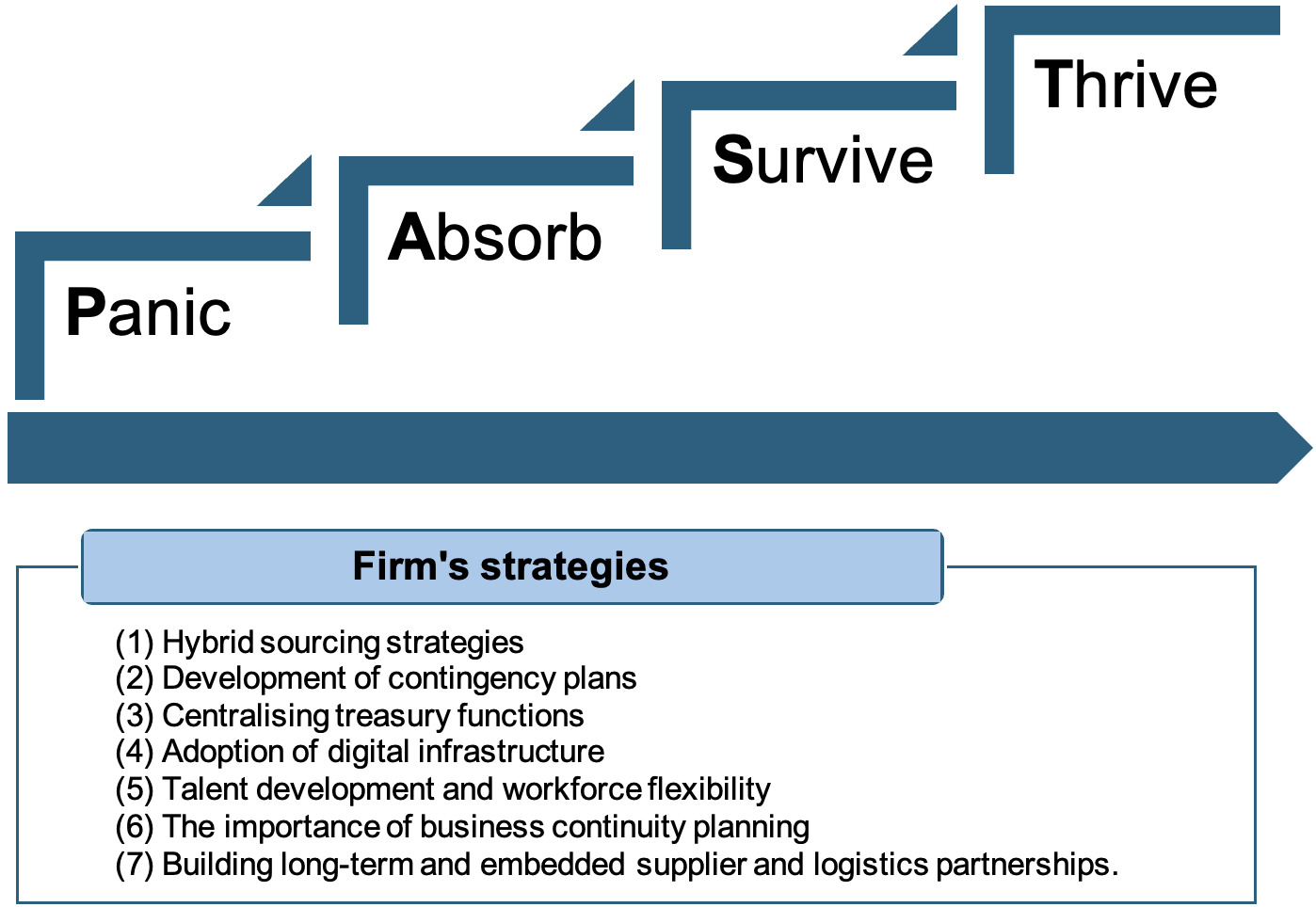
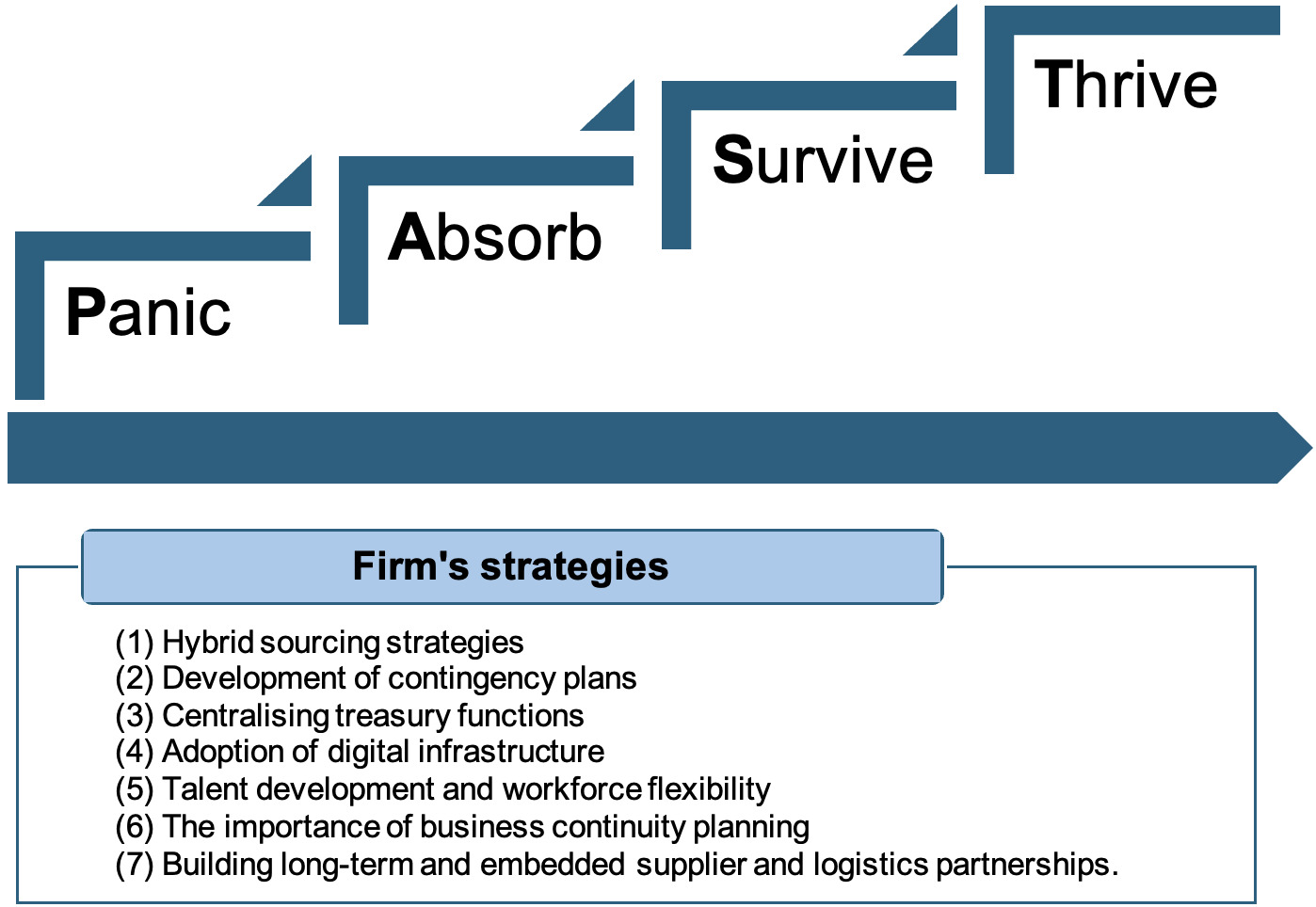
Previous research in the areas of supply chain resilience and crisis management presents some guidance to understand the experiences of MNEs during a crisis. Such studies have demonstrated that while the initial stages of a crisis may result in uncertainties and ambiguity (Dikova, Smeets, Garretsen, & Van Ees, 2012; Free & Hecimovic, 2021; Kim, Scullion, Avvari, Jooss, & Uddin, 2024), some organizations will wither the impacts of the crisis and emerge stronger. Studies which have explored how firms manage crises reveal that firms will utilize their superior assets such as supply chain relationships (Cinti et al., 2024), dynamic management capabilities (Fainshmidt, Nair, & Mallon, 2017), and social capital (Gölgeci & Kuivalainen, 2020) to survive the impacts of crises. In the process of changing and surviving crises, firms also demonstrate the ability to build superior agility and networks which place them in a better position than earlier (Cinti, Marcone, Sabatini, & Temperini, 2024). Using these findings as a conceptual base, we propose a model which captures the reality of the Sri Lankan firms that were interviewed for the study. Based on this discussion, we expect MNEs that deal with supply chain crises to go through four phases of Panic, Absorb, Survive, and Thrive. Using these stages as a guide, the interviews were conducted and thematically analysed. The Analytical approach section presents the details about the firms interviewed and findings of this study. The subsequent section, titled Model, elaborates the experiences of MNEs within each phase, as revealed through the interview findings.
Analytical Approach
To gather insights on existing MNE resilience strategies within supply chains during the economic crisis, three developed market MNE subsidiaries operating in Sri Lanka were selected. They include a Swiss-based food MNE (A), a UK-based leading global financial infrastructure and data providing MNE (B), and a Sri Lankan unit of a US-based industrial goods manufacturing MNE (C). The said MNEs represent diverse sectors such as food, manufacturing, financial services and industrial goods which are globally integrated while having locally dependent supply chains. Their operations involve networks of sourcing, production, distribution and service delivery that were directly affected by the economic crisis. These companies exemplify how MNEs operating in emerging economies adapt and build resilience through strategic flexibility, local responsiveness, and global coordination while having insights on MNE resilience within supply chains across different industries.
Based on these interviews and our review of past literature, we propose the PAST model in figure 1, which aims to describes the stages that MNEs have undergone during the economic crisis in Sri Lanka. The PAST framework is comprised of four phases: PANIC, ABSORB, SURVIVE, and THRIVE. All study MNEs have experienced these four stages. However, the MNE’s experiences in each stage and the firm’s ability to move through stages is dependent on both internal factors such as organizational culture and support from the parent firm, as well as external factors such as conditions of the industry and the global markets. This model reflects the timely and strategic evolution of MNE’s supply chain resilience. Accordingly, seven key themes have been developed: (1) hybrid sourcing strategies, (2) development of contingency plans, (3) centralising treasury functions, (4) adoption of digital infrastructure, (5) talent development and workforce flexibility, (6) the importance of business continuity planning, and (7) building long-term and embedded supplier and logistics partnerships. These key themes have been a foundation in developing and presenting actionable recommendations that any MNE can follow during a crisis situation.
Panic
At the initial stages of the crisis, widespread confusion over MNE survival was experienced by the MNE’s stakeholders. Especially with the fear that the MNE may be asked to exit the market by its parent firms and uncertainties regarding continuous operations of the supply chain resulted in a lack of long-term direction. Along with the brain drain experienced by the country during this period, many experienced professionals of these MNEs also left the organization. With uncertainties in both external and internal environments, the MNEs faced an uncertain outlook marked with instability and fear among all parties of the supply chain. In order to assess the environment, the firms reported to have held meetings with similar firms who would usually be competitors and local industry experts, thus highlighting the importance of stakeholder communication in this stage. For example, MNE C, an industrial goods manufacturer located in a special economic zone, attended assessment meetings with other firms in the special economic zone and the government officials overlooking the special economic zone, while MNE B, a financial and data service firm, conducted meetings with similar service providers with domestic and foreign origins. The primary challenges identified through the interviews during this phase were uncertainty regarding continued operations and parent firm commitment, and inability to make reliable short-term projections related to logistics and workforce availability.
Absorb
When certain internal factors become present, particularly if the parent firm provides assurance of the survival of the MNE subsidiary and when the MNE subsidiary possesses a resilient organization culture, the firms started to absorb the impacts of the crisis. Firms in this stage often followed strategies such as scaling back operations, halting new recruitments and investments, providing motivation to existing staff of their importance in the value chain and cutting costs from expenses which are deemed non-value adding to the value chain. This allowed firms to absorb the negative effects of the economic crisis while also providing a degree of certainty to supply chain partners about the continuation of the business. Furthermore, the ability of stakeholder partners to absorb the impacts of the crisis was also considered an important criterion when entering into supply contracts. For example, in both MNE A and C, manufacturing that was outsourced to smaller manufacturers was halted temporarily and production was either made in house or outsourced to larger supply chain partners who were expected to have the ability to withstand the shocks. Prolonged power cuts, fuel shortages, and vulnerability of smaller supply chain partners constrained the firms’ stable operations and were highlighted by the interviewees as the key challenges during this phase.
Survive
As the firms absorbed negative impacts, the MNEs also started to make strategies towards surviving the continued effects of the crisis. While the immediate impact of the crisis was felt through ceasing of imports, political instability and rising inflation, the resulting effects were felt over a much longer period. As MNEs attempted to adapt to these conditions, they followed multiple strategies, including forming partnerships to find alternatives to imported raw materials, shortening supply chains by partnering with local suppliers, using alternative currencies when conducting transactions with local suppliers to mitigate the impacts of local currency devaluation, allowing work from home options to appease employees and finding alternative shipping arrangements to mitigate the reduced number of vessels arriving to the country. These strategies helped the MNEs survive and withstand the continued impacts of the crisis while providing a level of assurance and a degree of stability to supply chain partners.
While all firms in this study have moved beyond this stage, there are other MNEs who exited the market at this stage. Interviewees highlighted challenges such as severe currency depreciation, restrictions on international transactions, import controls, and rising employee turnover which required adaptive operational and financial responses as the main challenges during this phase. Therefore, the survival of the MNE at this stage is greatly influenced by both internal as well as external factors which were established prior to the crisis such as a strong network of suppliers and customers who may be willing to change contract terms through mutual agreement and being located in a special economic zone allowing better facilitation of infrastructure. For example, in the case of MNE C, located in a special economic zone, much shorter power cuts were imposed when compared to other parts of the country and limited quotas imposed on purchase of fuel were overridden under special arrangements when using foreign currency payments.
Thrive
At this stage, MNEs seemed to use the impacts of the economic crisis to design and implement strategies that allow the MNE to move beyond survival and to form long-term strategic and competitive advantages. By finding more efficient and effective ways of conducting operations, the MNEs have been able to thrive in the market. Particularly, by using digital tools to strengthen partnerships and communication with internal and external stakeholders, by changing supply chain policies to be more localized, by implementing HR strategies which are more dynamic such as recruitment of contract/temporary staff over permanent staff due to strong labour policies in the local economy and by carefully considering business continuity plans to navigate unforeseen external shocks, MNEs have found ways of thriving in their local markets. Furthermore, MNEs have also considered the possibility of empowering local suppliers with the aim of developing them into possible supply chain partners in the long run. In addition, MNE A and C also proposed government assistance in building resilience of the SME sector to ensure that smaller supply chain partners can withstand shocks. A strong SME sector would strengthen the supply chains of MNEs while also making the SMEs less reliant on a single large MNE for its survival, resulting in stronger value chains that could thrive under volatile market conditions. Despite stabilisation, MNEs continued facing challenges such as limited resilience of upstream and downstream supply chain partners, forecasting uncertainty and the absence of locally tailored business continuity plans.
Actionable Recommendations
This section was developed inductively from empirical challenges identified across four phases of the PAST model. Data from the interviews were first analysed to identify recurring operational, financial and HR-related challenges faced by MNEs at different stages of the crisis and then mapped onto PAST phases to examine how firms responded to similar constraints using different strategic mechanisms. Afterwards, recommendations were derived by identifying strategies adopted by firms, their perceived effectiveness and strategy generalisability.
Based on the interview findings from the three MNEs (A, B and C), it was found that there were several shortcomings in their existing supply chains. Thus, several actionable recommendations are provided along with their relevance to the PAST model. Furthermore, the relevant stakeholders who would be implementing these actionable recommendations as well as the stakeholders who would be affected by them have also been identified. Table 1 provides a more detailed and critical analysis of actionable recommendations. Table 1 was derived based on the insights obtained through in depth interviews conducted with supply chain managers and operations managers employed in the three MNEs.
Accordingly, Table 1 links key challenges identified across the PAST phases with empirically grounded recommendations derived from case firm responses and cross-case analysis.
Conclusion
This article aims to explore MNE resilience strategies within supply chains under economic crisis, specifically focusing on the South Asian context. For this purpose, interviews were conducted with participants from reputed MNEs in Sri Lanka (a Swiss based food company (A), a UK-based leading global financial infrastructure and data providing MNE (B), and a US-based industrial goods manufacturing MNE (C)). The paper suggests ten actionable recommendations for managers of MNEs to be resilient during crisis situations. They include regular communication with stakeholders, adopting a hybrid procurement strategy, developing contingency plans for fuel and power supply, effective financial risk management, adoption of appropriate digital infrastructure, talent development and ensuring workforce flexibility to minimise employee turnover amidst the crisis, need for business continuity plans, and finally, long term and more embedded supplier and logistics partnerships. These findings along with the support of existing literature have led to the development of the Panic, Absorb, Survive and Thrive (PAST) model. Thus, the PAST model presents insights into a firm’s experience during a crisis and provides actionable recommendations for MNE managers to adopt resilience strategies in their supply chains specifically in a South Asian context.
Acknowledgements
We acknowledge the insights provided by the interview participants in developing this paper and we respectfully thank the reviewers and the editor of AIB insights for giving comments to improve this paper.
About the Authors
Sandun Weerasekera is a Senior Lecturer in International Business, Department of International Business at the Faculty of Management and Finance, University of Colombo, Sri Lanka. He is a member of the Academy of International Business (AIB). His research interests include Liabilities of Outsidership of Multinational enterprises, Liabilities of Foreignness of Multinational enterprises.
Sashya Maheede Herath is a Senior Lecturer in International Business, Department of International Business at the Faculty of Management and Finance, University of Colombo, Sri Lanka. She is a member of the Academy of International Business (AIB) with research interests in corporate sustainability and foreignness of Multinational enterprises.
Venuka Batagoda is a Lecturer in International Business, Department of International Business at the Faculty of Management and Finance, University of Colombo, Sri Lanka. His research interests lie in Liabilities of Foreignness, Sustainability in Supply chains and MNE related studies.