
Introduction
Geopolitical conflict, such as war, affects nations, organizations and their global workforce (Nielsen, Wechtler, & Zheng, 2023). However, research on the impacts of such conflicts typically centers on the organizational level of multinational corporations (MNCs); much less is known about how individuals are affected. We focus on the case of Finnish experts on Russia who, as international managers, experienced a geopolitically-induced career shock following Russia’s invasion of Ukraine in February 2022. Hundreds of MNCs made the difficult decision to exit Russia and divest their businesses. Consequently, employees specializing in Russian business experienced dislocation, job loss, and profound uncertainty about their careers.
Research on career shocks shows that disruptive events can shape individual career identities and career paths in highly influential ways (Sugiyama, Ladge, & Dokko, 2024). Disruptive and extraordinary events outside of an individual’s control can trigger “a deliberate thought process concerning one’s career” (Akkermans, Rodrigues, Mol, Seibert, & Khapova, 2021: 454). Career shock can stem from a variety of sources including a personal life event, organizational restructuring, technological disruption or crises such as a pandemic. During periods of uncertainty associated with career shocks, awareness of identity and potential identity conflicts may become heightened, spurring identity work – the cognitive, discursive, physical, and behavioral activities through which individuals create, repair, maintain, and revise their identities (Ibarra, Wittman, & Smith, 2026). Given the prevalence of geopolitical conflicts, it is crucial for International Business (IB) scholars and practitioners to understand how individuals navigate career shocks and reconstruct their identities in such disruptive situations.
We studied international managers from Finnish MNCs who lived and/or worked in Russia prior to the conflict. Finnish managers with Russian expertise offer an interesting case given the rapid negative shift in Finnish public sentiment toward Russia following the invasion despite Russia’s importance to the Finnish economy. Similar to companies facing reputational challenges (Mol, Rabbiosi, & Santangelo, 2023), individuals with Russia-related expertise have experienced negative perceptions associated with their career background (Earl, Raskovic, Ishakova, & Ishakov, 2026). These individuals had to abruptly abandon their career identity as Russia experts and reinvent themselves. Our interviewees adopted diverse modes of career identity construction, illustrating multiple routes toward adapting and redefining their professional selves in a post-career shock context. We provide a typology of new career identities in volatile global environments and recommendations for managers, HR professionals and governments.
Contextualizing Finnish Experts on Russia
We interviewed 25 experts on Russia working for Finnish-based MNCs, recruited via personal contacts and snowball sampling. Interviewees described their career paths and reflected on their emotional responses to the Russia–Ukraine conflict, its career consequences, and their future professional prospects. We first transcribed verbatim the interviews conducted in Finnish and thereafter coded, categorized and compared them thematically. Themes such as career motives, career stage, reactions to the conflict, career consequences, career identity before and after the conflict, as well as their social embeddedness in Russia were at the heart of our analysis. We categorized the findings into macro-level mechanisms of career identity invalidation and new career identity types.
Some of the interviewees lived in Finland while commuting to Russia, while others were based in Russia before the outbreak of the war. These were mid- to late-career individuals who had built their career identity around their expertise on Russia. Many developed this expertise early, studying Russian language at school and university, thus securing their first jobs in Russia-related business. Over time, they found plentiful opportunities to join the Russian operations of companies and other organizations. These experiences propelled their exclusive specialization on Russia.
With a common border, Russia has long played a significant role in Finland’s economic and political life. During the Soviet era, Russia’s share of Finland’s foreign trade was 25% (Finnish Customs, 2022). By the early 2020’s, Russia remained Finland’s third most important trading partner (Finnish Customs, 2022) with more than 2,000 Finnish companies exporting to Russia and about 200 Finnish companies employing over 32,000 people in Russia (Ali-Yrkkö, Hirvonen, & Kangasharju, 2022). To support these extensive business operations, individuals with Russian language, culture and business knowledge were highly sought after by Finnish companies.
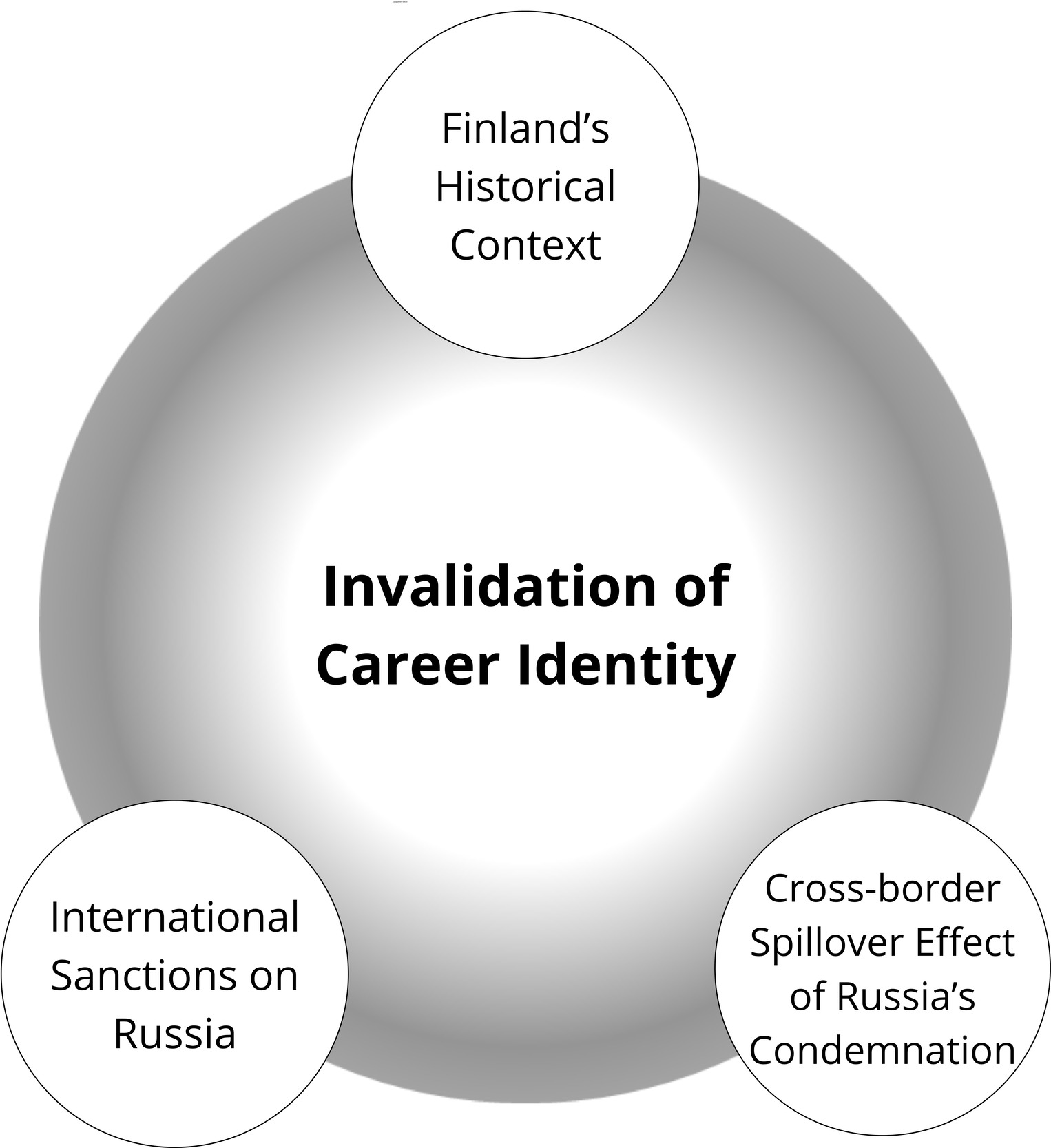
This all changed after the Russian invasion of Ukraine in 2022. Finland’s government strongly condemned Russia’s military actions in Ukraine and Finnish public opinion followed suit. Figure 1 illustrates the macro-level mechanisms explaining the invalidation of Finnish experts’ career identities: Finland’s historical context, international sanctions on Russia and cross-border spillover effect of Russia’s condemnation.
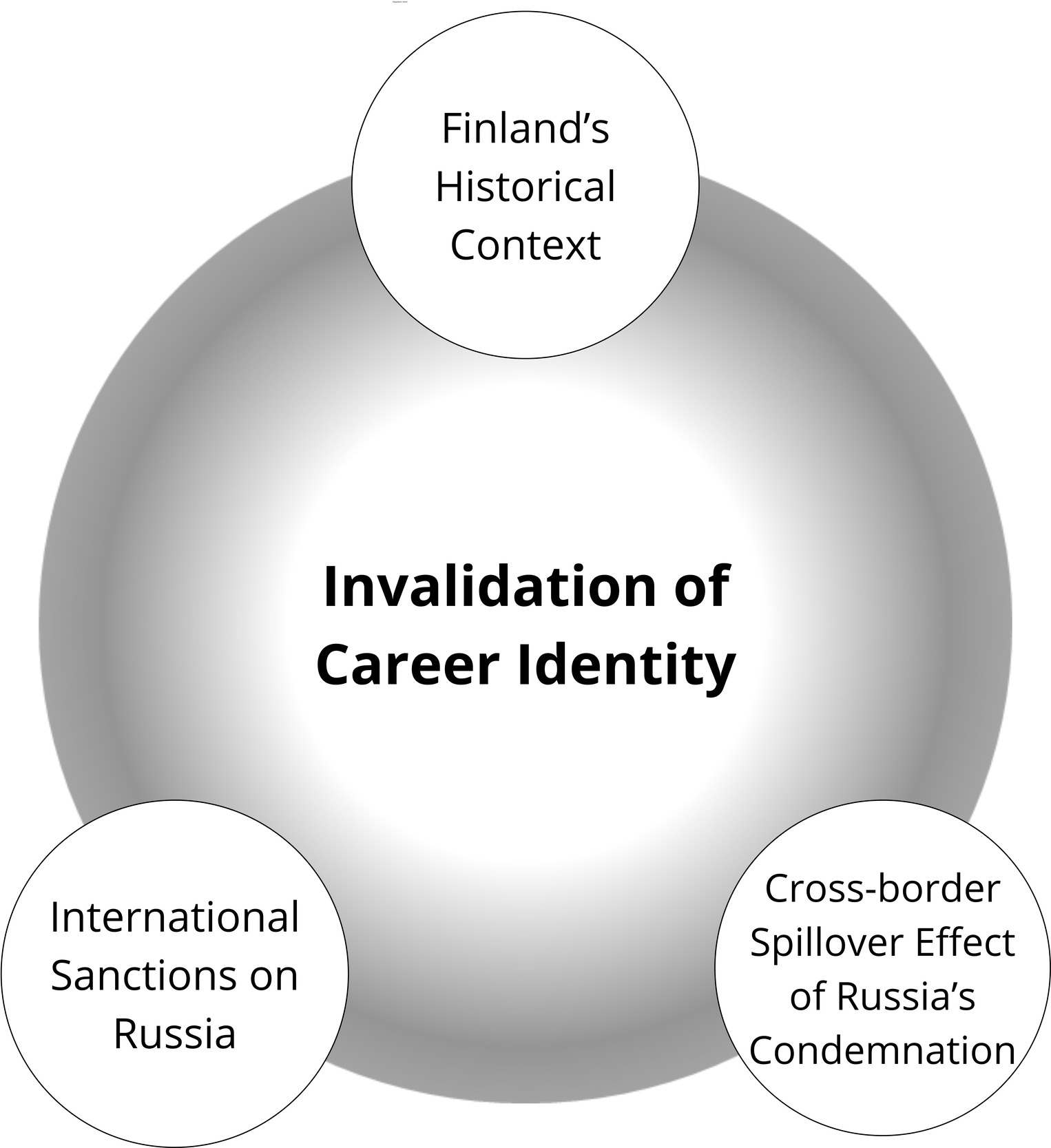
As Figure 1 shows, this shift in public opinion is rooted in Finland’s historical relationship with Russia. Finland was part of the Russian Empire for over a century until gaining independence in 1917, a period marked by attempts at Russification, including the imposition of Russian as an official language. The trauma of the 1939-40 Winter War, which resulted in significant casualties and territorial losses, remains a painful collective memory. These historical experiences resurfaced strongly among Finns following Russia’s invasion of Ukraine. International sanctions and compliance requirements further intensified reputational scrutiny of businesses associated with Russia.
Typology of New Career Identities among Finnish Experts on Russia
Finnish companies were among the first to withdraw their operations in Russia. Based on data from the KSE Institute of the Kyiv School of Economics, 83% of Finnish companies had either exited or were in the process of leaving Russia, compared to the global average of 43% (Leave-Russia.org, 2025). Most of the international managers we interviewed eventually lost their jobs. This loss was exacerbated by negative public sentiment in Finland towards their Russian expertise. Consequently, the war invalidated a large part of their skills and career identity. It was difficult to find work because, as one interviewee pointed out, “the general opinion is that you cannot hire a person with Russia experience” as it is not considered relevant for other work.
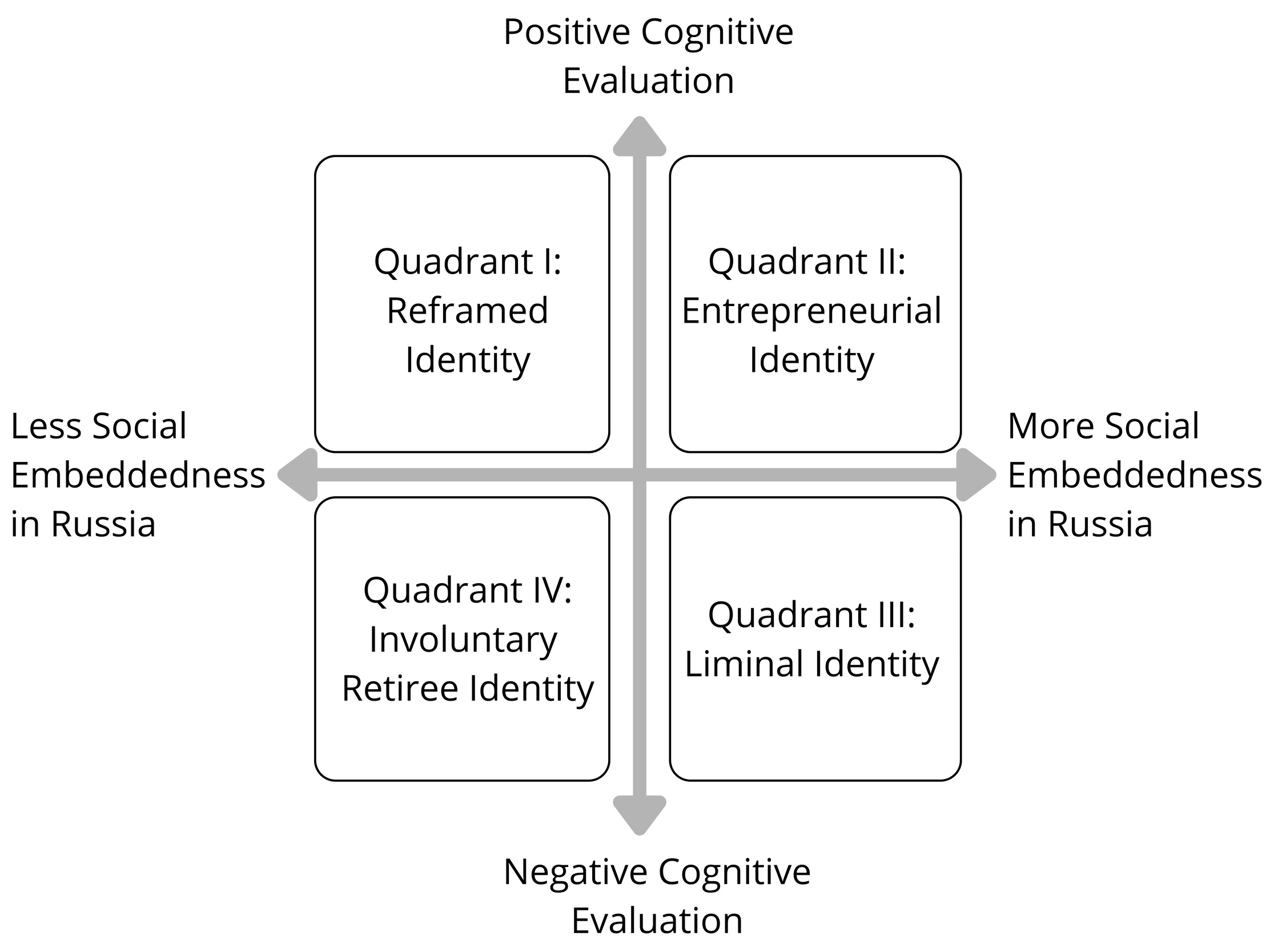
Thus, the geopolitical conflict triggered a deliberate and deep thought process by the interviewees about the future. While their original career identities were strongly tied to Russia, our findings revealed four new career identities that emerged following the shock: Reframed identity (Quadrant 1), Entrepreneurial identity (Quadrant 2), Liminal identity (Quadrant 3), and Involuntary retiree identity (Quadrant 4). In labelling these identities, we drew on the career shock and career identity literatures that also emphasize the importance of context (Akkermans et al., 2021; Ibarra & Obodary, 2016; Ibarra et al., 2026). Our analysis showed that “social embeddedness” (Granovetter, 1985: 481) in Russia, referring to the depth of social relations (e.g., personal and family ties), was a key contextual factor shaping interviewees’ post-shock trajectories. Consistent with prior work on career shock (Akkermans et al., 2021), we also observed differences in how individuals cognitively evaluated the shock: some interpreted it as an opportunity to grow and reconstruct their careers, while others struggled to move beyond their former identity as Russia experts. Figure 2 presents a two-by-two typology of post-shock career identities, organized along these two key dimensions: managers’ social embeddedness in Russia (horizontal axis) and their cognitive evaluation (positive vs. negative) of the career shock (vertical axis).
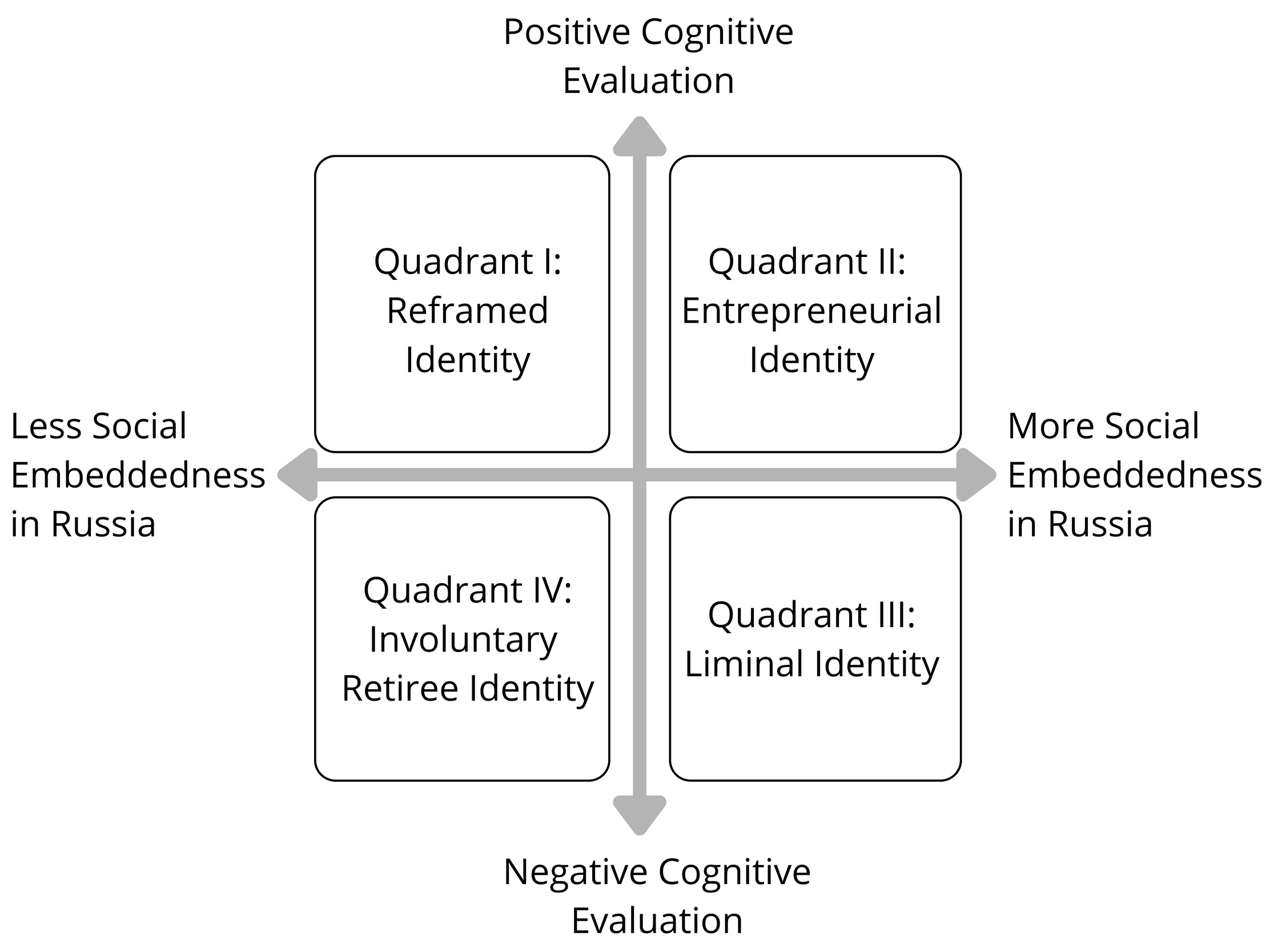
As our typology in Figure 2 indicates, the identity work of some interviewees led to a ‘Reframed identity’ (Quadrant 1), which refers to those individuals who successfully transferred their Russia-related skills to new contexts, hence demonstrating an ability to positively reframe their circumstances. Most of these individuals had a lower degree of social embeddedness in Russia, i.e. with few or no local family ties. These managers showed how expertise developed in Russia, such as navigating complex business environments, could be reframed as valuable international experience. One manager described feeling “lucky” because his experience in Russia was viewed as “international” rather than merely “Russia experience.” Another reflected that “it isn’t just Russia that excites me; it’s the global context as a whole.” These individuals typically continued working in cross-border business.
‘Entrepreneurial identity’ (Quadrant 2) represents those who were able to reframe their circumstances positively while being socially embedded in Russia. Although many interviewees were in their late-career stages, retirement was not always an option, particularly for those who had younger children with their Russian spouses. Finding a full-time job proved challenging for them, so they accepted board positions in start-ups or advisory roles where they could apply their knowledge. As one interviewee noted: “In start-ups, when they want to internationalize, or seek advice in financing, all my experience is beneficial. It gives me satisfaction that I can use my competencies.” For most of these interviewees, their new career identity was now less grounded in a geographical region and more in functional areas such as general management, finance, or administration.
Other interviewees, who had not yet been re-employed, grappled with their evolving identities. We have labelled this transitional stage ‘Liminal identity’ (Quadrant 3), reflecting “the state of being betwixt and between social roles and/or identities” (Ibarra & Obodary, 2016: 47). This struggle was particularly evident among mid-career individuals who still had many working years ahead of them. Although they could not yet articulate their future aspirations, the career shock sparked a process of self-reflection about what work would be meaningful moving forward. For several interviewees, strong personal and family ties with Russians further complicated their identity work, making it more challenging for them to detach from their previous career identity. As one manager stated: “Since my wife is Russian, we have not forgotten Russia; we still have the other leg on that side of the border.”
Finally, some interviewees developed an ‘Involuntary retiree identity’ (Quadrant 4). They tended to interpret the situation as forced yet somewhat acceptable. They had limited social embeddedness in Russia and felt that they had worked long enough in the demanding Russian business to “deserve” more time with their families in Finland. One manager, who compared himself to a retired army professional, stated: “I am a long-serving and successful Russian businessman.” He had completed a long expatriate career in Russian business in various industries, and there was no pressing financial need for full-time employment. However, all managers in this category acknowledged that, without the war, they would “for sure” have continued working in the Russian business, indicating that their retirement was ultimately involuntary.
Translating Contextual Embeddedness
Finnish experts on Russia represent an extreme category of highly educated professionals who enjoyed occupational prestige before the Russia–Ukraine war. The war engendered a geopolitically-imposed career shock and stigma. This differs from other triggers of career shocks such as personal tragedy, a cross-border merger or acquisition, or introduction of Artificial Intelligence which do not necessarily impose a stigma. Our experts, despite being Finnish, experienced a cross-border spill-over effect in their home country: their close association with Russia combined with Finland’s historical context, international sanctions and the general condemnation of Russia tainted them, leading to invalidation of their career identities. Consequently, the Finnish experts’ region-specific career capital became very hard to transfer to other contexts. Yet, in countries such as Austria, Hungary and Turkey, where select companies still do business with Russia, such expertise may remain an asset, reducing the need for career identity renewal. It has recently been noted that “Russia is not going to go away”; therefore, such expertise will be “indispensable for future dealings with Russia” (Rodgers, 2025: 251).
Our study focused on a critical real-world phenomenon affecting a specific group of experts in MNCs. While our findings are not generalizable to a population because we selected the interviewees theoretically – not randomly – we believe the richness of our contextualized study makes a meaningful contribution to IB scholarship (Welch, Paavilainen-Mäntymäki, Piekkari, & Plakoyiannaki, 2022). Our theoretical insights “conceptualize the empirical world in ways that challenge, enlighten, and provide pragmatic value,” rendering them translatable to other contexts such as career identities of China experts (Delios, Welch, Nielsen, Aguinis, & Brewster, 2023: 5). Thus, we extend previous work on career shocks (Akkermans, Rodrigues, Mol, Seibert, & Khapova, 2021) by showing how geopolitical conflict and embeddedness of personal ties shape the severity of career shocks and the feasibility of post-shock options. We also advance the understanding of career identity renewal in contexts of geopolitical conflict, where reputational and moral scrutiny influences which career identities are socially acceptable.
Recommendations
Based on our typology of new career identities derived from our findings, we offer recommendations for international managers themselves, HR professionals, and governments. We show that after a career shock managers tend to follow four identity pathways: reframing their expertise, pursuing entrepreneurial activities, remaining in a liminal exploration phase, or exiting work through involuntary retirement. Each pathway creates different support needs, which our recommendations address. These are summarized in Table 1.
First, some managers successfully reinterpreted their Russia specific expertise as transferable managerial competence. For managers developing a ‘Reframed identity’ (Quadrant 1), we recommend reflecting on the knowledge and skills developed in the Russian business environment and considering how these capabilities can be applied in new contexts. Managers may also seek roles requiring adaptability, such as international business development, where experience of change management is valuable. Because career shocks were described as stressful, HR professionals can offer coaching focused on identity reconstruction to help managers rediscover their strengths and reposition their Russia specific experience as globally relevant. Organizations could offer internal opportunities, such as temporary projects or international assignments to retain talent and preserve institutional knowledge of the Russian business environment which may be applicable in other emerging markets. For government authorities, our findings suggest that highly experienced managers may benefit from reskilling programs focused on transferable capabilities. Cities could therefore fund such programs as well as other public-private career transition programs where the experience of displaced professionals can be utilized.
Second, our findings also revealed that some managers reconstructed their professional identities through entrepreneurial activities, such as consulting, board and advisory roles. When constructing an ‘Entrepreneurial identity’ (Quadrant 2), managers are recommended to emphasize their functional expertise, whether in finance, leadership, or administration, as marketable and strengthen their professional networks by joining industry associations and start-up ecosystems. HR professionals can facilitate internal and external networking forums to help affected managers reconnect professionally and identify new opportunities. They can also utilize these experienced professionals as consultants in projects where their knowledge remains valuable, such as in start-ups. Governments can support entrepreneurial programs tailored to mid- and late career professionals affected by geopolitical disruption, including funding and advisory services for start-ups and enterprises of these individuals.
For managers in the ‘Liminal identity’ category (Quadrant 3), we encourage ongoing reflection and skill assessment, as well as coaching to help clarify career direction and rebuild confidence. Remaining engaged in learning and professional activities can help maintain self-efficacy. HR professionals can provide psychological and career transition support, ensuring that managers feel acknowledged and valued within the organization. Organizations can create peer discussion forums and alumni networks to help managers in transition to share experiences, learn from one another and rebuild professional confidence. Governments can support individuals by extending income security and unemployment benefits to allow time for reskilling and identity reconstruction. Cities can also provide career transition services, such as counseling and coaching, within public employment systems.
Fourth, our findings show that some managers responded to the career shock by exiting the workforce earlier than anticipated, developing an ‘Involuntary retiree identity.’ These managers may benefit from maintaining social relations and professional networks. Remaining connected to former colleagues and professional associations supports wellbeing and might open doors to part-time consultancy or mentoring roles, if they so wish. HR professionals can facilitate this process by designing gradual retirement options that include part-time consultancy or mentoring programs, allowing experienced managers to remain involved. Also, acknowledging the contributions of long-term managers supports their transition out of full-time work. By offering counselling and coaching, HR professionals can support managers in reconstructing a sense of purpose on their new stage of life. Governments can introduce flexible retirement schemes that allow continued engagement through part-time or advisory roles. They can also adjust pension and social security policies to prevent possible financial penalties for individuals whose careers are shortened by geopolitical events.
Conclusion
In today’s turbulent global landscape, careers have become complex and unpredictable. Contextual factors, such as geopolitical conflicts, can have severe implications for individual careers. Our study explored how the Russia–Ukraine war disrupted the careers of Finnish international managers whose professional success had been closely tied to Russia. When companies withdrew from the Russian market, these experts not only lost their jobs but also faced the sudden collapse of their long-standing career identities as Russia experts. Through our analysis and resulting typology, we show how these individuals responded to the career shock by reconstructing their career identities and provide recommendations for various stakeholders, including the affected managers. By preparing for such disruptions and learning from them, individuals, organizations, and governments can foster greater resilience in times of crisis. Our study has implications for the management of people in multinationals affected by geopolitical conflict, including the training and deployment of expatriates, who may not be willing to relocate to particular areas. Geopolitical conflict is thus shaping global careers, not only at the firm level but also at the level of individual mobility, identity and professional expertise.
Acknowledgements
We are grateful for the insightful comments provided by Marina Iskhakova, William Newburry and Elizabeth Rose on an earlier version of this paper. We would also like to acknowledge the constructive feedback received at the AIB annual meeting (2025), ANZIBA-AIB Oceania Chapter Collaborative Event (2025), AOM annual meeting (2024, 2025), EIBA (2025) and GEM&L (2025). We are indebted to the Finnish experts on Russia who were willing to share their career stories with us. Finally, we would like to thank the two anonymous reviewers for their most constructive feedback and Deputy Editor Desislava Dikova for her editorial guidance.
About the Authors
Virpi Outila is Assistant Professor of International Business at San José State University’s Lucas College and Graduate School of Business. Her research interests center around people management in cross-cultural contexts, headquarter-subsidiary relations, practice/knowledge transfer in multinational enterprises and emerging economies. Her research has been published in leading journals of management and international business, such as Organization Studies, Journal of World Business, Journal of International Management, Management and Organization Review, and Critical Perspectives on International Business.
Rebecca Piekkari is Marcus Wallenberg Chaired Professor of International Business at Aalto University School of Business in Finland. Her current research interests focus on diversity and inclusion; gender; languages and translation in cross-border business and scholarship; qualitative methods and knowledge production as well as landmark buildings of multinational corporations. She is Fellow of the Academy of International Business and European International Business Academy and Director of the Aalto Center for Qualitative Management Research (Qual+).
Carol Reade is Professor of International Management at San José State University’s Lucas College and Graduate School of Business. Her research interests lie at the intersection of culture and societal conflict, focused on the global mobility of employees and their lived experiences in multicultural, challenging and volatile environments. Her work has been published in, among others, Journal of Management, Journal of International Management, International Journal of Human Resource Management, and Journal of International Business Policy.