
Introduction
Conflict zones challenge multinational enterprises (MNEs) because institutional voids disrupt market functions, and authority is fragmented across parallel enforcement systems. Here, conflict zones are environments marked by fragmented authority, recurrent enforcement disruption, and contested political legitimacy. Managers must decide what role to play, how far to intervene, and when continued involvement becomes politically risky or operationally counterproductive.
Country-level averages conceal where exposure and legitimacy risks concentrate. Risks vary across sites and corridors, including transport routes, border crossings, and permitting and payment interfaces. Governance challenges therefore emerge unevenly across sites and corridors, and a firm’s role depends on its posture toward public authorities and market-supporting functions in each setting.
Prior literature shows that institutional conditions shape firm strategy (Peng, Wang, & Jiang, 2008) and that institutional voids can be patterned rather than simply absent (Dieleman, Markus, Rajwani, & White, 2022). In conflict-affected areas, diagnosis must be local, since violence affects foreign subsidiary survival unevenly across locations (Dai, Eden, & Beamish, 2013). Nonmarket strategy explains how firms engage public and social actors (Mellahi, Frynas, Sun, & Siegel, 2016), while Liou (2025) highlights socio-political engagement through corporate social responsibility and corporate political activity among emerging-market MNEs in developed markets. Zhang (2025) similarly shows that media can shape corporate legitimacy and public perceptions of MNEs under geopolitical tensions. These perspectives explain why institutions and legitimacy matter, but offer limited guidance on linking corridor-level conditions to governance roles. Bozonelos & Tsagdis (2023) recast geopolitics as an ongoing, endogenous process rather than a series of periodic shocks, underscoring the need for a practical framework for fragmented authority.
This limitation is consequential in conflict zones, where poorly timed role choices can disrupt operations and erode legitimacy. We therefore ask how MNEs can choose and sequence governance roles under institutional voids and authority fragmentation, where reversals are costly. What distinguishes conflict settings is not weak institutions alone, but repeated disruption across authority, enforcement, and political legitimacy.
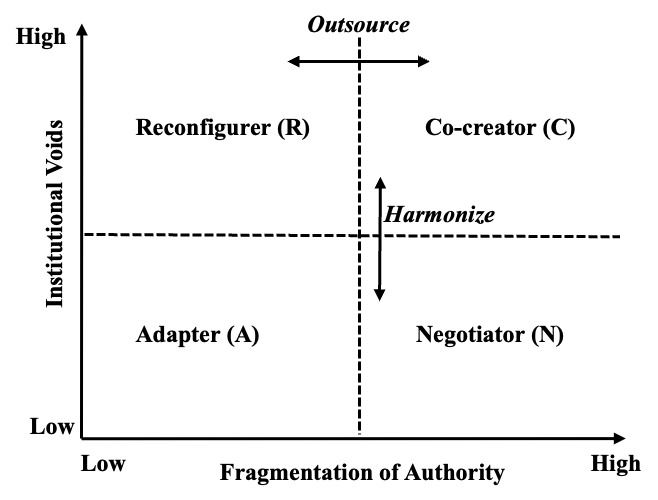
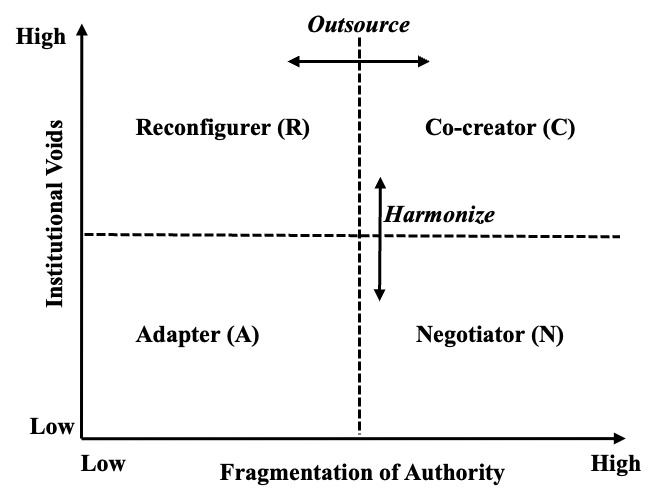
We address this problem through Institutional Anchoring and the ANCR Compass. Institutional anchoring refers to a firm’s deliberate choice and sequencing of governance roles to remain legitimate and operational under authority fragmentation and repeated disruption. The ANCR Compass places each project on an Institutional Voids-against-Authority Fragmentation grid and assigns a baseline role: Adapter, Negotiator, Co-creator, or Reconfigurer. Reconfigurer is the most far-reaching role, involving a narrowly scoped, auditable, and reversible redesign of a governance function. Two anchoring rules keep roles proportionate to context: headquarters involvement increases with Institutional Voids, while local political authorization rises with Authority Fragmentation. Safe transitions near quadrant boundaries are supported by two boundary tactics: Harmonize and Outsource.
What Existing Perspectives Miss in Conflict Zones
Country- or industry-level perspectives explain why institutions matter, but offer limited guidance on what managers should do within a specific corridor as conditions shift. In conflict zones, patterned voids and fragmented authority make roles provisional and role shifts politically consequential. Table 1 shows where these perspectives fall short on role choice, escalation, and adjustment at the corridor level.
These perspectives remain valuable, but provide limited guidance on evaluating corridor-level conditions, selecting governance roles, and adapting them as conditions shift.
Institutional Anchoring: From Diagnosis to Role Choice and Sequencing
Institutional anchoring links a changing environment to a stable governance role and an actionable adaptation path. Diagnosis is carried out at the corridor or site level using two conditions: the extent and durability of gaps in market-supporting functions and the degree of authority fragmentation. Two escalation rules keep the approach proportionate: headquarters involvement increases with institutional voids, and local political authorization rises with fragmentation. Figure 1 links these conditions to four default roles and two boundary tactics. Harmonize aligns forums, calendars, and records among fragmented authorities, while Outsource delegates a task to a certified third party while preserving standards, audit trails, and reversibility.
Adapter
This role applies when voids are low and authority fragmentation is minimal. Headquarters involvement is limited because public functions are accessible and predictable, and local political approval is routine rather than decisive. The operating logic is procedural alignment through compliance, localized routines, and standard public interfaces. GAM’s electronic vocational-license renewal service offers a procedural illustration of this posture in a municipal setting where license renewal is electronically administered (GAM, 2026).
Negotiator
This role fits settings where voids are limited but authority is highly fragmented. Headquarters involvement remains moderate because core functions still run, but local authorization must be maintained across overlapping authorities. The operating approach is to consolidate access through joint interfaces, shared records, and negotiated arrangements that remain usable across authorities. LUKOIL’s West Qurna-2 engagement illustrates how formalized agreements with host-country public authorities can help stabilize operations (LUKOIL, 2023).
Co-creator
This role is appropriate when both institutional voids and authority fragmentation are high. Headquarters involvement is crucial to mobilize resources, oversee standards, and coordinate partners, while local authorization must extend across multiple contested authorities. The operating approach is co-design and co-governance with milestones, sunset clauses, and parallel evidence trails. The SHADE forum in the Western Indian Ocean illustrates the coordination logic of this role (EUNAVFOR, 2023).
Reconfigurer
This role applies when institutional voids are high but authority fragmentation is low or consolidated. Headquarters involvement is crucial because the firm oversees a narrowly scoped, auditable, and reversible intervention to preserve an essential governance function. Local approval follows a clearer pathway to a single or dominant authority. MTN Rwanda’s case under RURA’s enforcement notice illustrates how formal supervision and specified remediation obligations can become central when service quality and compliance concerns intensify (RURA, 2016).
The compass assesses each site along two axes: Institutional Voids, the depth and persistence of functional gaps, and Authority Fragmentation, the degree to which authority is divided across parallel or overlapping actors. Each position on the grid implies a default role—Adapter, Negotiator, Co-creator, or Reconfigurer. Two anchoring principles connect context and organization: headquarters involvement increases with Institutional Voids, while local political authorization rises with Authority Fragmentation. Near boundaries, movement is stabilized by two safety strategies: harmonize between Negotiator and Co-creator and outsource between Co-creator and Reconfigurer.
From Diagnosis to Action: Managerial and Policy Guidance
Effective anchoring begins with two questions: how deep are the institutional voids, and how fragmented is authority? Managers assess whether licensing, enforcement, payments, security, and essential public services are reliable enough for daily operations, and whether multiple authorities claim jurisdiction over the same corridor or asset. This assessment should be conducted at the site or corridor level and revisited as conditions shift. In politically challenging environments, uncertainty evolves with political competition and enforcement patterns (DeBerge, 2024), making periodic reassessment essential. When contracts depend on an alternative forum accepted by both parties, or when parallel enforcement creates inconsistent procedures, the episode should be mapped on the ANCR grid to identify a default role.
Two anchoring rules connect diagnosis to organization. Headquarters involvement increases with Institutional Voids because coordination, audit, and misalignment risks rise as market support diminishes. Local political authorization increases with Authority Fragmentation because continuity depends on consent across overlapping actors. Managers can operationalize these rules by clarifying decision rights, approval thresholds, documentation standards, and escalation paths.
Once the role is set, priorities follow a simple sequence. Adapters emphasize compliance and stable localization while avoiding discretionary exemptions that create political dependence. Negotiators build joint interfaces, maintain a shared grievance record, and agree restart protocols usable across authorities. Co-creators stabilize critical functions through co-design and co-governance with milestones and sunset clauses. Reconfigurers implement narrowly scoped, auditable, reversible substitutions when essential functions fail under relatively consolidated authority. Across roles, the compass clarifies how much discretion to retain locally, when to escalate decisions to headquarters, and which functions can be shared, co-managed, or temporarily substituted.
Role changes should be episode-based and explained to counterparts to maintain legitimacy. Managers should clarify the purpose of the shift, its intended duration, and the conditions for reverting to a different role. In politically charged settings, responses may not originate from a single organizational level, as headquarters and franchise partners can respond differently to the same episode of pressure (Benmamoun, 2026). When bargaining stalls but the core governance coalition remains viable, the firm should harmonize by aligning forums and calendars without increasing corporate control. When public functions remain unavailable and co-creation cannot stabilize delivery, the firm should outsource specific tasks while preserving standards, audit trails, and an exit strategy. Pre-agreed triggers help keep transitions threshold-based rather than discretionary.
For policymakers, co-creation should be the default because it allows responsible firms to stabilize services and reduce governance costs, while disciplined substitution should be reserved for failure of essential public functions. Accelerated licensing, a single contact point, a shared grievance log, and targeted support for co-investment in public goods help firms clarify roles, reduce misfit costs, ensure continuity, and build legitimacy. Clearer expectations around role choice and transition can reduce uncertainty and limit governance vacuums during prolonged conflict.
Conclusion
In conflict-affected environments, firms repeatedly face a dilemma that existing theories do not fully resolve: when to act, how far to intervene, and when continued involvement becomes counterproductive or illegitimate. Actions accepted under one set of conditions may quickly become politically contested, while delay can produce operational paralysis. Geopolitical tensions intensify scrutiny of MNE behavior and public communication (Zhang, 2025), making legitimacy management a continuous rather than episodic task. Institutional anchoring helps by clarifying how role adjustments should be documented, explained, and, if necessary, reversed.
This article reframes strategy in conflict-affected environments as a problem of anchoring the firm under fragmented authority. The Institutional Anchoring framework, illustrated by the ANCR Compass, links institutional voids and authority fragmentation to four default roles: Adapter, Negotiator, Co-creator, and Reconfigurer. Two anchoring rules guide how diagnosis informs organization: headquarters involvement should rise as institutional voids deepen, while credible local political authorization should strengthen as authority fragmentation increases. Two boundary tactics support adjustment: Harmonize aligns forums and schedules between negotiation and co-creation, while Outsource delegates specific functions to specialized partners when co-creation cannot stabilize delivery. Used this way, anchoring reduces coordination loss, stabilizes daily operations, and makes authorization more defensible.
For policymakers, the compass indicates when to promote co-creation with responsible firms and when disciplined substitution is necessary because essential public functions have failed. By making role choice, escalation, and reversal explicit, institutional anchoring gives firms a way to remain engaged without drifting into overreach or disengagement, while also giving public authorities clearer expectations of corporate involvement. The ANCR Compass also provides a language for teaching and executive discussion under fragmented authority.
About the Authors
Xinwei Shi is Assistant Professor of Strategy at Durham University Business School. He received his PhD from Durham University and completed postdoctoral research at Tsinghua University. His research on strategy, international business, and innovation has appeared in journals including Production and Operations Management, Long Range Planning, Technovation, Industrial and Corporate Change, Journal of Business Research, International Business Review and Journal of Digital Economy. He serves on the review boards of the Journal of International Business Studies and Long Range Planning.
Yirun Lu holds a master’s degree in Applied Mathematics from Imperial College London. Her research interests include political risk, agent-based modelling, and financial market dynamics, with a broader interest in the use of quantitative methods to study strategic behaviour, uncertainty, and complex organisational and market environments. Her work combines management, finance, and computational modelling, with a special focus on how formal analytical tools can contribute to research in international business and strategy.
Wenwei Chen is a Postdoctoral Research Fellow at Tsinghua University. He was a Visiting Scholar at Regent’s Park College, University of Oxford. His research focuses on business ecosystems, corporate governance, internationalization, and innovation in emerging-market firms. His work has appeared in the International Business Review and the Journal of Digital Economy. He is particularly interested in how firms from emerging economies navigate digital transformation, governance challenges, and ecosystem change in both domestic and international contexts.