
What Is E-Residency?
E-Residency is a digital identity program, initiated by the government of Estonia that enabled individuals access to services in the country. E-Residency enables individuals to set up a company online – with access to the European Union common market – irrespective of their physical location. Additionally, e-residents can authenticate themselves and use electronic, legally binding signatures to sign documents, conduct transactions, and access services. There are over 134,000 e-residents as of January, 2026, with over 39,000 companies established by these e-residents (Government of Estonia, n.d.). These e-residents have garnered the attention of entrepreneurs and foreign governments, and assisted Estonia with an additional stream of tax revenue and positive publicity in the entrepreneurs’ home countries (Kotka, Vargas, & Korjus, 2015). However, e-residency does not confer any physical residency rights to entrepreneurs.
E-Residency and the digital infrastructure that Estonia has created has helped the country’s foreign policy objectives. X-Road, the country’s secure data exchange platform, on which services like e-Residency are built, have been a tool of statecraft due to its interoperability with different systems, and focus on data integrity and privacy (e-Estonia, n.d.). X-Road has been considered for adoption in a variety of countries, and it has enabled Estonia to deepen its collaboration with a variety of countries including Finland and Namibia (e-Estonia, 2023; X-Road Case Studies Library, 2024).
Based on e-Residency’s success in Estonia, countries like Azerbaijan, Palau, and Lithuania have initiated their own variants of e-residency programs, largely modeled after Estonia’s. Azerbaijan become the second country to offer mobile residency, which is its variation of the e-residency program in 2018, followed by Lithuania in 2021, and Palau in 2022.
Introduction of E-Residency
The Estonian government launched the first e-residency program globally in 2014, which enables individuals globally to become digital residents of the Baltic country. This enables individuals to set up an Estonian company, authenticate and verify documents, submit taxes, access Estonian services, and join a global community of entrepreneurs in Estonia, irrespective of their physical location. The nuances surrounding the e-residency program remain understudied, both from a public policy and an entrepreneur response perspective. Drawing on personal experience as an e-resident and prior literature, I propose actionable insights that would be beneficial for the various stakeholders in this endeavor, including entrepreneurs and governments, which is of particular importance from an international business perspective, as several countries are investigating or have proposed their own e-residency programs in recent years, with varied levels of success.
Literature Review and Framework
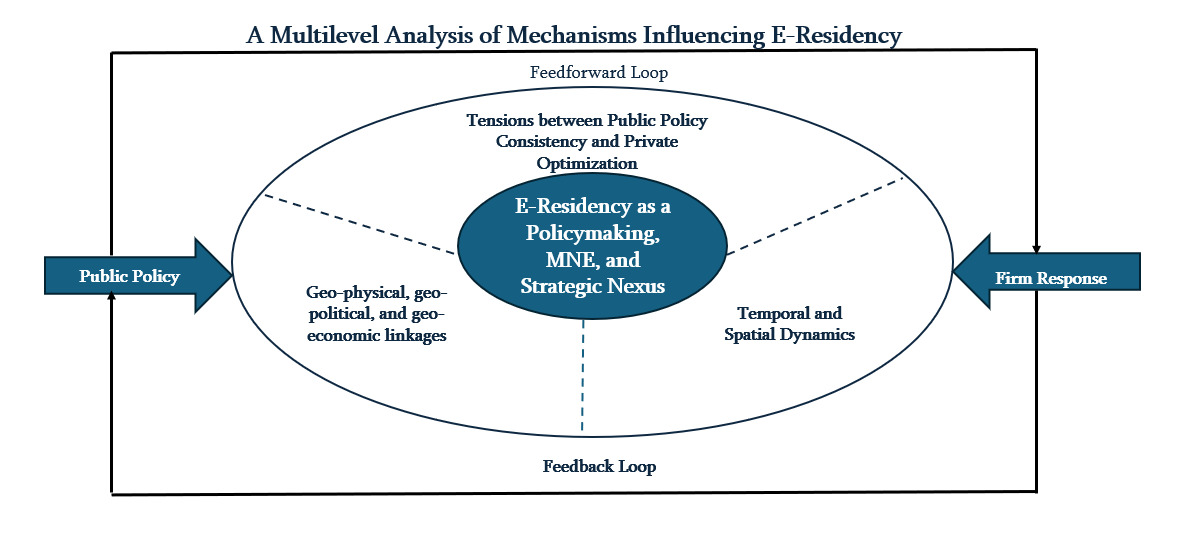
The role of governments, via policy making, in promoting business in their respective jurisdictions has received considerable attention and continues to be a topic of interest, as researchers and businesses investigate physical, economic, and political linkages between policy makers and global businesses (Gölgeci, De Marchi, Kolk, Kunisch, & Demirbag, 2026). Policymakers have repeatedly utilized a variety of tools, including financial, authoritative, informational, and organizational instruments to restructure firm behavior (Gölgeci et al., 2026; Wilhelm, 2024). However, policymakers need to align public policy goals with firm incentives to achieve long-term success to attract entrepreneurs and businesses to their jurisdictions (De Marchi et al., 2025). I utilize the policymaking perspective on international business and the natural environment developed by Gölgeci et al. (2026) to discuss the various mechanisms influencing e-residency both from a public policy and an entrepreneur perspective, as highlighted in Figure I below.
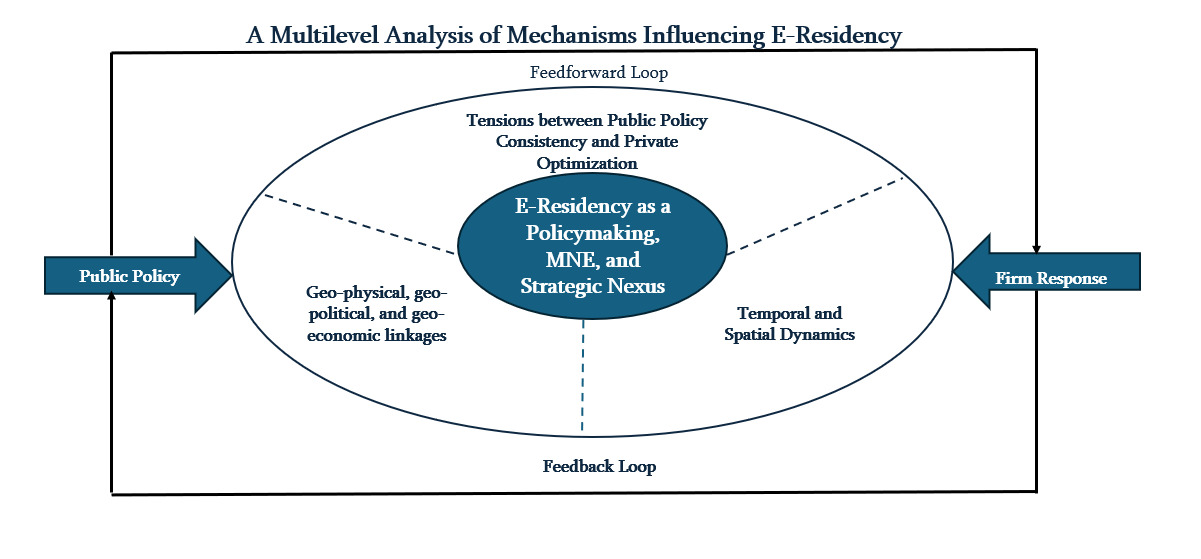
Geo-physical linkages, defined by Gölgeci et al. (2026) as “natural eco-systems and their proximity to planetary thresholds”, play a contributing role in Estonia’s role as the first country to introduce e-residency globally. With a small population of just over a million people, and lacking most natural resources, Estonia has focused on developing a strong information technology (IT) eco-system that it has leveraged successfully, to brand itself as a digital powerhouse in the European Union, and e-residency enables it to share some of its service with entrepreneurs, who can then contribute to the country via corporate taxes (Kotka et al., 2015). Additionally, prior research has highlighted that e-residents feel a sense of belonging towards Estonia (Sallam, Lips, & Draheim, 2021; Tammpuu, Masso, Ibrahimi, & Abaku, 2022). E-Residency has enabled the country to increase its tax base without being constrained by its population – without giving physical residency to individuals. Geo-economic linkages, defined by Gölgeci et al. (2026) as “market mediated and structural phenomena of production”, are a significant contributor to Estonia’s success as an e-residency hub, as the country can leverage its access to the European Common Market to attract entrepreneurs to set up an Estonian company. This has enabled Estonia to maintain a competitive advantage over competitors such as Azerbaijan, which is not a member of the European Common Market, which was the second country to launch an e-residency program in 2018, but has struggled to attract entrepreneurs, with the Azerbaijani application to accept new e-residents in the country currently being on hold. Geo-political linkages defined by Gölgeci et al. (2026) as “the choice, design, and interaction of policy instruments across jurisdictions and how these instruments steer or counteract … geo-economic forces”. As a member of the European Union, that prides itself on its digital governance, with the majority of government services being digital, Estonia has been able to utilize public policy in a manner that is consistent with growing itself – and by extension, the e-residency program- as a reliable partner for entrepreneurs who seek a stable jurisdiction for operating their businesses.
Temporal and spatial dynamics play a considerable role in the performance of the e-Residency program. Prior research has highlighted that actors – both public and private – manipulate their social, political, and economic environments to disrupt or defend institutional decisions (Rodner, Roulet, Kerrigan, & Vom Lehn, 2020). E-Residency is a classic example of this as the Estonian government has utilized its membership in the European Union and the European Common Market to attract entrepreneurs to set up businesses, irrespective of their physical location, in the country, by utilizing the concept of digital residency. From an entrepreneur’s perspective, this is advantageous as it enables corporate residency for their firms in a stable jurisdiction. Additionally, as e-Residency has grown, it has shaped the business environment in the country, as a variety of services have developed to assist e-residents with their needs, highlighting the importance of the value of local environments in impacting firms and vice versa, as clusters lead to the formation of specific skill sets in an area (Delgado, Porter, & Stern, 2014). As with any new government program, there are some tensions that are inherent to public programs – Estonia must balance its public policy objective of using the program to generate revenue for its citizens while providing value for money for its e-residents. Additionally, as competitors in the European Union like Lithuania have initiated their own e-residency programs, Estonia would need to increase efforts to maintain its competitive edge in this market.
Recommendations
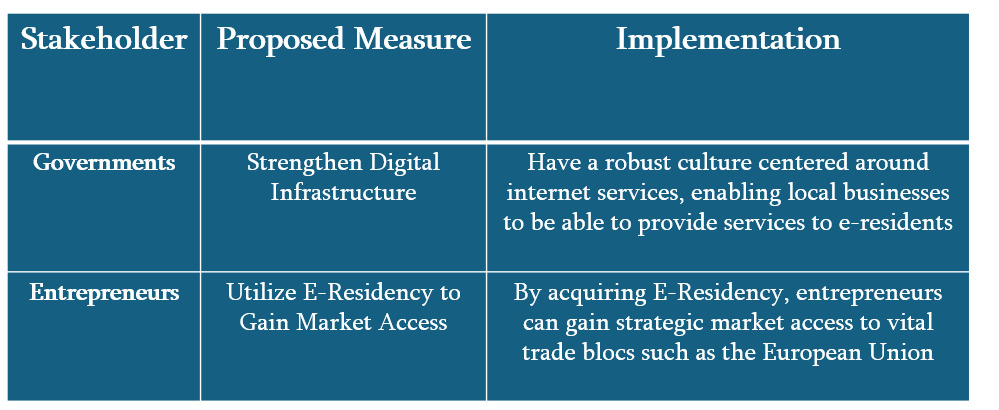
I have summarized the recommendations for the e-Residency program in Figure II below.
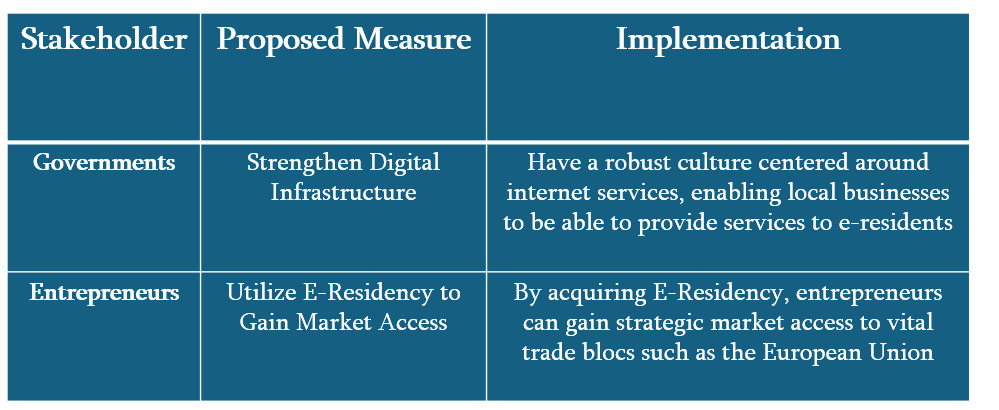
From a government perspective, the Estonian e-Residency program highlights the importance of transparency and utilizing digital ID for the mutual benefit of the state, and of prospective entrepreneurs, who may utilize it to open businesses in the country, without the need for physical presence. Estonia, which has long been considered a leader in information technology (IT) services in Eastern Europe, has leveraged its robust IT infrastructure to attract businesses to its tax jurisdiction, without any physical presence, thereby bypassing the debate about immigration that is sweeping across large parts of Europe. By investing in vigorous IT infrastructure including a national e-ID program, and secure data processing, Estonia established a reputation for consistency that it has been able to expand further to attract e-residents, who are a source of additional tax revenue and soft power internationally for the small Baltic country. This intentional usage of geo-political and geo-economic linkages between Estonia and its e-residents has objectively been a success for the country. It could be argued that e-Residency and its associated innovation have been a source of political support for Estonia (Hardy, 2024). Countries adopting similar programs are urged to invest in their digital infrastructure before embarking on ambitious projects such as e-residency.
From an entrepreneurial perspective, Estonia’s e-Residency program enables access to the European Union reducing barriers to entry for individuals – a fact that has not gone unnoticed, both in the European Union’s neighborhood and for entrepreneurs in the global south. The e-Residency program has successfully enabled entrepreneurs to have a digital base inside the European Union, enabling them to participate in Europe’s economic activity fully. At the same time, Estonia has had to place restrictions on individuals from Russia and Belarus to ensure that its e-Residency program is not being used to bypass European sanctions on those countries, highlighting the need for countries to ensure compliance with national and common market legislation. As more countries adopt e-residency, additional opportunities may arise, both for countries and entrepreneurs. Countries would have to compete, potentially by reducing corporate tax rates on their e-residents, as they compete to gain a greater share of entrepreneurs. It would be interesting to see how different countries manage the tensions between public policy consistency – a steady source of tax revenue, largely via corporate taxes – with the needs of the private sector – which would prefer lower taxes – to continue to attract e-residents as competition intensifies to attract e-residents in the future. However, irrespective of tax rates, e-residents would benefit from market access such as the one provided by Estonia and Lithuania’s programs, to the lucrative European Union single market.
The Estonian success with e-residency highlights the need to facilitate organic marketplaces around the service, built on robust digital infrastructure, which can enable entrepreneurs and businesses to participate in the process, building a community of like-minded individuals who collaborate and work with one another. This cluster of services that exists now in Estonia encourages the creation of more businesses and provides support and confidence to future entrepreneurs who have a community of people to interact and collaborate with. Additionally, from an entrepreneurial perspective, this provides revenue and opportunities for businesses to connect with and collaborate with one another. Other countries intending to mimic this program would do well to ensure that they have a plethora of services available to assist the entrepreneurs that they wish to attract.
Conclusion
E-residency remains a relatively new phenomenon since its inception in Estonia in 2014, allowing entrepreneurs to set up businesses in the country digitally and providing them with a form of digital identification, irrespective of their physical location. This can help reduce social and economic gaps, enabling entrepreneurs to access services and operate businesses in the European Union. Concurrently, countries offering e-residency programs such as Estonia need to continue ensuring that the digital ID is not abused, which can lead to tax fraud, financial crimes, money laundering, and bring the program’s reputation into disrepute (Estonian Ministry of Finance, 2022; Financial Action Task Force, 2022). It is in part due to its relative novelty that the topic remains understudied and under-explored in research, although governments and businesses alike are beginning to pay more attention to this phenomenon. This article explores e-residency, its framing from an international business perspective, summarizes its benefits and limitations, and provides insights into the program. I post actionable insights that highlight how the program can be of benefit for governments and entrepreneurs based on my experience as an e-resident, as this topic continues to garner interest and expand beyond Estonia.
About the Author
Omar Farooq is an Assistant Professor of Management in the School of Business and Economics at the University of Wisconsin, River Falls. His research investigates facility location, focused on reshoring and nearshoring, operational efficiency, and supply chain resilience.