
Introduction
In the complex markets of Latin America and the Caribbean (LAC), country-level data often obscures the true potential of local hubs. This article on international business (IB) argues that multinational enterprises (MNEs) must look beyond national borders to embrace subnational and micro-location strategies. By introducing a framework of four specific micro-location archetypes, this article provides a strategic roadmap for headquarters executives and policymakers. To contextualize the framework, we draw on Porter’s work on the competitive advantage of nations and the role of location in competition (1990, 1994) and Anholt’s (2024) concept of the nation brand and the broader place-branding literature. Underexplored micro-locations in LAC may offer competitive advantages through local specialization, lower operational saturation, place branding (PB), sustainable community growth and place development (Ardila-Lopez & Santamaria-Alvarez, 2026; Stallkamp, 2019).
To deepen understanding of MNE territories choices, MNEs must move beyond the country-level unit of analysis and examine the subnational factors that increasingly shape multinational investment and location-specific advantages (Chakravarty, Goerzen, Musteen, & Ahsan, 2021; Goerzen, Asmussen, & Nielsen, 2024). Global cities are powerful drivers of innovation and growth, but they are also associated with urban inequality and ecological pressures (Goerzen et al., 2024).
Conversely, subnational units, particularly non-traditional or lesser-known cities and regions, are increasingly recognized as strategic investment sites (Ardila-Lopez & Santamaria-Alvarez, 2026; Hutzschenreuter, Matt, & Kleindienst, 2020). These geographies may offer MNEs distinctive competitive advantages that are obscured by country-level data or the dominance of primary metropolitan hubs.
The relevance of this discussion is reinforced by the growing presence of multinational companies in LAC. The Global LATAM Multilatinas Index includes 348 Latin American companies with sales exceeding US$2.5 billion, with Brazil and Mexico dominating the regional landscape. In addition, numerous US-based multinational companies operate across the major Caribbean economies (Global LATAM, n.d.). While in the Caribbean countries, 527 U.S.-based multinational companies operate across the six largest Caribbean economies alone.
The “micro” conceptualization refers to subnational locations regardless of their physical size or wider economic impact. Such locations may be geographically or economically overlooked, may have relatively small populations, or may receive limited representation in international business analysis. In this article, however, a micro-location is defined not by scale, but by strategic distinctiveness.
MNE headquarters executives and directors may use the framework developed within this article when considering locations for new subsidiaries. After all, selecting where to “plant a flag” is one of the highest-stakes decisions an MNE can make. In contemporary international business, this decision concerns not only labor costs and access to tangible resources, but also strategic fit, market access, long-term viability, place development, human empowerment, and local capacity building.
The following discussion develops this debate through the international business and place-branding literature.
Literature
From Macro-Locations to Micro-Locations Strategy
Grounded in Country-of-Origin (COO) theory, this article challenges country-level approaches to MNE location choice by highlighting the potential of micro-locations within LAC. Although international business analysis often relies on indicators such as market size, labor costs and tax rates, such macro-level assessments may overlook urban and rural advantages relevant to attracting investment, human capital and public–private partnerships. A place-branding perspective, therefore, provides MNE headquarters executives with a more granular basis for distinguishing three evolving and interrelated concepts:
-
Country-of-Origin (COO): Historically, this construct focused on how a product’s home country influenced buyer evaluations, as demonstrated in early studies of products such as fruit and automobiles. Over time, COO evolved from product-level appraisal into a broader assessment of country reputation (Govers, 2024; Mariutti, 2017).
-
Place Branding: This represents a contemporary, proactive, and collaborative management strategy. While COO largely concerns existing perceptions, PB involves the active development and communication of a location’s reputation through public-private partnerships and the mobilization of local resources (Kotler, 2024; Oh, Keller, Neslin, Reibstein, & Lehmann, 2020). A regional brand may emerge when geographically connected countries or cities promote a shared identity, economic cooperation, or regional affiliation (Govers, 2024; Ocke & Mariutti, 2025).
-
Micro-Location Strategy: This focuses on subnational clusters, specialized districts and lesser-known hubs. It addresses local characteristics that national-level studies may overlook (Goerzen et al., 2024). These location-specific characteristics may include economic, institutional, and cultural dimensions that are external to the MNE but strategically relevant to its activities (Chakravarty et al., 2021). For MNEs, the place brand of a host city or region can act as a signaling mechanism by supporting legitimacy, strengthening perceptions of sustainability and reducing perceived risk. In this context, some micro-locations may also be understood as intermediate cities that combine business potential with opportunities for sustainable community growth, policymaking and place development (Ardila-Lopez & Santamaria-Alvarez, 2026; Stallkamp, 2019).
A micro-location may therefore be a secondary city, logistics corridor, innovation district, tourism enclave, industrial ecosystem, border region, free-trade zone, or particular agricultural region. Its defining characteristic is not whether it is small or hidden, but whether it possesses a distinctive combination of assets that makes it strategically attractive for particular international business activities while remaining overshadowed by broader national or metropolitan narratives.
Within international business, a place brand comprises the cognitive and emotional associations generated by a location’s identity, capabilities and communications. These associations reflect both tangible and intangible attributes, including institutions, infrastructure, culture, human capital and geography (Govers, 2024; Kotler, 2024). Country-image research similarly considers the value associated with nations, regions, and cities and the economic consequences of treating them as brands (Mariutti, 2017; Oh et al., 2020; Samiee, Leonidou, Katsikeas, & Aykol, 2024). A place-branding perspective can therefore help explain how MNE location strategies contribute to investment attraction, place development and the reduction of economic and social disparities.
Landscape of Latin America and the Caribbean (LAC)
Each LAC country has a distinctive cultural, ethnic, geographical and economic landscape. The region has been shaped by Indigenous peoples, Iberian colonization, African populations and later international migration. Spanish and Portuguese are the principal languages, alongside English, French, Dutch, and numerous Indigenous and Creole languages.
The LAC region comprises 33 sovereign nations across Latin America and the Caribbean, creating substantial diversity in institutional conditions, market structures, infrastructure and international connectivity.
Ocke and Mariutti (2025) examine the balance between cooperation and competition among LAC nations when integrating individual country attributes into a collective regional brand identity. Countries across the region increasingly seek to diversify their intangible assets and develop more varied place images to attract investment, talent and other resources in a globally competitive environment. Nations, regions and cities develop place brands based on their distinctive narratives, assets and identities (Kotler, 2024; Oh et al., 2020). These brands can support economic progress, social prosperity and environmental sustainability when they are grounded in substantive local capabilities rather than promotional communication alone (Chakravarty et al., 2021; Govers, 2024).
Research has identified substantial differences between global cities and surrounding areas in the ways location characteristics and FDI patterns evolve over time (Chakravarty et al., 2021; Goerzen et al., 2024; Llop, Iglesias, Vargas, & Blanc, 2019). The growing focus on subnational location choice challenges the assumption that countries are spatially homogeneous (Hutzschenreuter et al., 2020) as well as regions (Stallkamp, 2019). Nevertheless, non-global, second-tier, and smaller cities remain underrepresented in the international business literature.
LAC Micro-Locations Strategy Framework
Latin America and the Caribbean provide a diverse setting for MNE micro-location strategy, encompassing resource-based clusters, special economic zones, innovation hubs and under-recognized regional centers. The strategic value of these locations depends on the fit between firm-specific needs and local economic, institutional, infrastructural, and human-capital conditions.
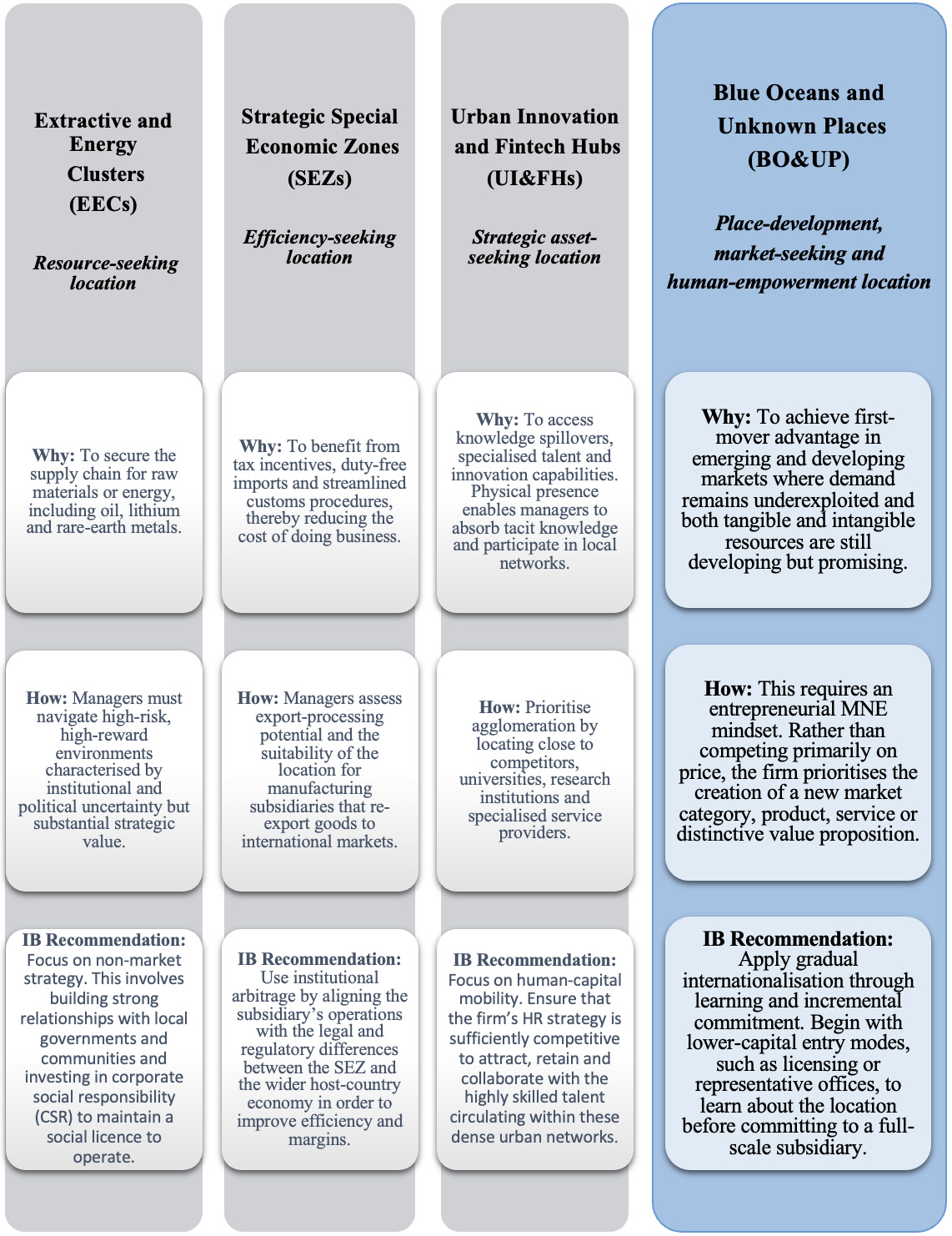
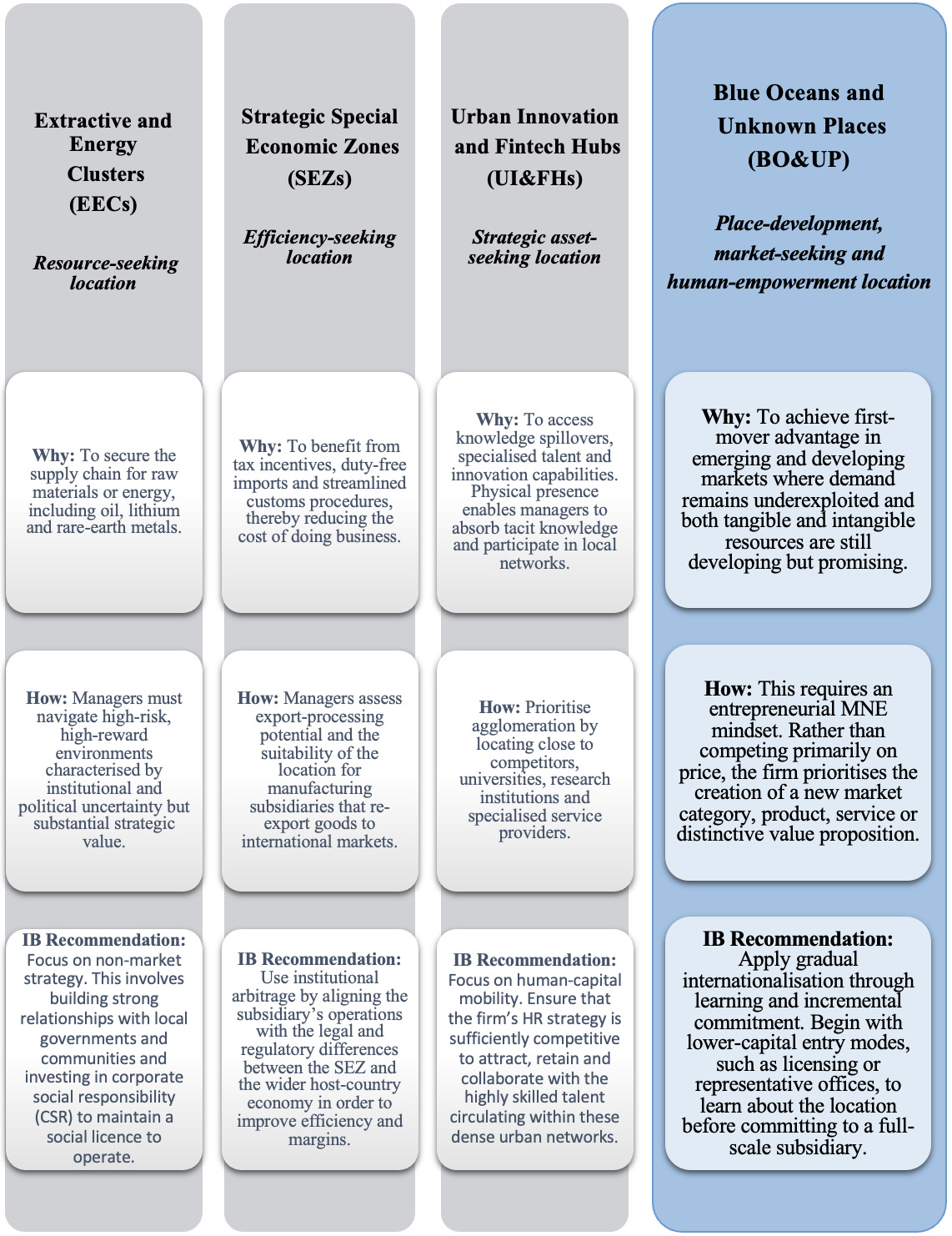
Building on the literature and observations discussed above, the MNE micro-location framework identifies four types of micro-geographic areas relevant to headquarters executives and core subsidiaries operating in LAC: (i) Extractive and Energy Clusters; (ii) Strategic Special Economic Zones; (iii) Urban Innovation and Fintech Hubs; and (iv) Blue Oceans and Unknown Places. These four archetypes are briefly explained and illustrated below. The archetypes are ideal types rather than mutually exclusive categories; individual locations may combine characteristics from more than one archetype.
-
Extractive and Energy Clusters (EECs): These are resource-seeking micro-locations associated with region-of-origin products and natural resources. One example is the Lithium Triangle, comprising micro-regions in the high-altitude deserts of Argentina, Chile, and Bolivia. Another example is the Brazilian Amazon bio economy, illustrated by Natura’s emphasis on sustainable extraction and partnerships with Indigenous communities in the production and branding of its bio-cosmetics. In this case, origin is not simply a location; it also functions as a resource and development laboratory. EECs are therefore particularly relevant to MNEs seeking proximity to origin-specific resources, supply-chain efficiencies and access to logistics facilities. Their principal trade-offs include political uncertainty, environmental pressures, community consent and dependence on resource cycles;
-
Strategic Special Economic Zones (SEZs): These are efficiency-seeking micro-locations associated with import, manufacturing, and distribution activities. For example, the Manaus Free Trade Zone in Brazil offers reductions in import taxes and exemptions from taxes on industrialized products. Similarly, the Caucedo Logistics Center in the Dominican Republic provides significant logistical advantages for international trade. SEZs are therefore particularly relevant to MNEs seeking rapid access to global markets, multimodal transport links and tax or customs advantages. Their principal trade-offs include dependence on government policy, changes in incentive regimes, and limited integration with the wider domestic economy.
-
Urban Innovation and Fintech Hubs (UI&FHs): These are strategic asset-seeking micro-locations associated with a particular district, city, or place brand. Examples in Brazil include São Paulo’s Faria Lima district, Avenida Paulista and Pinhão Valley in Curitiba, which has supported the development of firms such as EBANX. In Guadalajara, Mexico, Ciudad Creativa Digital is an urban-renewal initiative in the historic city center that encourages the development of high-technology and creative industries. Guadalajara also hosts a substantial cluster of technology, payment-processing, and engineering activities. UIFHs are therefore particularly relevant to MNEs seeking specialized labor, local infrastructure, knowledge networks and demand-centered opportunities. Their principal trade-offs include higher employment and property costs, congestion and strong competition for specialized talent.
-
Blue Oceans and Unknown Places (BO&UP): These are place-development, market-seeking and human-empowerment micro-locations that integrate place-branding principles with international business location strategies. They represent less-saturated locations in which an MNE may exercise greater influence, reduce operating costs, and gain first-mover advantages. In smaller regions, an MNE may also become an important economic actor, supporting stronger employee retention, local loyalty and community development. Examples include the Tijuana–San Diego corridor, the Cúcuta–San Cristóbal border region and Ciudad del Este within the Triple Frontier of Paraguay, Brazil and Argentina. Here, “blue oceans” is used metaphorically to describe comparatively unsaturated locations, while “unknown” refers to places that are under-recognized in conventional headquarters location screening rather than literally unknown. BO&UP are therefore particularly relevant to MNEs seeking new markets, lower saturation and stronger local embeddedness. Their principal trade-offs include infrastructure limitations, institutional immaturity, shortages of expert labor and longer investment horizons.
We propose that the Blue Oceans and Unknown Places archetype makes the article’s principal contribution by integrating international business and place-branding knowledge to support investment attraction, market development, local capacity building and human empowerment across LAC. Its focus is on secondary and under-recognized cities, towns and corridors with untapped strategic potential.
The MNE micro-location framework and its actionable recommendations are presented in Figure 1 as a future-oriented guide for corporate decision-making and academic research. The framework emerged through an integrative synthesis of the international business literature on location choice, subnational geography and place branding, complemented by observations of contemporary investment patterns across Latin America and the Caribbean. Rather than representing an exhaustive typology, it groups recurring forms of location-specific advantage into four practitioner-oriented archetypes designed to support strategic subsidiary-location decisions.
The four categories may also be extended beyond LAC to other regions containing subnational territories with potential for internationalization (Ardila-Lopez & Santamaria-Alvarez, 2026; Hutzschenreuter, Matt, & Kleindienst, 2020).
When MNE headquarters executives identify a subnational territory with strong internationalization potential, they can use the framework to assess the strategic benefits presented in Figure 1.
For managerial decision-making and practical application, Table 1 presents three complementary mechanisms through which MNE headquarters executives can operationalize the Blue Oceans and Unknown Places archetype: Place Immersion (PI), Community–Private Partnerships (CPPs) and Place-Based Employee Value Propositions (EVPs). These three mechanisms were developed grounded in the theoretical-practice literature of both IB and PD referenced in this article.
A Framework for MNE Headquarters Executives
The framework should not be viewed only as a classification of micro-location types, but as a practical decision-support tool that helps multinational enterprise (MNE) headquarters executives align subsidiary location choices with strategic objectives. Rather than beginning with a preferred country or city, managers should first identify the firm’s primary investment motivation and then assess which micro-location archetype offers the most appropriate combination of location-specific advantages, institutional conditions and long-term strategic potential.
The proposed framework follows a five-step decision process for micro-location strategy.
Step 1 – Define the Strategic Objective
Managers first determine the dominant purpose of the investment, such as securing access to natural resources, improving operational efficiency, acquiring strategic assets and innovation capabilities, or developing new market opportunities through regional development.
Step 2 – Match the Objective to the Appropriate Micro-Location Archetype
The framework then guides decision-makers towards one of four archetypes: Extractive and Energy Clusters, Strategic Special Economic Zones, Urban Innovation and Fintech Hubs, or Blue Oceans and Unknown Places. Each archetype represents a distinct configuration of location-specific advantages rather than a particular city or administrative unit.
Step 3 – Evaluate Enabling Conditions and Trade-Ooffs
Managers should then assess the economic, institutional, infrastructural and human-capital characteristics of candidate locations, together with the risks and trade-offs associated with each archetype. These may include political uncertainty, infrastructure maturity, labor-market competition, policy dependence and market-development challenges.
Step 4 – Design the Implementation Approach
Once an archetype has been selected, organizations can operationalize their strategy through complementary place-based mechanisms, including Place Immersion, Community–Private Partnerships and Place-Based Employee Value Propositions, particularly when investing in emerging or under-recognized locations.
Step 5 – Compare Candidate Locations and Make the Selection
A managerial decision-making dashboard is presented in Table 2, summarizing the typical characteristics, principal benefits, and managerial trade-offs associated with each micro-location archetype.
Policymakers can use the framework to diagnose infrastructure, institutional, and human-capital gaps, target investors whose strategic needs match local capabilities, and align place-branding initiatives with substantive development priorities. Thus, the framework possibly will permeate the business-subsidiary model configuration by aligning not only physical-based and machine-driven resources but also human-centered and reputational resources.
Conclusion
This article develops a practitioner-oriented framework for identifying and comparing subnational locations in LAC. It also provides two strategic insightful tools to support MNE headquarters executives: one for operationalizing and the other for selecting the appropriate micro-location archetype. Thus, by integrating international business and place-branding perspectives, it distinguishes four micro-location archetypes and links them to different investment motives, enabling conditions, and trade-offs. The framework helps MNE headquarters executives evaluate subsidiary locations beyond established global cities and helps policymakers identify interventions that can improve investment readiness. Although developed for LAC countries, the framework may also enlighten the analysis of under-recognized subnational locations in other regions and continents. Furthermore, entrepreneurs and investors may also be supported by the Micro-Location Strategy framework.
Acknowledgments
Acknowledgments to William Newburry and Matevž Rašković for the helpful and motivational PDW at AIB-LAC in Lima, Peru, in February 2026. We also thank you the anonymous reviewers for the cooperative and applicable recommendations to improve our publication.
About the Authors
Fabiana Gondim Mariutti is a Lecturer and Supervisor at three MBAs courses at FUNDACE – FEARP at Universidade de São Paulo, Brazil since March 2024. She brings over 15 years of higher education experience across Brazil and the United Kingdom, backed by research grants from leading funding bodies, including FAPESP, CNPq, and CAPES. Her academic profile is supported by more than a decade of executive leadership in marketing, corporate communications, and strategy in Brazil.
Stratis Koutsoukos is the Course Director at the Leeds Business School at Leeds Beckett University, England. He is a senior researcher in the field of regional economic studies, public sector, and corporate strategy and multi-level governance with over 17 years’ experience in bidding and collaborating in cross-cultural and cross-disciplinary teams.