
Introduction
Tourism serves as a powerful engine for economic growth, cultural exchange, and global connectivity. In Sri Lanka, the sector contributed 2.2% of GDP in 2023 and is projected to rise to 3.3% by 2034 (World Travel & Tourism Council, 2024), driven by its rich natural and cultural assets, including UNESCO World Heritage Sites, diverse landscapes, and a year-round tropical climate. Nature-based and cultural tourism have long formed the backbone of Sri Lanka’s tourism appeal, with growing demand for eco-friendly and authentic wildlife experiences. However, tourism development has often prioritized externally led growth, which can erode local authenticity (Fernando, Janaka, de Silva, & Pastorini, 2024). To address this, we propose a community-based tourism (CBT) approach that prioritizes local empowerment, cultural preservation, and sustainable livelihoods, offering practical relevance for local communities, micro-entrepreneurs, and policymakers engaged in tourism development. Yet in Sri Lanka, CBT initiatives remain fragmented and unevenly supported, limiting their ability to generate sustained local benefits. South Korea’s Tour Dure initiative offers a useful reference because it combines resident-led tourism businesses with sustained public support (Joo, Choi, & Kim, 2019). Its key lesson for Sri Lanka is the Producer role: a locally embedded intermediary who helps residents connect with tourism markets, public authorities, and private partners (Kim & Kim, 2018). This paper shows how adapting this role can help Sri Lankan rural entrepreneurs overcome limited market access, weak bargaining power, fragmented support, and revenue leakage while building locally owned businesses, retaining more value, and strengthening residents’ voice in tourism development.
Opportunities and Structural Challenges in Sri Lanka’s Tourism Sector
Sri Lanka’s tourism sector presents significant opportunities for growth, particularly through sustained investment in infrastructure and the expansion of niche tourism markets. Since the post-civil war period, the country has heavily invested in airport expansions, new hotels, and improved transport networks, supported by investor-friendly policies. Projects such as the Jaffna International Airport have enhanced access to the northern region, boosting heritage tourism and supporting the national goal of positioning Sri Lanka as a cultural tourism hub (Manage, 2024). At the same time, the rise of Ayurvedic, agro, and tea tourism offers authentic, place-based experiences tailored to contemporary travelers. Destinations such as Meemure, Hiriwadunna, and the Knuckles Valley highlight rural life and traditional practices, while tea tourism showcases the Ceylon tea legacy through immersive, hands-on experiences. However, the benefits of these developments have remained unevenly distributed, with limited integration of local communities into tourism value creation.
Despite overall sector growth, local community engagement remains weak, with few mechanisms ensuring that residents, particularly in regions such as Matale, benefit from tourism development or participate meaningfully in activities such as wildlife and eco-tourism (Jayakody, Arachchi, & Pattiyagedara, 2024). Moreover, gender disparities continue to hinder inclusive participation. Cultural expectations, safety concerns, and limited career progression pathways restrict women’s involvement, particularly in frontline hospitality roles (Perera, Wasantha, Lakshan, & Bandara, 2024). While institutional barriers persist despite policies aimed at promoting female entrepreneurship (Handaragama & Kusakabe, 2021), the sector also faces significant skill shortages and digital knowledge gaps that constrain sustainable growth (Chandrasiri, 2023). Addressing these issues is critical to ensuring that Sri Lanka’s tourism development is both inclusive and sustainable.
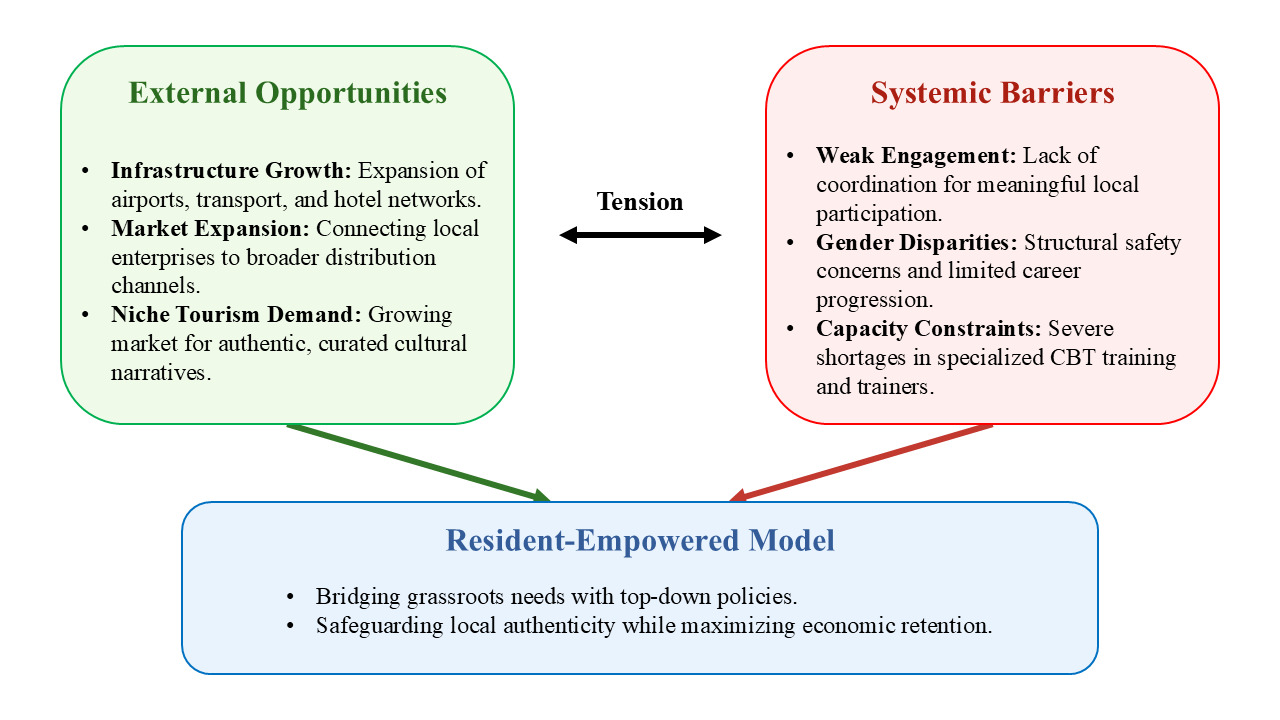
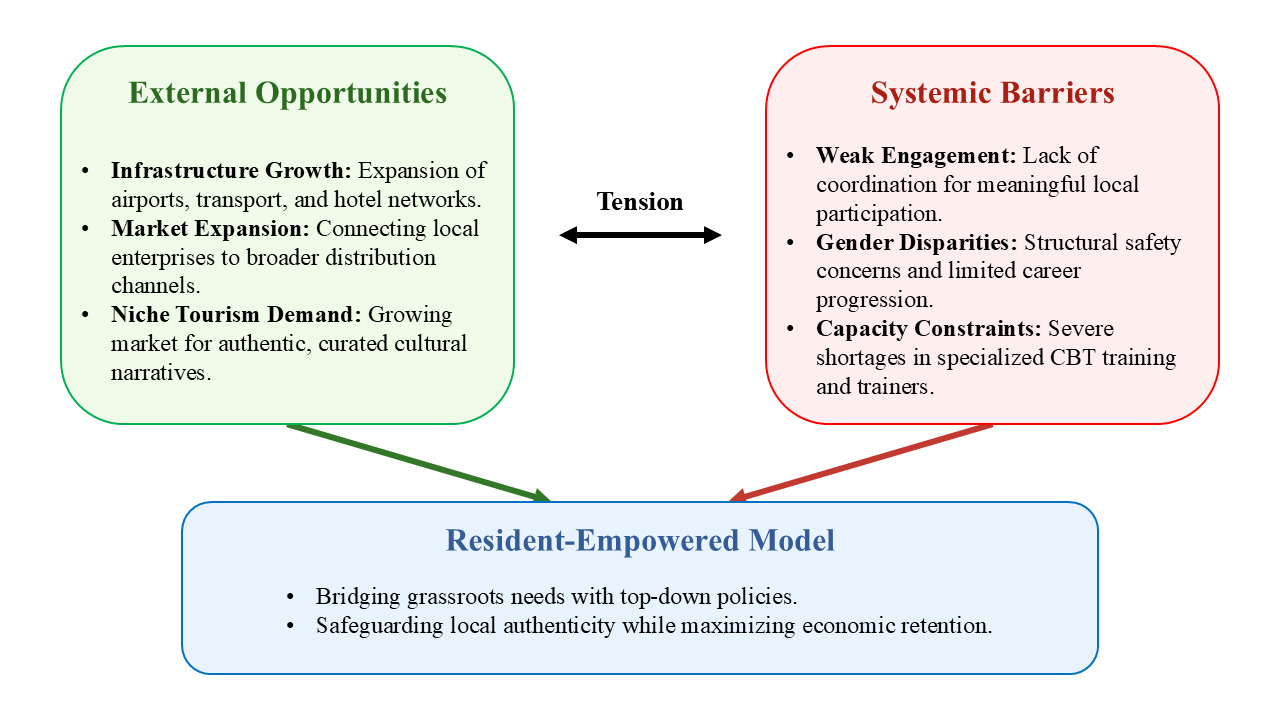
According to Sri Lanka’s recent strategic tourism plans, priority is placed on environmentally sustainable, culturally responsive tourism with stronger public participation. This strategic orientation reflects a growing recognition that earlier growth-first approaches, which emphasized large-scale infrastructure investment and visitor-centered destination development, have often constrained meaningful community involvement and generated uneven local benefits. While these models have supported tourism growth and international visibility, they have also produced challenges for local economies, cultural preservation, and ecosystem management. Figure 1 summarizes the tension between external investment opportunities and systemic barriers, such as revenue leakage and gender gaps, which point to the need for a resident-empowered model.
Learning from South Korea’s Tour Dure Model
South Korea’s Tour Dure (Korean: 관광 두레) initiative shows how public policy can support resident-led tourism businesses. Supported by Korea’s Ministry of Culture, Sports, and Tourism, Tour Dure is a national program that helps residents establish and manage tourism businesses based on their community’s unique resources. Although the term Dure (du-le) historically refers to a farmers’ cooperative, the project adopts its broader connotation of cooperative labor to emphasize shared responsibility and the equitable distribution of tourism benefits among local stakeholders (Kim & Lee, 2020). The program primarily targets rural regions characterized by underdeveloped tourism sectors and aging populations, aiming to stimulate regional tourism and socio-economic revitalization through employment generation (Kang, Ha, & Kim, 2020).
Any adaptation to Sri Lanka must account for important contextual differences. While South Korea has prioritized decentralized governance to strengthen local autonomy (Kim & Lee, 2020), Sri Lanka is only now undergoing a gradual transition from a centralized framework toward decentralized arrangements (Ministry of Finance, 2020). Furthermore, gender disparities and capacity constraints remain more acute in Sri Lanka, where cultural and safety barriers persist despite policy efforts. Unlike Korea’s focus on digital revitalization, the Sri Lankan adaptation must prioritize foundational entrepreneurship and overcoming social barriers to female participation. The most useful lesson from Tour Dure is the Producer role. Producers work with residents to organize community businesses, improve tourism products, set prices, build market knowledge, and coordinate with local authorities and private operators (Kim & Kim, 2018). Taken together, these differences highlight the relevance of Tour Dure for Sri Lanka not as a model to replicate, but as a source of adaptable practices, as summarized in Table 1.
Actionable Strategies to Strengthen Community-Based Tourism in Sri Lanka
Building on lessons from Korea’s Tour Dure model, we propose a set of actionable strategies to strengthen Sri Lanka’s community-based tourism (CBT). Rather than replicating Tour Dure, we identify three key principles that can be localized: (1) education rooted in practical experience and local knowledge, (2) grassroots entrepreneurship as a driver of inclusion, and (3) participatory governance frameworks that align stakeholders around shared goals. Together, these strategies place local communities and micro-entrepreneurs at the center of tourism development and provide a pragmatic pathway for embedding CBT more deeply within Sri Lanka’s tourism economy (see Table 2).
Build Practice-Focused Tourism Skills
Tourism is a multidimensional sector in which effective participation often requires far more than theoretical knowledge. In rural tourism especially, local expertise is shaped by tradition, community leadership, and deep place-based knowledge—domains that are not typically addressed in conventional tourism curricula (Teare, Bandara, & (Chandi) Jayawardena, 2013). To address the disconnect between practice and education, educational strategies should integrate contemporary tourism skills with the preservation of traditional techniques and local cultural knowledge.
In the Sri Lankan context, experiential learning has been strongly shaped by repeated crisis events, such as the tsunami and the COVID-19 pandemic. As highlighted by Adikaram and Surangi (2024), these experiences required adaptive decision-making and practical problem-solving, generating valuable learning for coping with future disruptions in tourism. Embedding such experiential insights into tourism education, through community workshops, mentoring schemes, and applied training, can strengthen local capacity, resilience, and long-term sustainability, particularly in environmentally sensitive rural destinations.
Foster Local Entrepreneurship
Sri Lanka’s tourism strategies have often focused on managerial roles in large hospitality businesses, while giving less attention to grassroots entrepreneurship. Yet fostering entrepreneurship offers a more inclusive and adaptive pathway to local economic empowerment, especially for local micro-businesses and women entrepreneurs. This is particularly important given the cultural and structural barriers that continue to limit their participation in conventional hospitality roles (Perera et al., 2024).
A notable example is Amba Yaalu, a luxury eco-resort in Dambulla that is fully operated by an all-female workforce (Mallawarachi, 2025). By redesigning work structures to address common deterrents such as safety concerns, inflexible schedules, and job insecurity, the initiative demonstrates how culturally sensitive entrepreneurial models can create safer and more flexible opportunities for women in tourism while maintaining high service standards (Samath, 2025). Scaling such models through targeted policy support, training, and funding mechanisms can help embed entrepreneurship as a core mechanism for inclusive tourism development rather than an exception.
Connect Public Support with Local Communities
Local tourism governance refers to how residents and public authorities jointly make decisions about tourism development. In Sri Lanka, however, much tourism activity continues to be dominated by established tour operators, intermediaries, and external agencies that control itineraries, pricing, and distribution channels, limiting communities’ ability to shape offerings or retain value (Jayasundara, Tennakoon, & Wijesundara, 2020). Long-standing contractual arrangements often result in revenue leakage and weak local bargaining power, constraining community empowerment.
To address these constraints, Sri Lanka could adapt Tour Dure’s Producer role. Producers would work with rural residents to turn local cultural, ecological, and everyday-life resources into viable community-owned tourism businesses. Their role would include improving product design, pricing, branding, market access, and coordination with local authorities and private operators. This directly addresses practical barriers facing rural entrepreneurs: limited business capabilities, weak links to buyers and tour operators, fragmented support, and dependence on urban-based operators or externally hired guides. In practical terms, the goal is to help rural communities participate more effectively in Sri Lanka’s tourism economy, retain more value, and gain greater influence over tourism decisions.
Evidence from Sri Lanka indicates that localized businesses such as community-run homestays and village-based experiences in Hiriwadunna are most successful when supported by strong governance structures, marketing access, and fair integration into tourism value chains (Hettiarachchi, 2024). Without such structural support, smaller enterprises continue to face persistent barriers related to branding, market access, financing, and low bargaining power. Strengthening local governance, formalizing community–operator partnerships, and embedding PD roles can help small tourism businesses gain fairer access to Sri Lanka’s tourism economy. These steps can also help communities manage environmental sustainability and cultural preservation more effectively.
Conclusion
South Korea’s Tour Dure initiative offers practical lessons for Sri Lanka: the model should not be replicated wholesale, but its Producer role can be adapted to strengthen community-based tourism. By empowering local communities through practice-focused education, inclusive entrepreneurship, and participatory governance, Sri Lanka can move beyond externally driven tourism toward more culturally grounded and locally embedded development.
These insights may also be useful for other South Asian tourism contexts where rural communities face similar barriers. In India, for instance, deep-rooted patriarchal norms often exclude women from tourism decision-making, despite their foundational economic contributions to local communities (Kala & Bagri, 2018). In Nepal, local communities struggle with revenue leakage to external stakeholders and the exclusion of marginalized groups, which threaten both inclusive growth and cultural preservation (Shrestha, 2025). Similarly, in Bangladesh, indigenous communities with high CBT potential, such as those in Sunamganj, are severely hindered by capacity constraints and a lack of participatory planning (Avi, Bappy, Tripura, Nasrin, & Hossain, 2020).
Across these contexts, the practical lesson is clear: community-based tourism needs more than local enthusiasm or new tourism products. It requires intermediaries who can help residents organize, connect with markets, negotiate with partners, and keep more value locally. For Sri Lanka and similar South Asian contexts, adapting the Producer role can support a shift from externally driven tourism projects toward more resilient, community-led tourism economies.
About the Authors
Hyeyoun Park is an Assistant Professor at Surrey Business School with experience across academia and industry. Her research focuses on cross-border alliances, innovation, diversity, and emerging markets. Before joining Surrey, she worked at the Korea Institute for International Economic Policy and the Korean National Commission for UNESCO, developing expertise in global strategy and business development. She is committed to strengthening collaboration between academia and industry by providing research-informed insights into global strategy, foreign market expansion, innovation, and business development.
Donghyeok Jeong is a Lecturer at the Epsom School of Creative Business, Fashion and Enterprise, University for the Creative Arts. His teaching focuses on business strategy, marketing, decision-making, and leadership in the creative industries. Previously, he worked at the Korea Centre at Coventry University, contributing to academic and cultural events and research activities. His research examines sustainable and innovative business models in creative and tourism industries, particularly how stakeholders respond to technological and cultural change while maintaining competitiveness and cultural relevance.
Isuru Koswatte is a Lecturer at the School of Business and Creative Industries, University of the West of Scotland. His research focuses on organizational resilience, entrepreneurship, and business sustainability. He chairs the UWS Staff Research Forum and supports the British Academy Early Careers Scotland Cluster. He also serves as an External Examiner at Northumbria University and an Adjunct Senior Research Fellow at NSBM Green University, Sri Lanka. In addition, he is a Director at Lakarcade, a leading handicrafts enterprise.