
Introduction
Regional trade agreements (RTAs) are a defining feature of the contemporary global economy. According to the World Trade Organization (WTO, 2026), 382 RTAs are in force, with more than 600 cumulative notifications. Their scope has expanded from tariff reduction to comprehensive frameworks governing trade, investment, regulatory standards, and institutional coordination, increasingly shaping not only trade flows but also the strategic behavior of multinational enterprises (MNEs).
The EU–Mercosur Agreement is one of the most ambitious recent examples of interregional integration. It has just entered into force on a provisional basis, pending final review by EU judicial bodies. Drawing on previous precedents, the European Commission decided to provisionally apply the provisions of the agreement related to trade liberalization. This provisional implementation will allow, starting in May, the gradual elimination of tariffs and the application of relevant trade disciplines.
The onset of these effects will require firms to incorporate the reconfiguration of the EU–Mercosur partnership into their strategic planning. Some sectors will perceive opportunities for exports, while others may identify possibilities for partnerships aimed at investment, technology transfer, and capability building.
By linking the European Union with Mercosur countries Argentina, Brazil, Paraguay, and Uruguay, it creates a market of more than 700 million consumers and a broad framework covering trade in goods and services, investment, intellectual property rights, regulatory cooperation, and sustainable development. While often discussed in trade and political terms, this paper argues it is an institutional driver of FDI reconfiguration, shaping FDI motives, direction, and organization, and reshaping inward and outward investment strategies.
We contend that the EU–Mercosur Agreement generates asymmetric yet interconnected investment dynamics with direct managerial and policy implications. European MNEs are likely to intensify down-market FDI, leveraging Mercosur as a platform for market expansion, production efficiency, natural resources, and in some specific industries, even increasing their asset-seeking strategies. In contrast, Mercosur firms are expected to accelerate up-market FDI into Europe to gain access to advanced technologies, innovation ecosystems, and sustainability standards. As a result, the agreement is expected to redefine how MNEs organize their market approach and build long-term competitive advantage in an increasingly complex global economy. This dual dynamic reflects structural differences between advanced and emerging economies while revealing new pathways of integration through investment.
This paper advances the international business literature in three main ways. First, it reconceptualizes RTAs as institutional platforms that actively shape firm-level investment behavior rather than merely facilitate trade flows. Second, it develops an interregional perspective on bidirectional FDI dynamics between advanced and emerging economies. Third, it links specific agreement pillars to distinct FDI mechanisms, offering an integrative framework for understanding how trade agreements reshape international investment strategies and competitive dynamics.
Literature Review: Regional Trade Integration and Trade Agreements
To assess the implications and dynamic of a RTA, we build on the regional integration literature and bridge it with the International Business approach of FDI. While the former provides the general framework for trade agreement and its impacts, the IB provides the conception of FDI strategies of MNEs.
The multilateral system has focused on regulating international trade and dispute settlement, but the stalemate in the Doha Round has contributed to a shift toward regionalism (Dunning & Lundan, 2008). According to WTO, the Doha Round launched in 2001 is the latest round of trade negotiations among the WTO membership. Its aim is to achieve major reform of the international trading system through the introduction of lower trade barriers and revised trade rules.
Since then, regionalism has expanded across regions, with agreements such as NAFTA, now USMCA, between the United States, Canada, and Mexico in 1994, and Mercosur illustrating a system of open regionalism. According to the WTO (2026), regional trade integration refers to agreements among economies to reduce or eliminate trade barriers on a preferential basis, granting members more favorable conditions than nonmembers within the broader multilateral system.
A foundational contribution to regional integration is Jacob Viner (2014), who introduced trade creation and trade diversion. Trade creation arises when lower cost producers within a bloc replace higher cost domestic producers, improving efficiency and welfare, while trade diversion occurs when imports shift from more efficient external producers to less efficient members due to preferential tariffs. Building on this, Béla Balassa (2013) outlined stages of integration from free trade areas to political unions and distinguished static effects such as trade creation and diversion from dynamic effects including greater investment flows and technological progress.
More recently, scholars highlight the emergence of “new regionalism” (Hettne & Söderbaum, 2007), distinguishing it from earlier forms of integration. While old regionalism, such as postwar European integration, was inward looking, protectionist, and state driven, new regionalism is characterized by openness and integration with global markets. Unlike earlier agreements focused mainly on tariff reductions, modern trade agreements include broader regulatory and institutional provisions, addressing intellectual property rights, investment protection, competition policy, environmental standards, and labor regulations, reflecting deeper and more comprehensive economic integration.
Thus, RTAs as an institutional framework reduce uncertainty, lower transaction costs, and facilitate the movement of goods, services, capital, and knowledge. In this context, the relationship between RTAs and FDI is critical, as trade and FDI often act as complements, especially in vertically integrated production systems. Understanding this relationship requires extending the trade perspective toward a multi-factor perspective of RTA, viewing RTAs as drivers of FDI strategies.
Under this perspective, FDI can be driven by different motives. Dunning and Lundan (2008) identifies four main types of foreign direct investment (FDI): market-seeking, efficiency-seeking, resource-seeking, and strategic-asset-seeking FDI, each reflecting different motivations for multinational enterprises’ (MNEs) international expansion.
Market-seeking FDI aims to serve domestic or regional markets in host countries, often supporting local production and market access. Efficiency-seeking FDI focuses on reducing production costs through the international rationalization of geographically dispersed activities and economies of scale. Resource-seeking FDI is driven by access to raw materials, natural resources, or low-cost labor, frequently linked to export-oriented activities. Finally, strategic-asset-seeking FDI involves acquiring advanced technologies, brands, managerial capabilities, or innovation assets through investments such as mergers, acquisitions, joint ventures, or greenfield operations, with the objective of strengthening long-term competitiveness.
However, the surge of MNEs from emerging economies offers the opportunity to distinguish between FDI from developed to emerging economies (here called down market FDI), and FDI from emerging economies in developed economies (here called up-market FDI) (Ramamurti & Singh, 2009).
Down-market FDI refers to investments undertaken by firms from advanced economies into emerging or less-developed markets to exploit cost advantages, access growing consumer markets, secure natural resources, or improve production efficiency. This type of investment is commonly associated with market-seeking, efficiency-seeking, and resource-seeking motives. In the context of the EU–Mercosur relationship, European MNEs may engage in down-market FDI by relocating production, expanding regional operations, or accessing lower-cost inputs in Mercosur countries.
Up-market FDI refers to investments undertaken by firms from emerging economies into advanced economies to access strategic assets such as technology, innovation ecosystems, and advanced institutions. This type of investment is strongly linked to strategic-asset-seeking motives and capability upgrading. In the EU–Mercosur context, Mercosur firms may pursue up-market FDI in Europe to enhance competitiveness, gain legitimacy, and integrate into higher-value segments of global markets.
While strategic asset-seeking has become one of the principal explanations for OFDI by emerging market multinational enterprises (EMNEs), it represents only one of several internationalization motives driving investments abroad. Extending this perspective, EMNEs internationalize not only to exploit existing firm-specific advantages but also to augment capabilities, overcome home-country competitive constraints, access new markets, acquire knowledge, and strengthen their long-term competitiveness through international expansion (Cuervo-Cazurra, Narula, & Un, 2015).
In the context of Mercosur firms investing in the European Union, these motivations may coexist and reinforce one another. Beyond acquiring strategic assets, firms may establish subsidiaries, warehousing and distribution facilities, logistics platforms, sales offices, and customer service operations to support and expand their exports within the European market, suggesting a “sell more” approach (Cuervo-Cazurra et al., 2015) aimed at strengthening market presence and increasing sales in the region.
Such investments improve coordination with downstream partners, reduce transaction and distribution costs, enhance responsiveness to customer needs, and facilitate compliance with local regulations, thereby increasing export competitiveness. Consequently, OFDI should be understood as a multifaceted internationalization strategy in which Mercosur firms simultaneously exploit existing advantages, support their commercial activities abroad, and augment capabilities through exposure to advanced institutional and competitive environments. This perspective is particularly relevant in light of recent evidence on trade agreements, which suggests that integration processes can generate both efficiency gains and asymmetric regional outcomes. These findings highlight the importance of complementary regional coordination and policy frameworks to ensure that the benefits of economic integration are more broadly and evenly distributed across participating and non-participating economies (Arte, 2025).
The EU-Mercosur Trade Agreement
Mercosur is the principal regional integration initiative in South America, established by the Treaty of Asunción in 1991, signed by Argentina, Brazil, Paraguay, and Uruguay to promote economic integration through trade liberalization, macroeconomic coordination, and the gradual creation of a common market. Conceived in the context of post Cold War regionalism and market-oriented reforms, Mercosur aimed to move from a preferential trade arrangement to a customs union through the elimination of internal tariffs and adoption of a common external tariff. More recently, it has pursued external partnerships, notably with the EU, reflecting a shift toward interregionalism to enhance competitiveness and attract foreign investment.
Negotiations between the two regions began in 1999 and led to a political agreement in 2019 after nearly two decades. On 3 September 2025, the European Commission adopted proposals for Council decisions on the signature and conclusion of the EU-Mercosur Partnership Agreement (EMPA) and the interim Trade Agreement iTA (European Commission, 2026). On 9 January 2026, the Council authorized their signature, and on 17 January 2026, both agreements were signed.
The goals of the EU Mercosur trade deal are (European Commission, 2026):
-
to increase bilateral trade and investment, and lower tariff and non-tariff trade barriers - notably for small and medium-sized enterprises;
-
to create more stable and predictable rules for trade and investment through better and stronger rules, e.g. in the area of intellectual property rights (including geographical indications), food safety standards, competition and good regulatory practices, and;
-
to promote shared values and sustainable development, including by strengthening worker’s rights, fighting climate change, ensuring environmental protection, and encouraging responsible business conduct.
Its main pillars include:
-
Trade in goods (tariff reduction and market access)
-
Trade in services and establishment
-
Investment and public procurement
-
Regulatory cooperation and non-tariff measures
-
Intellectual property rights (IPR)
-
Competition policy and state-owned enterprises
-
Trade and sustainable development
-
Dispute settlement
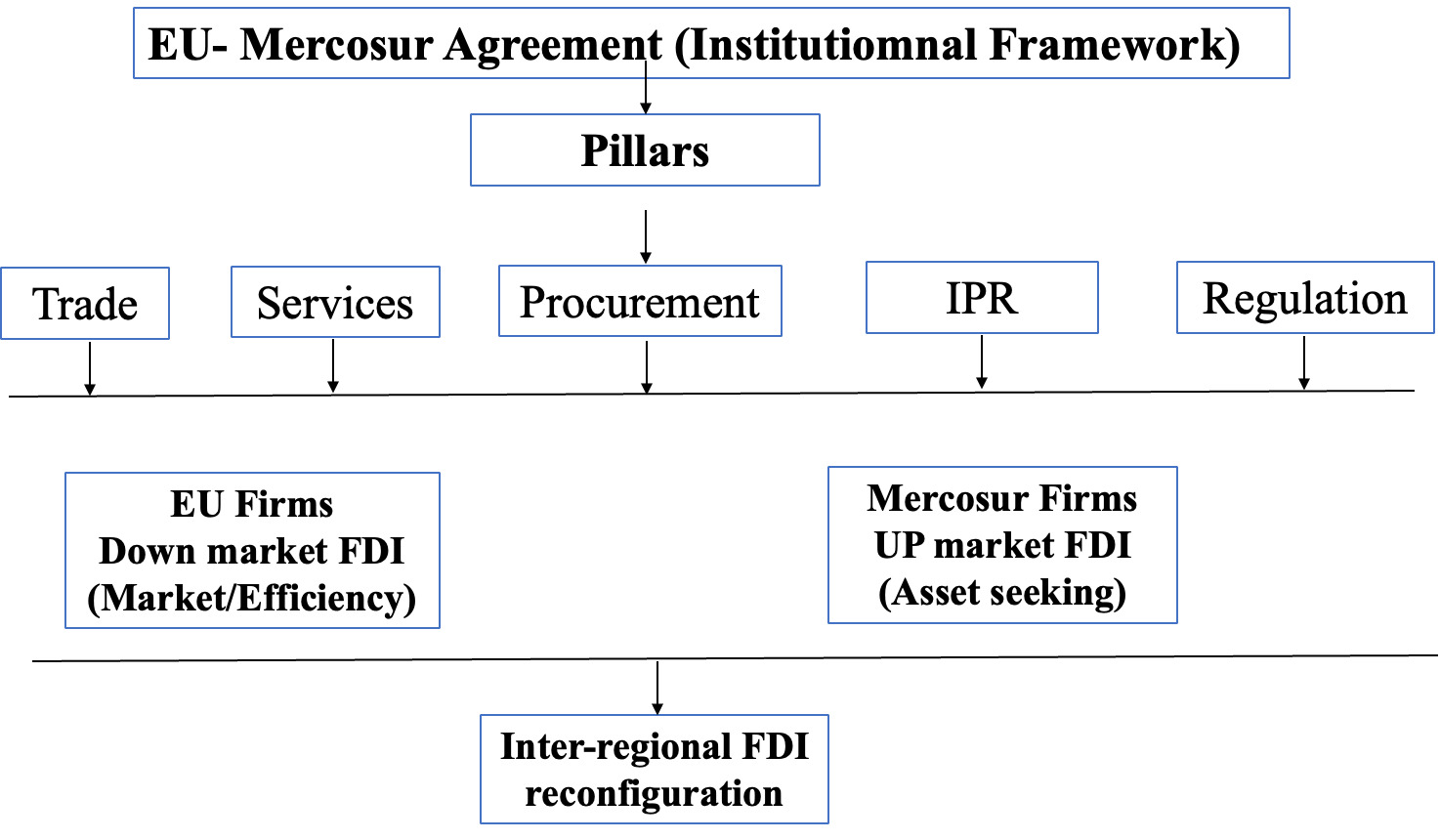
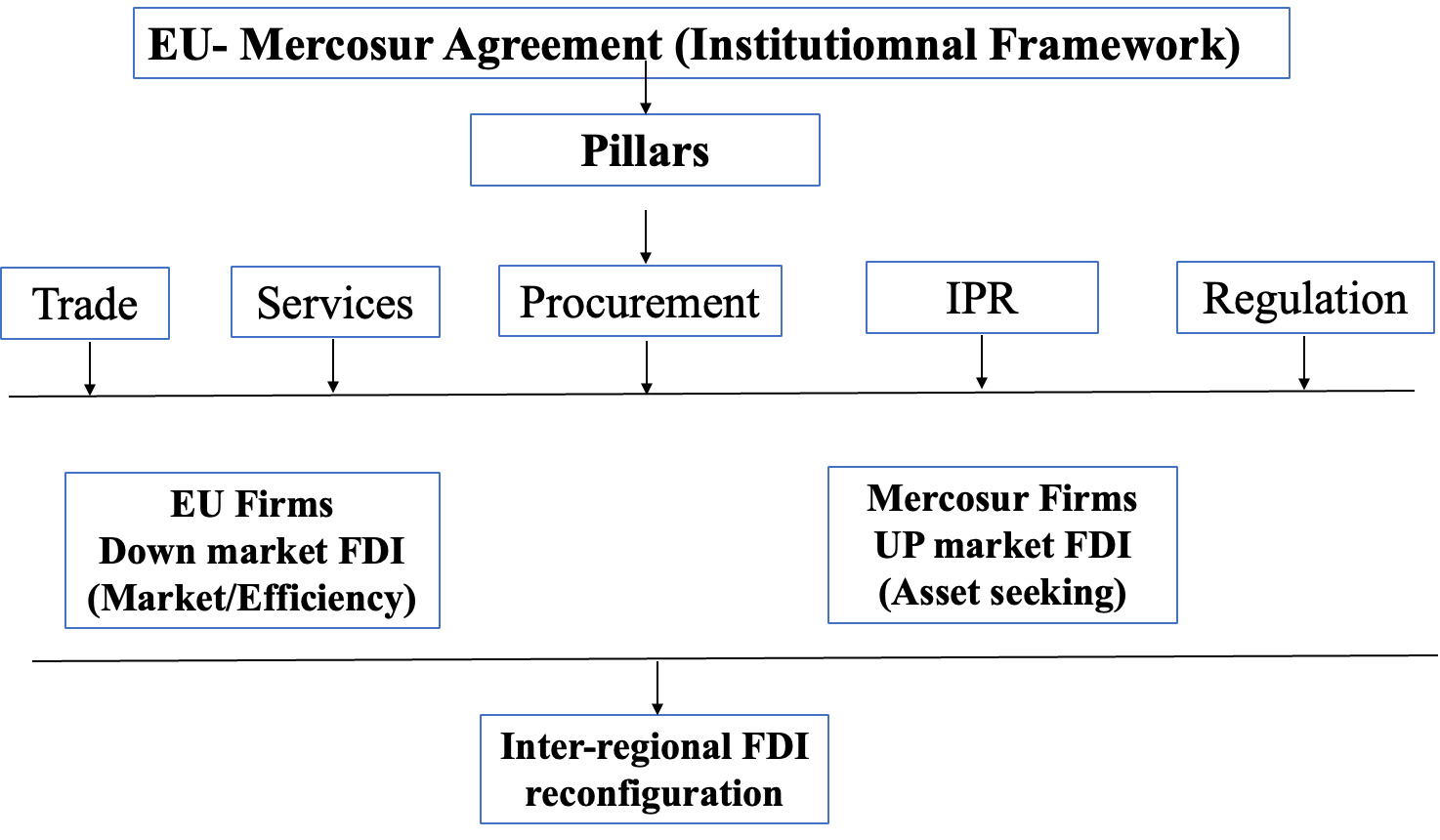
Together, these provisions create a rules-based institutional environment that enhances predictability and reduces uncertainty for firms operating across regions. Importantly, the agreement does not simply liberalize trade—it reshapes the conditions under which occurs the reconfiguration of inter-regional FDI. Figure 1 provides the general pillars of the agreement and its implications for down market and up-market FDI.
RTAs and International Business
From the perspective of international business, regional trade agreements play a critical role in shaping the strategic behavior of MNEs. Trade liberalization reduces transaction costs, expands market access, and increases opportunities for cross-border investment. Firms often respond to these changes by adjusting their market entry strategies, reorganizing supply chains, and expanding FDI activities. The presence of stable institutional frameworks and predictable regulatory environments further encourages firms to engage in long-term investment planning.
To capture these effects, we conceptualize the EU–Mercosur agreement as a driver of inter-regional FDI strategies. A key feature of this framework is the distinction between down-market and up-market FDI (Ramamurti & Singh, 2009), reflecting directional asymmetries between advanced and emerging economies.
A key implication of the agreement is the potential and context building of dual and interconnected investment strategies by MNEs. This refers to the idea that MNEs from different regions pursue distinct, yet mutually related, FDI strategies within the same integration framework. In the context of the EU–Mercosur Agreement, the “dual” dimension reflects the existence of two different directions and motivations of investment. European firms tend to engage in down-market FDI in Mercosur countries, seeking larger consumer markets, lower production costs, natural resources, and regional production platforms. In contrast, Mercosur firms pursue up-market FDI in Europe, aiming to access advanced technologies, innovation ecosystems, brands, managerial capabilities, and sophisticated markets.
These strategies are “interconnected” because they are part of the same broader process of economic integration. Investments from one region influence opportunities, competitive dynamics, supply chains, and strategic responses in the other region. For example, European investment in Mercosur may strengthen local supplier networks and export capabilities, while Mercosur firms investing in Europe may acquire strategic assets that later enhance their competitiveness at home or in third markets.
Thus, the concept highlights that international investment under regional agreements is not a one-way process, but a reciprocal and interdependent dynamic in which firms from advanced and emerging economies occupy different but complementary positions within global and regional value chains.
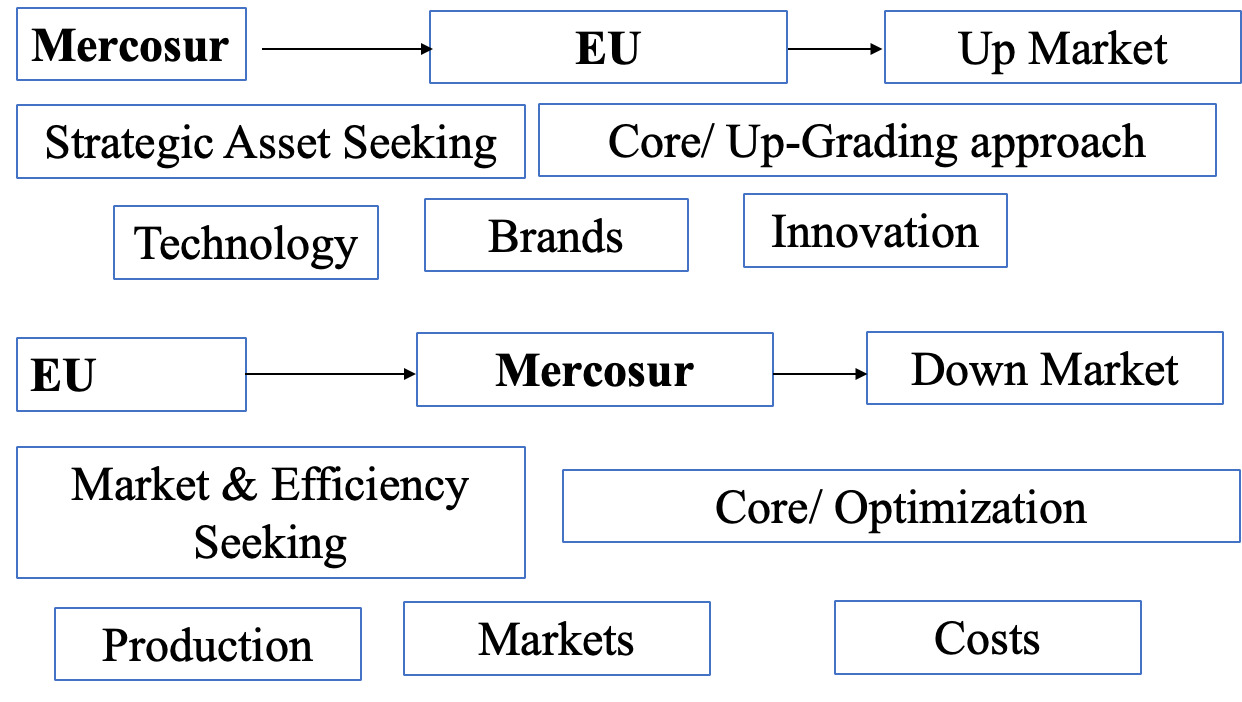
We argue that the direction of FDI systematically reflects underlying asymmetries between the two blocks. Down-market FDI, predominantly undertaken by advanced economy firms, is driven by market- and efficiency-seeking motives and reinforces existing production hierarchies. Figure 2 displays the mechanism of FDI dynamics and shows the differences between down-market and up-market FDI.
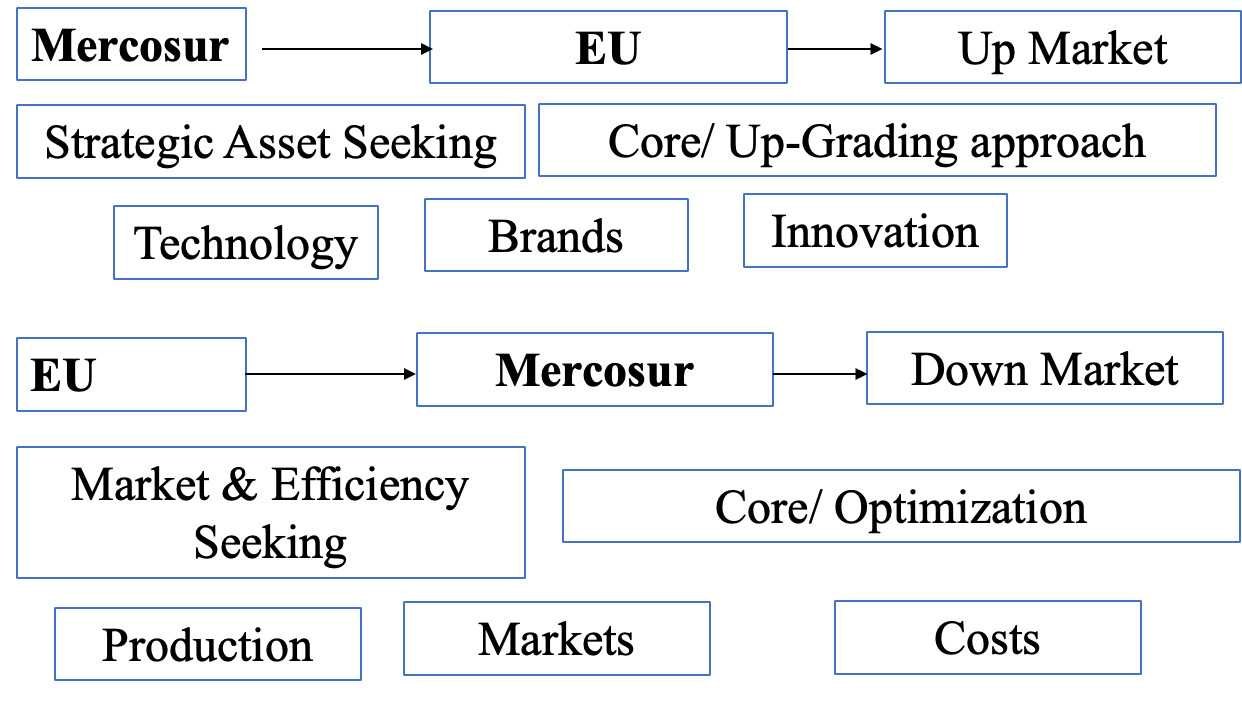
From a down-market FDI perspective (EU → Mercosur), European firms expand into Mercosur markets primarily to: (i) Access growing consumer markets (market-seeking FDI), (ii) Exploit cost advantages (efficiency-seeking FDI) and, (iii) Integrate local production into global value chains.
This type of FDI is consistent with the logic of production fragmentation, where firms tend to choose low-cost location for their upstream and support activities and select locations closer to the customer for their downstream activities.
From an up-market FDI perspective (Mercosur → EU), Mercosur firms, in contrast, are likely to internationalize toward Europe to: (i) Access advanced markets and distribution channels, (ii) Acquire strategic assets (technology, brands, knowledge) and, (iii) Upgrade their position within global value chains.
Here, FDI serves as a mechanism of capability building, allowing firms to overcome domestic constraints and move into higher value-added activities (Amal, Floriani, & Sosa Varela, 2024).
While the agreement represents a general framework for MNEs to assess their investment strategies, in this paper we explore how each pillar of the agreement can shape their FDI motives and strategic responses to this new context (Table 1).
Trade in Goods: Rebalancing Trade and FDI
Tariff liberalization reduces trade costs but does not eliminate the need for local production. Instead, it reshapes the trade–FDI relationship. The impacts of trade on FDI are not linear. While the reduction or elimination of trade tariffs tends to increase exports and, it can also encourage FDI aimed at supporting exports and building distribution networks". In some specific sectors, however, such a process can imply a substitution for FDI, reducing the need for local production because lower tariffs facilitate producing from home and then exporting. This suggests that, in such an agreement, trade can drive more FDI in some sectors than in others.
For European firms, lower tariffs reinforce market-seeking and efficiency-seeking FDI, particularly in sectors requiring proximity to consumers or integration with local suppliers even though some costs of doing business are quite high in Mercosur (e.g., labor-related charges (although salaries are usually lower), low productivity, complex taxation system, bureaucracy (e.g., to obtain permits), slow judiciary system.
For Mercosur firms, improved access to EU markets encourages outward FDI aimed at supporting exports and building distribution networks.
Services Liberalization: Expanding Capability-Based Investment
The liberalization of services markets reduces regulatory barriers and facilitates cross-border operations in sectors such as finance, telecommunications, and logistics. European firms are more likely to expand service-sector FDI in Mercosur seeking for market expansion while Mercosur firms gain opportunities to invest in knowledge-intensive sectors in Europe. Over time, this supports a shift toward capability-driven internationalization of Mercosur Multinationals.
From the perspective of Mercosur firms, firms invest in the European Union to acquire advanced technologies, managerial know-how, brands, and innovation capabilities. However, services liberalization also facilitates asset-exploiting FDI by reducing barriers to the international transfer of firms’ existing ownership advantages. In this context, liberalization should not be viewed solely as a mechanism for expanding trade in services; it also enables firms to internationalize by leveraging transferable firm-specific advantages, including proprietary business models, digital platforms, organizational routines, and customer relationship capabilities. Such investments are primarily market-seeking, allowing firms to establish a commercial presence that supports customer acquisition, service delivery, and the replication of successful business models in foreign markets.
Brazilian fintech companies, such as Nubank, EBANX, StoneCo, and PagSeguro, illustrate this phenomenon. Having developed internationally competitive capabilities in digital banking, instant payments, customer-centric financial services, and low-cost operating models within Brazil’s sophisticated digital financial ecosystem, these firms may expand into European markets not only to acquire strategic assets but also to exploit and replicate their proven business models.
Public Procurement: FDI as Market Access Strategy
The inclusion of public procurement provisions creates strong incentives for firms to establish a local presence.
The agreement offers the opportunities for public-private partnerships in Mercosur, particularly regarding investments in infrastructure (e.g., highways, ports, airports, sanitation, water supply). Also, the potential benefit of lowering corruption in public procurement, given the much more stringent EU regulation and monitoring.
European firms are likely than to invest in Mercosur to access infrastructure and government contracts, while Mercosur firms may gradually increase participation in EU procurement markets. This pillar reinforces market-seeking FDI and promotes institutional upgrading.
Intellectual Property Rights: Enabling Strategic Asset Flows
Stronger IPR protection reduces uncertainty in technology-intensive sectors and facilitates the transfer of knowledge. As a result, European firms are more likely to invest in innovation-related activities in Mercosur, leading to spillovers for local firms in terms of their strategies to develop and protect their intellectual property assets.
Strengthened IPR protection under the EU–Mercosur Agreement may influence international business relationships through channels that extend beyond FDI. From an internalization perspective, firms prefer to retain ownership of proprietary technologies when intellectual assets are vulnerable to imitation or contractual enforcement is weak. Improvements in IPR protection reduce these risks by strengthening the legal protection of patents, trademarks, industrial designs, and proprietary knowledge, thereby lowering transaction costs associated with cross-border technology exchange. As a result, European firms may become more willing to license technologies, proprietary production processes, software, and brands to Mercosur firms rather than relying exclusively on wholly owned subsidiaries. Likewise, stronger IPR regimes can facilitate original equipment manufacturing (OEM) arrangements, in which Mercosur firms manufacture products designed and owned by European companies under contractual agreements. Such governance structures enable European firms to exploit cost and production advantages in Mercosur while maintaining control over their intellectual assets, and they provide Mercosur firms with access to advanced technologies, production know-how, and integration into global value chains.
Thus, while Mercosur firms are encouraged to pursue strategic asset-seeking FDI in Europe, this dynamic also encourages reciprocal upgrading processes. This pillar is central, both to enabling up-market internationalization and to reconfiguring the down-market approach.
Regulatory Cooperation: Supporting Value Chain Integration
Regulatory convergence refers to the alignment of rules, standards, and procedures between countries. By reducing differences in technical regulations, certification requirements, customs procedures, and investment rules, it lowers non-tariff barriers and decreases the costs and uncertainty associated with operating across borders.
As a result, firms are better able to coordinate activities internationally, which encourages vertical FDI and the fragmentation of production processes across multiple countries. Instead of concentrating all activities in a single location, multinational enterprises (MNEs) can allocate different stages of the value chain—such as raw material sourcing, manufacturing, assembly, logistics, and marketing—to countries offering specific advantages in terms of costs, resources, capabilities, or market access.
However, this integration process is not symmetrical. Firms and countries tend to occupy different positions within global and regional value chains according to their technological capabilities, productivity levels, and institutional development.
Investment Framework: Reducing Uncertainty
Through the process of internalizing the EU-Mercosur agreement provisions into domestic law, we may expect a context of improved legal support and transparency that enhances the attractiveness of cross-border investment. This pillar supports both inward and outward FDI by reducing risks and enabling long-term strategic commitments.
Taken together, these dynamics suggest that the EU–Mercosur agreement not only increases cross-border investment, but also reconfigures FDI motives across regions, creating a mirror effect between efficiency-driven and asset-seeking internationalization.
The EU–Mercosur Agreement reshapes FDI not through isolated policy channels, but via a set of interrelated pillars that jointly generate incentives, constraints, and strategic signals. As shown in Table 2, each pillar is associated with distinct—yet often overlapping—FDI logics. Empirical evidence suggests that European multinationals do not respond through single-motive investments; rather, firms combine market-, efficiency-, and strategic asset-seeking behaviors in anticipatory ways. For instance, Stellantis’ regional production integration and upstream investments in critical minerals illustrate how trade, investment, and regulatory dimensions interact to produce hybrid strategies. Similarly, TotalEnergies’ infrastructure investments reflect the convergence of resource-seeking and geopolitical considerations, while adjustments by Carrefour highlight the constraining role of sustainability provisions.
Conclusions
This study shows that the EU–Mercosur Agreement operates as a multidimensional institutional framework that generates asymmetric and dynamic investment responses across regions. Rather than producing uniform outcomes, the agreement creates differentiated opportunity structures that firms interpret and act upon according to their capabilities and strategic positioning. At the same time, the agreement remains politically and institutionally contested.
Important sectors within the European Union, particularly agribusiness groups in countries such as France and Poland, have expressed concerns regarding increased competition from Mercosur exports in industries such as beef, poultry, and sugar. In parallel, several European governments and civil society actors have raised concerns about environmental governance, deforestation, and the enforcement of sustainability standards in Mercosur countries. These criticisms reinforce that the agreement extends beyond economic integration, involving broader tensions related to regulatory convergence, environmental legitimacy, and the social sustainability of regional integration processes.
From a managerial perspective, the findings highlight that trade agreements should be approached as forward-looking strategic signals, not merely as legal instruments. European MNEs demonstrate the value of anticipatory investments, combining market-, efficiency-, and asset-seeking motives to secure early advantages in regional production systems and strategic resources. In contrast, Mercosur MNEs must treat expansion into the EU as a capability-upgrading process, where success depends on the ability to meet stringent regulatory and sustainability standards while leveraging advanced markets for learning and innovation.
Firms should adopt coherent strategic pathways, distinguishing between market-driven and technology-driven upgrading trajectories. Across both directions, the evidence underscores that competitive advantage lies less in the choice of location and more in the firm’s ability to sustain growth through hybrid investments. Moreover, the growing relevance of environmental and ESG-related requirements suggests that firms increasingly need to integrate sustainability capabilities into their internationalization strategies to maintain legitimacy and long-term competitiveness across regions.
From a policy perspective, the results suggest that the effectiveness of trade agreements depends on their ability to enable investment, not just liberalize trade. Policymakers should therefore prioritize stable investment frameworks, regulatory cooperation, and intellectual property protection mechanisms, which are critical for attracting long-term, asset-seeking FDI. At the same time, the asymmetric effects of the agreement call for differentiated policy approaches. For Mercosur countries, this implies strengthening domestic capabilities through investments in innovation systems, standards compliance, environmental governance, and export upgrading programs, ensuring that local firms can fully benefit from access to advanced markets. For European policymakers, balancing competitiveness concerns in sensitive sectors with broader strategic and geopolitical interests will remain essential for sustaining political support for the agreement. This perspective is consistent with Arte (2025), who argues that while the India–UK Free Trade Agreement may foster supply-chain integration and economic opportunities, it may also generate uneven regional outcomes, thereby reinforcing the need for stronger regional coordination and complementary policy frameworks to ensure that the benefits of integration are more broadly distributed.
On the other hand, despite the advantages of a process of harmonization and alignment in a context of inter-regional agreement, firms should adapt their strategies to institutional variations across the member states as pointed by Fon et al (2025) in the case of African regional trade integration. This suggests that firms also should conduct their market entry strategies to the unique institutional environment of each country and the changing process of regional integration toward an institutional context of harmonization mechanisms of regulating investment and IP provisions (Carls & Amal, 2026).
Finally, deeper intra-Mercosur coordination and investment in regional infrastructure are essential to position the bloc as an integrated and attractive platform for global investors.
Acknowledgements
We would like to thank the AIB Insights Editor, Professor Desislava Dikova, and the two anonymous reviewers for their insightful comments and constructive feedback, which have helped us improve the manuscript.
About the Authors
Mohamed Amal is a Professor of Economics and International Business at the Regional University of Blumenau (FURB) and University of Vale Itajaí (Univali) - Brazil, specializing in Multinational Enterprises and Foreign Direct investment in emerging economies, with special focus on the geopolitical tensions and global changes on their regional strategies. Visiting professor at Bournemouth University.
Suelen Carls is a Senior Lecturer in Intellectual Property Law with a Doctorate in Law from the Federal University of Santa Catarina and research experience at the University of Oxford. Former Senior Research Fellow at the Max Planck Institute, currently at Bournemouth University and WIPO Academy expert. Research focuses on intellectual property with emphasis on Latin American emerging economies.
Henrique Correa da Cunha is an Associate Professor in the Global Management Studies program at the Ted Rogers School of Management at Toronto Metropolitan University. His research focuses on the factors that influence the internationalization of multinational firms in Latin America.