
Introduction
In October 2025, the Royal Swedish Academy of Sciences awarded the Nobel Prize in Economic Sciences to Joel Mokyr, Philippe Aghion, and Peter Howitt for work on innovation-driven economic growth and creative destruction. Beyond its macroeconomic implications, the award underscores a point central to international business. When environments shift, executives must not simply react to disruption, they also need to create new paths through it.
That insight is important because foreign entry decisions remain affected by uncertainty. Executives rarely choose how to enter foreign markets by simply analyzing numbers or optimizing transaction costs (Schotter & Beamish, 2013). In reality, entry mode decisions are also shaped by experience, interpretation, and – in some cases – creativity. Yet the dominant conversation still frames these decisions primarily as organization-level trade-offs among cost, control, and risk (Brouthers & Hennart, 2007). That perspective has generated important insights, but it does not explain how managers inside firms interpret uncertainty and actively shape the option set before an entry mode decision is made.
A microfoundations – managerial focused – perspective helps open that black box. Put simply, microfoundations research explains how individual judgments and actions combine to produce effective organizational outcomes (Felin & Foss, 2005; Santangelo, Phene, Coviello, Tung, & Felin, 2024) when hard data do not tell the entire story. This perspective is especially useful for understanding internationalization processes, almost always marked by heightened uncertainty. Here decisions emerge from analysis, imagination, dialogue, and organizational sensemaking as the managerial microfoundations of the decision process. Recent empirical research shows that organizational creativity is a managerial microfoundation underlying firms’ international business competence and performance (de Vasconcellos, Parente, Schotter, Garrido, & Gonçalo, 2024). We build on that insight and argue that creativity is both an individual-level trait and an outcome of organizational innovation. It is a strategic process that helps firms imagine, evaluate, and commit to international entry choices.
Our contribution is straightforward. Using Coleman’s (1984) framework, we trace a five-step cascade from individual creative sparks to firm-level strategic commitments. The model shows how external stimuli influence individual cognition, how ideas are then socially validated in teams, and how they are translated into organizational decisions. In doing so, we recast the most effective entry mode decision processes as a creativity-enabled, human-centric process that complements rather than replaces traditional economic logic.
Coleman’s Framework for Linking Creativity to International Strategy
Understanding how creativity drives international entry decisions requires a model that connects individual insight to organizational outcomes. Coleman’s framework (1984), sometimes called Coleman’s Boat, offers that bridge. Originally developed in sociology, the model explains how broad external forces influence individual behavior, which then aggregates into collective action in three linked movements.
First, macro-level conditions such as global competition, institutional complexity, geopolitical shifts, or technological disruption shape how managers perceive the situational context and decision issues at hand. Second, managers respond through creative cognition, generating ideas, imagining alternatives, and reframing what might be possible in a specific foreign target market. Third, first ideas are being refined through collaboration and social validation, then evolving into specific firm-level strategies such as alliances, acquisitions, platform-based, or escalating ownership entry strategies. What appears at the end as a logical, often purely transactional, risk-weighting organizational decision begins as an individual act of reframing complex external uncertainties into viable, creativity-powered alternative options.
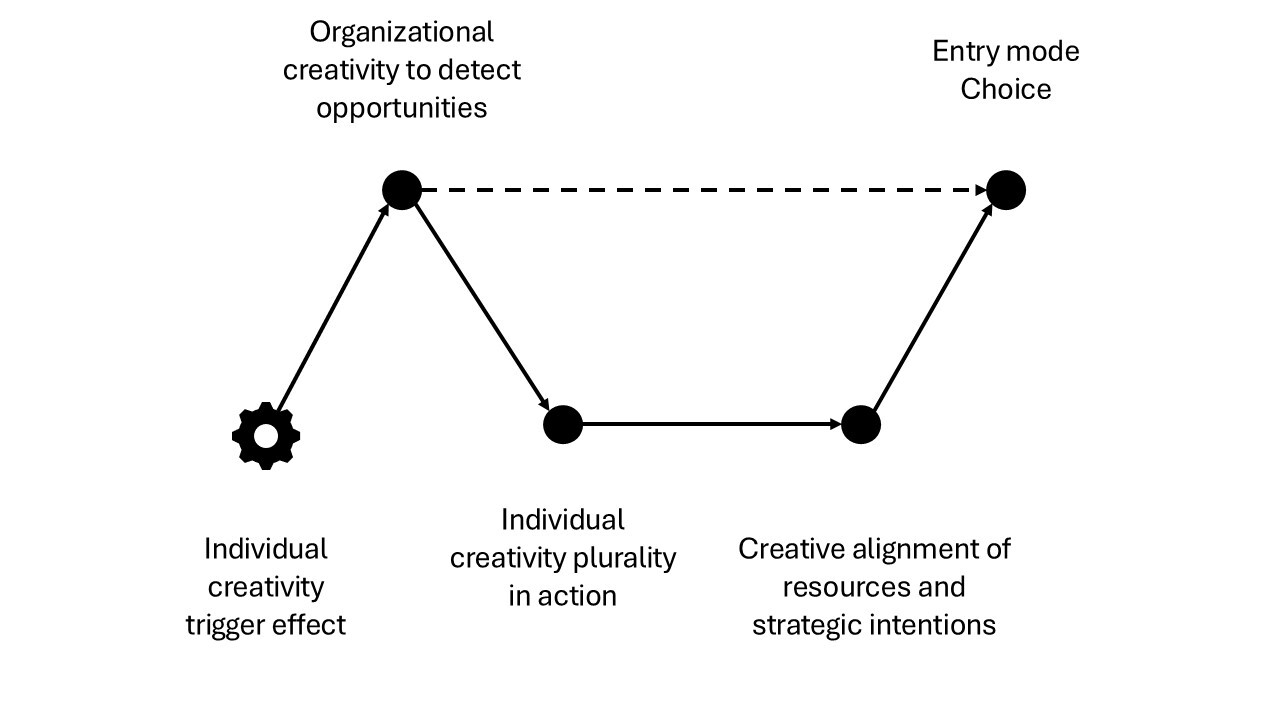
Think of it this way: Macro-level conditions such as global competition, institutional complexity and variation, geopolitical shifts, or technological disruption shape how individual managers interpret the world. This triggers micro-level action, i.e., managers respond through attention, interpretation, and imagination, generating creative entry options beyond organizationally proven ones. This process is then followed by micro-to-macro aggregation at the firm level. Here ideas are discussed, refined, and converted into an organizational commitment that is jointly recognized as appropriate. This movement is what turns individual insights into an organizational strategic choice. Figure 1 illustrates this five-step process cascade. Rather than a linear decision process, the model highlights entry mode decision processes as dynamic, socially constructed, and shaped by creativity under uncertainty.
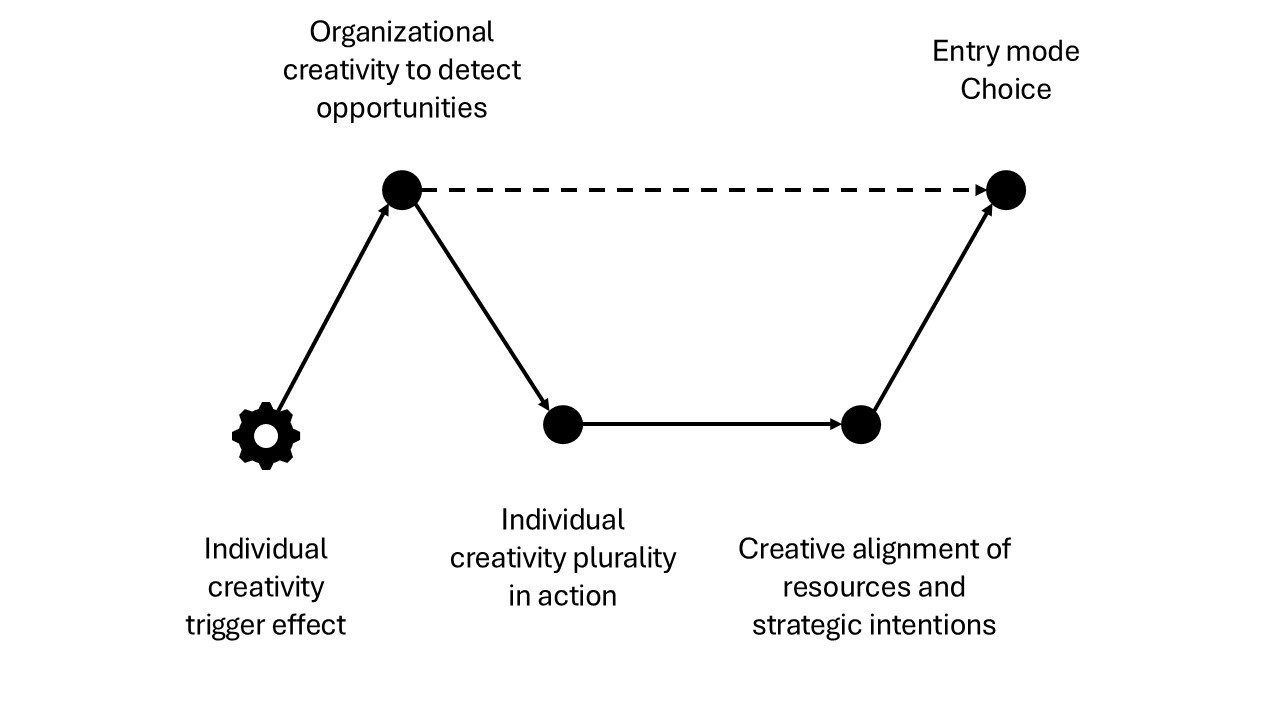
To make the logic tangible, consider a brief illustration, e.g., a sudden geopolitically motivated trade disruption challenges a firm’s established export model. In response, a creative-thinking manager proposes an unconventional joint venture with a digital platform firm. The idea gains traction through internal debate, then is mapped against the firm’s capabilities, and finally becomes a credible entry strategy, one that was not even considered before. What looked like a firm-level decision at the end began as an individual creative spark.
Creativity connects with capability development when actively considered as an initiating resource that helps firms identify what they possess, what they must develop, and how they can combine those into a feasible new entry path. Creativity, in this sense, should not be viewed as just a ‘nice to have’ option; instead, it should be part of the mechanism through which managerial teams create novel strategies.
However, novelty alone is not enough. An idea may be imaginative yet strategically incoherent, politically unsupported inside the firm, or misaligned with the capabilities required for execution. That is why the middle stages of the cascade matter so much. Collective validation forces an idea to confront operational facts, governance constraints, and financial realities. Shared framing prevents the firm from confusing a clever workaround with a scalable strategy. Configuration disciplines imagination by asking whether and how the proposed path can be staffed, governed, and adapted over time.
From Individual Creativity to Entry Mode Choice: The Five-Step Cascade
Rather than treating creativity as a black box, the five-step cascade specifies how ideas are triggered, socially shaped, and strategically configured into concrete entry choices.
Step 1: The Individual Creative Spark – The Trigger
Every process begins with individual insight, a creative spark. Managers activate creativity when they face ambiguous information, unfamiliar institutional conditions, or disrupted industry assumptions. At this stage, creativity allows them to reframe institutional voids, channel barriers, or regulatory complexity not as obstacles but also as opportunities for imaginative recombination. For an international entry decision, manager may ask whether a partner, platform, phased commitment, or other alternative path could make a specific foreign entry viable over the firm’s preferred or previously tried options.
This first step matters because firms rarely discover new entry paths without someone first seeing the problem differently. Creativity here is goal-directed rather than abstract—it is directed toward a concrete strategic challenge and expands the set of serious options the firm can consider.
Step 2: From Ideas to Organizational Creativity – Firm Level Validation
Individual creativity becomes impactful only when others engage with it. At the firm level, managerial interactions transform individual ideas into shared meaning through dialogue, reflection, and feedback. This is where creativity becomes an organizational process rather than merely an individual managerial one (Woodman, Sawyer, & Griffin, 1993). In international contexts, this multi-actor validation also serves as a sensing capability, that helps interpret external signals, question assumptions, and create additional options. Here, cross-functional discussions are essential. Multi-actor validation does not simply filter out weak proposals; it often improves promising ones by adding realism, identifying blind spots, and clarifying the conditions under which the idea could work.
Step 3: Integrating Creative Plurality – Building Shared Strategic Frames
At this stage, multiple individual contributions converge into a collective sensemaking process. Managers, specialists, and international teams exchange and align their viewpoints, transforming diversity into collective direction. From here the organization begins to build a shared strategic frame – a common understanding of the opportunity, the most important constraints, and the design principles that should guide the final entry mode decision.
This step is critical because firms often fail not from a lack of ideas but from a lack of alignment around what those ideas mean. A creative process does not suppress differences in perspective; it channels them. When the organization develops a shared frame, it can move beyond individual suggestions and begin coordinating action across functions.
Step 4: Configuring Creative Entry Alternatives – From Possibilities to Prototypes
In Step 4, the creativity supported process becomes architectural and integrative. Managers synthesize and validate shared strategic options into tangible strategic configurations that fit the target country and the firm’s capabilities. Here, creativity acts as a strategic connector, aligning existing resources and capabilities with what the firm needs to acquire or build, and what it seeks to achieve.
Step 5: Entry Mode Choice – The Creative Organizational Outcome
The final step converts creativity into firm level strategic commitment. At this stage, the organization combines individual level ideas, social validation, shared framing, and strategic design into a specific entry decision. The process also establishes feedback loops. As firms gain experience abroad, learning cycles reignite the creativity process for future ventures. Creativity therefore does not stop at the entry decision point – it persists as a guiding force for adaptation and renewal. That ongoing interaction between imagination, judgment, and experience helps explain why some firms repeatedly discover workable novel entry paths in difficult settings while others rely on prior templates, that may be ill-fitting.
Taken together, the five-step cascade recasts entry mode choice as a microfoundational managerial creativity supported process inside the firm. That reframing is valuable because it explains how successful international strategies (de Vasconcellos, Garrido, & Parente, 2019) are constructed when the environment is too uncertain or novel for routine templates to suffice. It also clarifies why some firms discover workable entry paths that others never see. The significance of the five steps is demonstrated in a brief example.
Imagine a firm whose export model depends on distributors that suddenly become unreliable after a policy shift, for example through erratic tariff actions of the destination country’s government, like in the case of the 2025 US government under President Trump. A conventional response would be to delay entry or accept a weaker market position. A creativity-enabled response starts differently. One manager sees the disruption as an opportunity to redesign the route to market through a local platform partner, limited in-country coordination, and a staged investment path. The team then tests whether the partner can deliver reach, whether the governance structure protects knowledge, whether the economics improve after learning, and whether the configuration fits the firm’s broader regional strategy. By the time the firm commits, the question is no longer whether exporting is preferable to a subsidiary in the abstract. The question is which tailored configuration best supports learning, control, and – importantly – flexibility and speed to market.
Creativity and intuition are related but distinct throughout this process. Creativity is generative, as it expands the set of possible entry paths by producing novel combinations that the firm had not previously considered. Intuition is evaluative, as it helps managers make rapid judgments about which paths deserve commitment when evidence remains incomplete. The two are complements rather than opposites. In uncertain foreign markets, firms often need creativity first to widen the option set and intuition later to decide which option should be pursued. Recent research on intuition and rationality shows that effective strategic judgment depends on how organizations combine analysis with experience-based judgment, rather than treating them as mutually exclusive (Zimmermann, de Vasconcellos, Faccin, Tontini, & Parente, 2025).
Managerial Implications
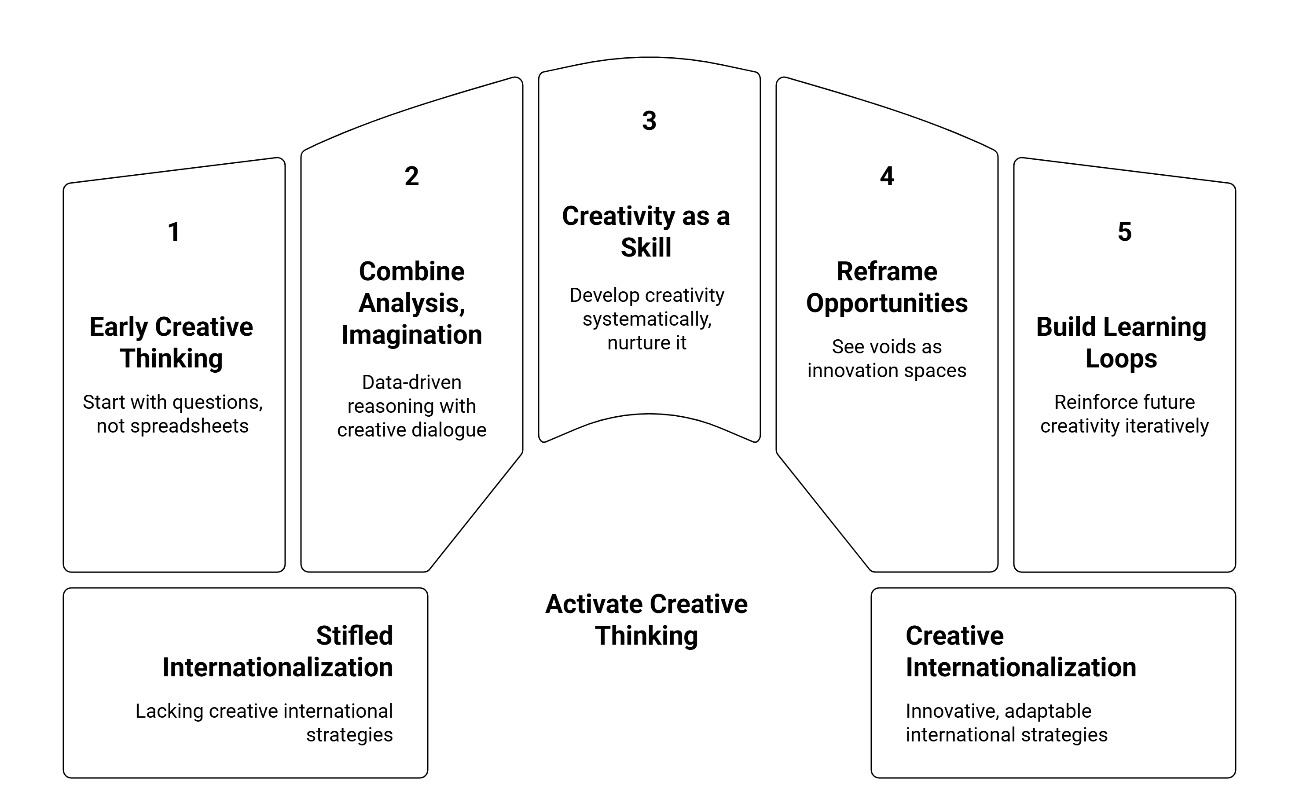
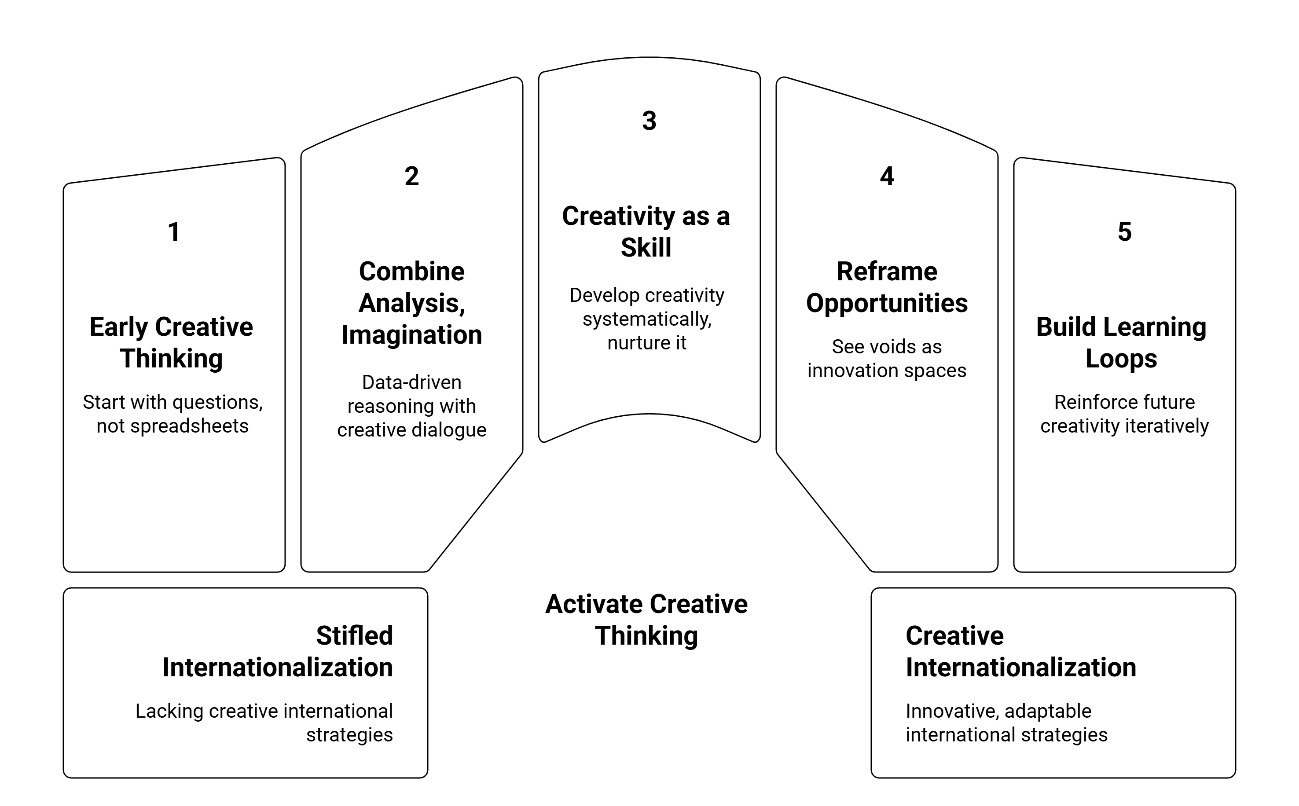
If creativity influences how firms decide to enter foreign markets, then international strategy must be crafted through both economic analysis and imagination. Our framework translates this logic into five practical lessons for managers seeking to strengthen international entry decisions.
Lesson 1: Activate Creative Thinking Early in International Planning
Entry mode decisions often start with spreadsheets and risk matrices, but they should begin with questions. Before deciding how to enter a market, managers should ask which and how could different entry modes shape the firm’s evolution, which unconventional options might be available, and which constraints might be remodeled rather than merely accepted for the decision. Techniques such as reframing exercises, “what if” sessions, scenario projections, or temporary creative labs can expand the option set before economic evaluation narrows it.
Lesson 2: Combine Analytical Rigor with Collaborative Imagination
Data-driven reasoning remains vital, but it is stronger when combined with creative dialogue. Cross-functional workshops in which marketing, operations, finance, legal, and digital teams jointly explore entry scenarios enable richer and more balanced solutions. They also reduce the risk that a clever idea will prove operationally naïve or financially brittle once the firm commits.
Lesson 3: Treat Creativity as a Skill, Not a Personality Trait
Organizational creativity can be developed and deployed systematically. Managers can nurture it through deliberate practice, prototyping, structured challenge sessions, and retrospective reviews of previous market entries. Treating creativity as a capability embedded in routines makes it more transferable across teams and markets and reduces the tendency to rely on a few unusually imaginative individuals.
Lesson 4: Reframe and Prototype Rather Than Treat Entry Mode Categories as Fixed Boxes
Under uncertainty, the best path is often neither a standard export model nor an immediate wholly owned subsidiary. It may be a staged design that balances learning, speed, and commitment over time. Managers should therefore ask – in addition to which entry mode to choose at the get go – how to configure and sequence it along the way when things evolve. A creativity-enabled flexibility focused entry design often preserves optionality by creating room to learn, deepen commitment, and redirect if local conditions change.
Prototype thinking and simulations are especially important to assess how things may unfold over time. A licensing arrangement can become a joint venture; a platform partnership can become partial ownership; a minority stake can become a fuller commitment once the firm has learned how the market works. Creativity helps managers design these sequences deliberately instead of drifting into them by chance. That is often the difference between an adaptive entry path and a costly all in.
Lesson 5: Build Learning Loops That Reinforce Creativity
Every entry decision offers material for organizational innovation. Post-entry reviews should focus on both, economic performance metrics and on the creative processes that led to success or failure. Executives should ask (a) which assumptions were reframed successfully, (b) where collective validation added value, and (c) which design choices proved more adaptive than expected. Intentional learning loops strengthen future entry decisions.
Leadership matters throughout the cascade. Senior managers shape whether unusual entry ideas will be entertained. When leaders invite reframing, tolerate constructive challenge, and reward thoughtful experimentation, they increase the odds that the firm will discover options that conventional decision-making processes would miss. When leaders over-specify and provide only room for limited answers, the discussion narrows before a genuinely workable option can emerge.
Figure 2 illustrates the cascade. It shows creativity as the bridge between individual cognition and firm-level internationalization outcomes while emphasizing that the process does not end with the initial decision. Creative entry processes generate feedback loops through learning, adaptation, and recombination.
Managers should also know when creativity matters most. Its influence is most relevant under high uncertainty, institutional voids, technological disruption, or digital and platform-based entry contexts, where established templates offer limited guidance. In familiar markets with stable institutions and well-known pathways, more analytical and experience-based approaches may be sufficient. The implication is not that creativity should replace economic reasoning, but that it should complement and enrich it when traditional analyses alone cannot generate optimal pathways.
Today, these lessons are especially relevant for internationalizing through digital channels, ecosystems, or partner-heavy models. In such contexts, the quality of the decision depends as much on design and sequencing as on ownership structures. Managers need to decide what to own, what to access through partners, what to learn first, and where to preserve flexibility. Creativity adds value precisely because it helps treat entry mode as a configurable system rather than a black or white static economic optimization decision.
Conclusion
With this article we argue for adding creativity to international entry mode decision processes. Inspired by the 2025 Nobel Prize in Economic Sciences, we apply the logic of innovation and creative destruction from a micro foundational view to international strategy. In complex environments, successful international expansion depends on accessing cost, control, and risk, but equally importantly on the creativity of managers who imagine new combinations of partners, platforms, sequencing, and ownership structures.
We argue that creativity is not an indulgence reserved for innovators. It is a strategic discipline that helps firms navigate uncertainty, reconfigure resources, and sustain competitiveness across borders.
Ultimately, firms that succeed internationally do not simply predict the future better. They shape it more effectively through the entry paths they design, validate, and adapt over time.
This argument does not imply that every internationalization decision needs radical novelty. In many familiar markets, analytical routines and accumulated experience may be sufficient. The practical challenge is to recognize when the environment is uncertain enough that firms must do more than compare standard templates. Under those conditions, the discipline of creativity becomes a source of strategic advantage.
About the Authors
Sílvio Luís de Vasconcellos is a Full Professor in the Graduate Program in Business Administration at ESPM in São Paulo, Brazil. His research has been published in leading journals, including Long Range Planning, Global Strategy Journal, International Business Review, Journal of International Management, and The Journal of Technology Transfer. His research interests include organizational creativity, internationalization processes, innovation ecosystems, effectuation, and process research, with particular emphasis on how organizations develop and mobilize resources and capabilities under conditions of uncertainty and institutional polycentrism.
Andreas Schotter is the BMO Endowed Professor of International Business at the Ivey Business School at Western University, Canada, and Professor of International Business at the Vienna University of Economics and Business (WU) and a Visiting Professor at the University of Economics, Prague, Czech Republic. He was named a John H. Dunning Fellow at the Henley Business School at University of Reading. His research interests are MNE development and evolution, boundary spanning leadership, the Future of Work, and the internationalization of digital firms.