
Introduction
In a bilateral trade decoupling crisis or trade war, both a firm’s supply chains and its destination markets are at stake (Cui, Vertinsky, Wang, & Zhou, 2023). Yet, while much of the current conversation on geopolitical risk focuses on securing supply chains (Witt, Lewin, Li, & Gaur, 2023) and on the flexibility that allows firms to redeploy assets as conditions turn hostile (Ma, 2025), the question of how companies deal with the complete disappearance of demand remains largely unanswered. This oversight prompts the critical question of what happens when a firm’s most vital export market is suddenly blocked through a politically driven collapse.
So far, little has been studied about firm strategies when geopolitical risk materializes into market loss (e.g., Crosignani, Han, Macchiavelli, & Silva, 2026). However, since 2009, hundreds of Colombian firms have had to improvise a strategic repertoire in this exact situation. Before 2009, Venezuela was their natural market, the second-largest destination for Colombian exports, and the primary market for value-added goods, accounting for 10 percent of Colombia’s total trade (Bolivar & Maza-Avila, 2022). By 2017, that bilateral trade had plummeted to 0.7 percent, leaving these companies scrambling to survive.
This article provides insights into how firms face a trade decoupling crisis that causes a demand-side shock. Our findings are grounded in a qualitative case study of the 2009 Colombia–Venezuela trade collapse. Drawing on the characteristics of the crisis our informants faced and their reported strategic actions, we propose a three-phase process model of survive-adapt-thrive. Advancement through this process is associated with the firms’ initial asset exposure and with the strength of their resilience capabilities, resulting in four distinct strategic archetypes.
Study Approach
This article draws on a case study of Colombian firms that held heavy exposure to the Venezuelan market when bilateral trade peaked in 2009. Customs export records identify 347 such firms, which together accounted for 80 percent of the bilateral export volume during the peak period and whose export and financial trajectories we followed through 2023. To extract the strategic mechanisms behind their outcomes, we then conducted 22 in-depth interviews with executives and regional directors across food, textiles, chemicals, construction materials, personal care, paper, automotive and logistics, reading each account against the firm’s own export record and against contemporaneous press coverage of the crisis. Appendix A reports the procedure in full.
Framework of Firm Resilience in Trade Decoupling Shocks
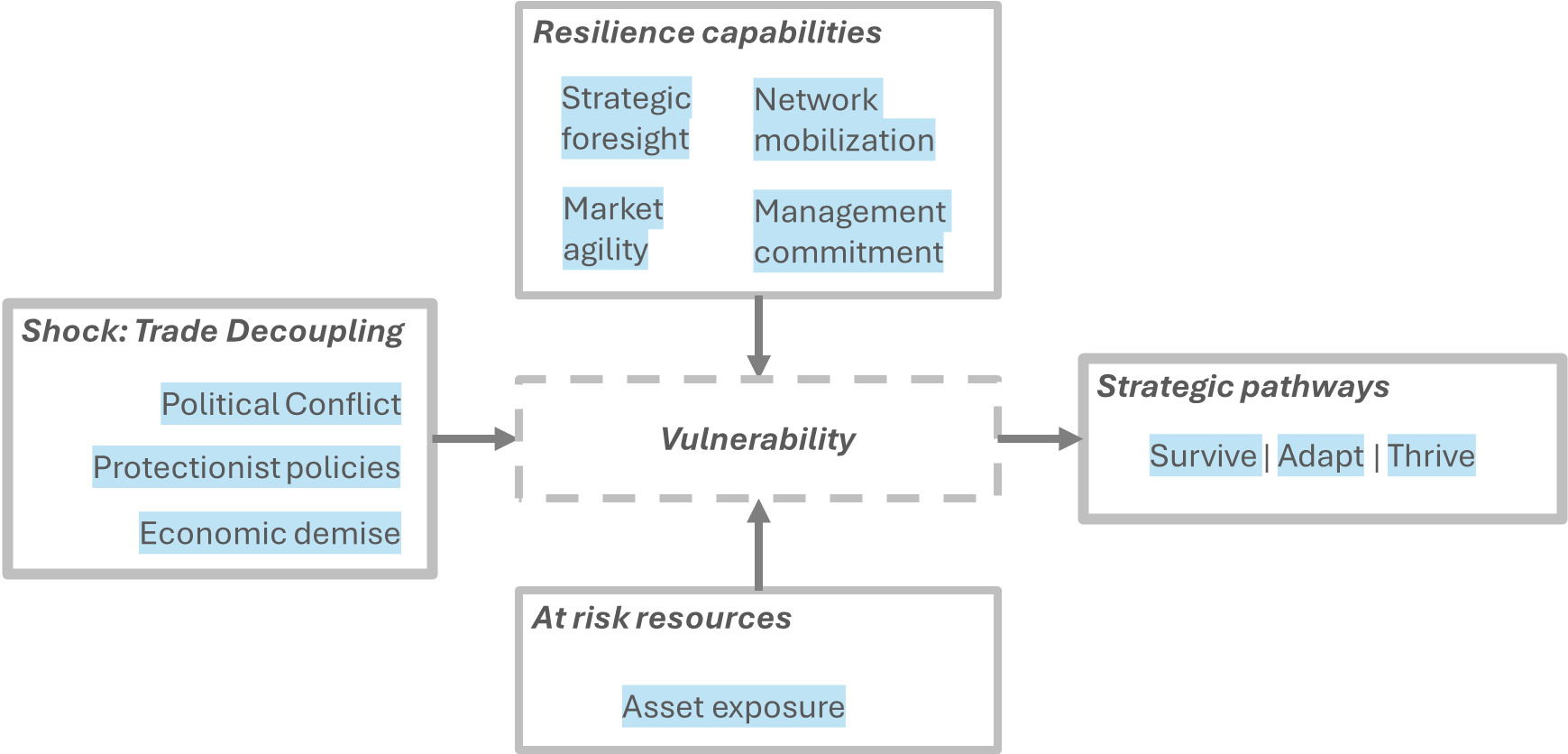
Following Eden (2024), we conceptualize the crisis experienced by firms as a severe institutional shock that triggers existential vulnerability and exposes the firm to an imminent loss of market access. As illustrated in Figure 1, Eden’s framework suggests that a firm’s capacity to strategize amid this vulnerability is moderated by both the resilience capabilities and the at-risk resources. In our model, we account for the firm’s level of asset exposure, and we break down resilience capabilities into four core categories based on informants’ responses.
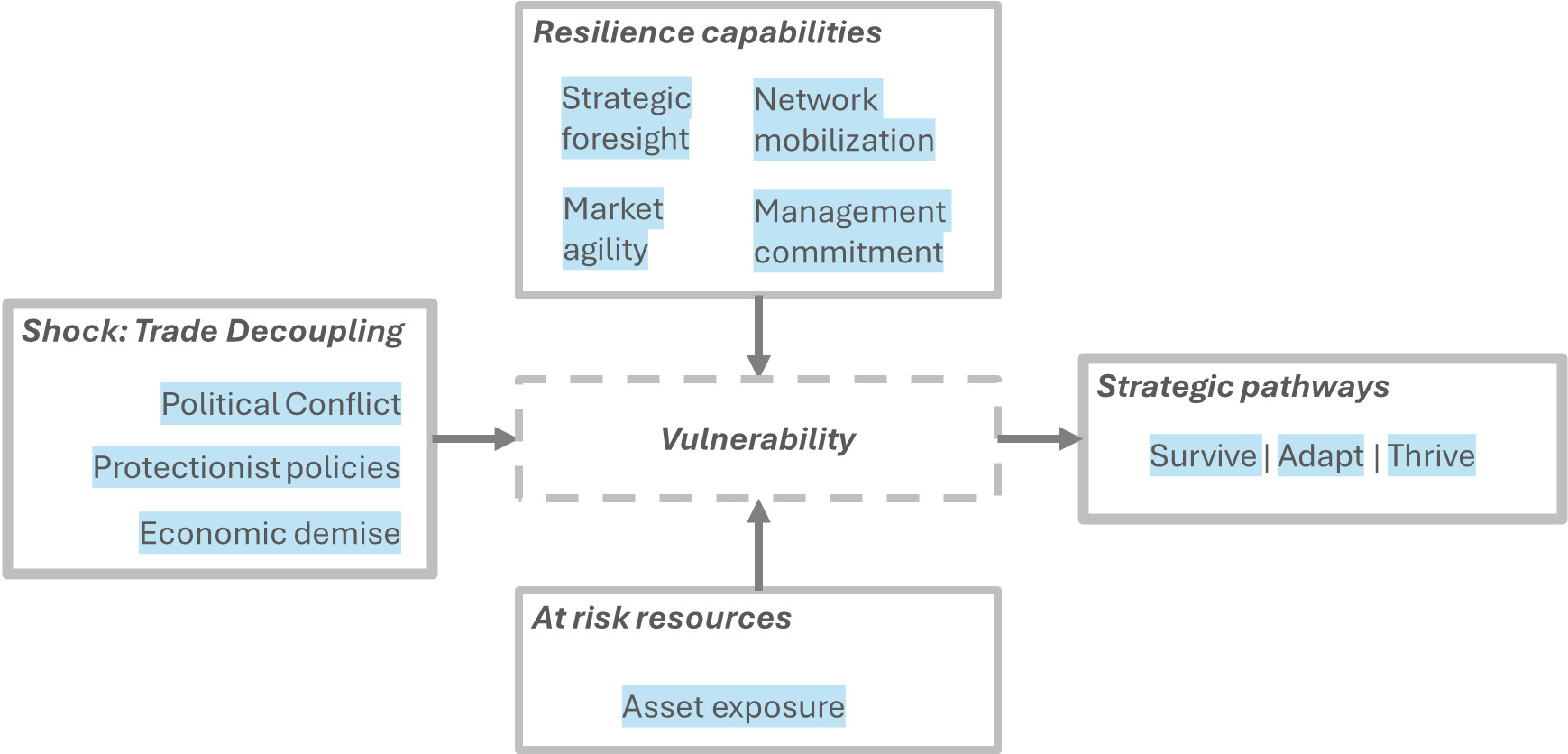
The trade decoupling shock experienced by Colombian firms mirrors contemporary geopolitical fractures, where economic efficiency is subordinated to geopolitical drivers. In contexts ranging from the U.S.–China rivalry to the Japan–Korea trade dispute to the Colombia–Venezuela rupture, political hostility replaces stable institutional frameworks with aggressive state interventionism, manifesting through tariffs, export controls, and the weaponized interdependence of state actors (Kim, 2021; Petricevic & Teece, 2019). These shifts force multinational enterprises to adapt rapidly to survive the sudden loss of supply networks and market access.
The pattern has grown more familiar since. Successive rounds of tariff escalation through the 2020s again place destination markets, rather than supply networks alone, at the center of corporate risk assessment, leaving firms that depend on a single large buyer market with the question the Colombian exporters faced in 2009, namely whether to defend the position, leave it deliberately, or rebuild demand elsewhere (Ma, 2025).
The Colombia–Venezuela case, however, presents extreme stressors that compounded this demand-side shock. The crisis was characterized by restrictive currency schemes like the CADIVI system (Hausmann, 2017; Vera, 2017), which blocked revenue repatriation, alongside Venezuela’s withdrawal from the Andean Community and frequent border closures. Coupled with arbitrary expropriations, pervasive physical insecurity, and hyperinflation, these institutional failures transformed a once-profitable market into an existential liability, representing a uniquely severe manifestation of the decoupling phenomenon (Bolivar & Maza-Avila, 2022).
Firm Capabilities for Resilience
As a decoupling crisis unfolds, our evidence indicates that four core organizational capabilities arise to form the engine of resilience. Building this engine before trade fragmentation occurs allows firms to respond once they find themselves in a position of vulnerability.
Strategic Foresight
This involves the capacity to act on weak signals from the future of the geopolitical landscape (Iden, Methlie, & Christensen, 2017). Respondents described this as an active intelligence process that spans scanning the environment, interpreting early warnings, and converting anticipation into concrete pre-commitments that discipline exposure and prepare the firm’s finances for adversity. A ceramic-tile company exemplified this by identifying early risks and preemptively exploring Central American markets.
Market Agility
This is the capability to quickly make sense of market changes and take offensive action to adapt the firm’s value proposition and logistics (Kalaignanam, Tuli, Kushwaha, Lee, & Gal, 2021; Teece, Pisano, & Shuen, 1997). However, such short-notice transformations incur steep financial costs, meaning this agility is constrained by the firm’s available capital and resources. Our interviewees emphasized the need for extreme logistical flexibility to bypass institutional breakdown. When borders closed, one paint manufacturer shifted freight to alternative corridors and completely restructured shipping schemes. Companies in the food or services sector, for instance, practiced agility by systematically tailoring products and service structures to align with the specific demands of new local market realities.
Network Mobilization
This dimension extends organizational social capital into a dynamic ability to mobilize their networks of organizational, political, and social ties (Gallego, Casanueva, & Barrera, 2026; Kwon & Adler, 2014). In volatile markets where formal contracts provide little protection, our respondents found that trust-based relationships became the primary mechanism for managing commercial uncertainty. This involves cultural immersion and engagement with bilateral chambers of commerce. As seen with a hygiene products company, this capability includes rigorous due diligence to ensure partners in the network avoid money laundering and other legal risks.
Management Commitment
This is the enduring commitment to a strategic vision for the market and long-term principles amid market turbulence (Wilson, 1992). This commitment manifests, for instance, in a dairy producer’s resolve to keep operating in the market amid extreme circumstances such as slow payment flows, political turmoil, and government-fixed prices, to the point of becoming the only milk brand on supermarket shelves in Venezuela. It can also act as a stabilizing force during chaos. For example, another packaged-food company resisted the temptation of informal smuggling trails used by competitors, instead deploying legal teams to ensure absolute transparency.
Phases of Resilience and Capabilities Deployment
Firms first assemble their resilience capabilities ahead of the rupture, then activate and deploy them as the crisis progresses from specific trade barriers to structural separation, and then to a new long-term context. We specify this process in Table 1, which describes firms’ strategic deployment amid crisis management and resilience efforts (Seville, 2017).
Pre-crisis: Anticipate the Rupture
Some firms showed strategic foresight before the crisis was evident, and this early foresight conditioned their actions and performance. Firms that acted on weak geopolitical signals entered the rupture already prepared. A chemical products firm, for instance, imposed collection discipline by halting shipments until debts cleared, and a paper products firm secured credit in local currency so that devaluation would neutralize the firm’s obligations. Network mobilization and management commitment were likewise meaningful in this phase, as durable local ties and a long-term posture toward the market were built ahead while formal conditions still held.
Phase 1: Survive the Immediate Rupture
During the initial rupture, firms faced immediate financial risk. The primary deal-breaker for Colombian exporters was the inability to get paid, as a dairy firm executive noted: the worst situation was being unable to repatriate invested capital. At this stage, the strategic foresight capability deployed in advance paid off, since the financial firewalls and diversified instruments assembled before the peak contained the contagion. Simultaneously, as overnight volatility eroded formal contracts, network mobilization capability allowed the crisis response, since intelligence from local, non-transactional relationships became the firm’s reliable guidance system. This phase required empowering country managers with autonomy and rewarding a deep understanding of local social dynamics over simple statistics. While firms that institutionalized this tacit understanding of local dynamics gained the footing to advance, others remained in stagnant survival.
Phase 2: Adapt during Structural Change
Once immediate instability was mitigated, firms faced the imperative to evolve for new market-access conditions and the political climate. Managers pursuing diversification often found that value-added products successful in Venezuela struggled in markets like Brazil because of different price structures and local competition. Therefore, market agility became the capability most called upon in this phase. Some firms re-engineered products and business models through co-creation with local partners, while management commitment reinforced the shift by designating leaders to tackle the assumption that what worked in one market would carry over to the next. Market agility also manifested in understanding the market dynamics. Learning that political volatility was a permanent market climate allowed firms to develop the political judgment required to operate amid disorder, and detecting the optimal windows for strategic execution allowed some firms to exit deliberately, without outstanding debt. Hence, those that integrated non-economic risk analysis and war-gaming created favorable conditions to advance, whereas firms with limited agility to retool fell into a position of diminishing returns.
Phase 3: Thrive for the Long Term
The final phase involves using the shock as a catalyst for market diversification. Our evidence points to the vulnerability created by market concentration. Among firms whose only export market was Venezuela in 2009, 97 percent had ceased all exporting within five years of the collapse; among the 347 most exposed firms, 120 had ceased exporting entirely by 2023. This vulnerability was exemplified by a firm that realized too late that a disproportionate reliance on a single market is a strategic blind spot. Network mobilization was the capability most associated with this phase, since the depth of market, political, and social ties distinguished the firms that converted heavy exposure into opportunity rather than liability. Yet firms leveraged management commitment to capture the gains. Leading firms began managing their market portfolios like investment portfolios, utilized lightweight entry models and digital channels to lower the cost of experimentation, and remapped post-collapse ecosystems through zero-based analysis, treating even familiar territories as new countries. These practices supported more resilient operational and financial architectures, leaving the crisis as a lasting corrective toward diversified, institutionalized resilience.
Strategic Responses and Evolutionary Pathways
Drawing on Eden’s (2024) framework, the scope and success of firms’ responses depend on the interplay between the at-risk resources represented in asset exposure within the market and the strength of the resilience engine associated with the firm’s progression through the survive-adapt-thrive continuum (Seville, 2017). As illustrated in Table 2, these dynamics yield four distinct archetypes that showcase whether firms fail at the rupture, stall at survival, or advance to adaptation and long-term thriving. Strong and weak resilience capabilities refer to the firm’s overall configuration rather than to any single capability, so a firm with a weak configuration may hold one capability as a strength, while a firm with a strong configuration may still have one that remains underdeveloped. All four capabilities remain valuable across every profile, but their leverage varies; strong capabilities may drive a firm forward, whereas a single underdeveloped capability indicates where a firm stalls.
Unwillingly Exiting Firms
Low asset exposure and weak resilience capabilities. Holding neither sunk costs to defend nor the capacity to redeploy, these firms let their export activity lapse rather than ending it through a decision, resulting in arrested export survival. Limited management commitment leaves the resilience process unstarted, while limited market agility and network mobilization leave them without an alternative destination once Venezuelan demand falls away, so these firms depart from international activity altogether.
Defender Firms
High asset exposure and weak resilience capabilities. Heavy financial exposure gives these firms strong reasons to stay, and management commitment, together with a degree of strategic foresight, allows them to build protection around what they have already committed. They do this through, for instance, tightened payment terms, advance or triangulated payments, stricter distributor screening, or hardened compliance parameters. These moves aim to mitigate immediate losses and maintain a reduced market presence, yet firms often remain trapped in long-term stagnation, since products and business models stay largely unchanged and their engagement narrows over time to a smaller set of customers and products. The resilience capabilities of these firms can be considered a weak configuration because market agility, the capability that generates new market alternatives, remains underdeveloped and marks a binding constraint.
Pivoting Firms
Low asset exposure and strong resilience capabilities. Unburdened by heavy assets, pivoters can use market agility and strategic foresight to reduce commitment on their own terms, time their withdrawal, collect outstanding receivables before leaving, and redirect capacity toward Central America, other third markets, or the domestic market. For these firms, exit is a deliberate reallocation of resources rather than a failure to respond. However, they may be limited in a different sense, since few remaining ties inside the decoupled market can provide little standing to re-enter as conditions later shift, and network mobilization inside that market generates the constraint.
Thriving Firms
High asset exposure and strong resilience capabilities. These firms integrate market and non-market strategy (Baron, 1995). Network mobilization supplies intelligence and standing as formal contracts lose force; market agility allows them to re-engineer products, packaging and logistics for a market with far less purchasing power; and management commitment holds the long-term position while conditions deteriorate. They operate under considerable institutional ambiguity while maintaining sanctions, anti-corruption and partner-vetting controls, and several of them rebuild a wider portfolio out of the disruption, transforming a regional shock into a resilient, diversified architecture. All four capabilities are important for this configuration to create the setting for holding agency in the market selection as well as to capture value amid the bilateral decoupling shock.
Conclusion
The Colombia–Venezuela decoupling case shows how quickly an entire export market can close. This kind of shocking event removes the demand base on which firms depended and makes sudden market loss as urgent as supply chain disruption. Moving from survival through adaptation to thriving in this scenario rests on preparation before the rupture and on an accurate diagnosis of a firm’s evolutionary limits. Managers must therefore assess whether their organizations hold the endowments to survive an institutional rupture alone, or the resilience engine required to pivot and ultimately thrive in reconfigured markets. For firms with limited asset exposure, a well-timed exit follows as a legitimate outcome of that diagnosis rather than as an admission of failure.
To prosper amid this geopolitical uncertainty, international business leaders must shift from designing rigid structures to actively managing dynamic market environments. This approach requires breaking up dangerous market concentration by treating international presence as an investment portfolio, establishing revenue concentration limits, and incentivizing geographical exploration. Firms can also build network mobilization capabilities and localized social capital before formal contracts fail, while simultaneously creating robust financial firewalls, such as pre-set withdrawal triggers and third-country letters of credit, that may curb financial vulnerability. They should also institutionalize strategic war-gaming to continually stress-test their logistical agility against plausible political shocks. Shocks of this kind reshape the careers of the managers who absorb them as well as the firms themselves (Outila, Piekkari, & Reade, 2026), supplying one further reason to prepare ahead of the rupture. Success in a fragmenting global economy therefore demands that leaders evolve to skillfully orchestrate resilience across an unpredictable portfolio of international markets.
Acknowledgements
The author wishes to express sincere appreciation to the reviewers of AIB Insights for their thoughtful, constructive feedback; to research assistant Elisa García-Marcano for her valuable assistance with data collection; and to Universidad EAFIT for its institutional support of this project.
About the Author
Luis M. Bolívar is an Associate Professor of International Business at Universidad EAFIT. He holds a Ph.D. in Strategic Management and International Business from Universidad de Sevilla, Spain. His research examines trade, investment, cross-border alliances, networks, and international business strategy. Professor Bolívar also brings more than 18 years of professional experience in international marketing and trade, including consulting work across multiple industries.