
Introduction: Beyond External Perceptions of Country-of-Origin
The concept of Country-of-Origin (CoO) has long been a cornerstone of international business and international marketing. Early CoO research focused on the informational role of a product’s national origin in shaping consumer evaluations (Samiee, Leonidou, Katsikeas, & Aykol, 2024). This later evolved toward the concept of Country-of-Origin Image (COI), which captures the broader set of beliefs and associations consumers hold about a country and apply to products and brands linked to it. Labels such as “German engineering”, “Italian fashion”, “French cuisine”, or “American jeans” reflect widely shared industry-, service-, or product-level images associated with quality, craftsmanship, and authenticity rather than geographic origin alone (Magnusson, Westjohn, & Sirianni, 2019). The central message of this article is simple: managers should stop treating country image as something firms passively inherit and instead actively manage it as a resource to strengthen international competitiveness.
Research across the fields of international marketing, international business, nation branding, and public diplomacy has shown that COI influences consumers and firms, and impacts on broader national reputation (Nye, 2008; Papadopoulos, 2004; Samiee, Leonidou, Katsikeas, & Aykol, 2024). Yet less attention has been given to how managers can actively translate these country associations into firm-level actions and competitive advantages. This issue is particularly relevant today. In an environment marked by geopolitical uncertainty (Zhang, 2025), climate-related challenges, supply chain reconfiguration and growing scrutiny of where firms and products come from, country associations have become increasingly visible and strategically relevant for managers. Managers need to ensure that the COI attributes they communicate externally are authentic and consistently supported internally by their brands, operations, and employees.
COI should not be viewed merely as a passive perception, but as a strategic resource that managers can identify, activate, and incorporate into their firm’s international strategy. This article proposes a practical framework to help managers leverage COI through three actions: identifying internally recognized country strengths, aligning country-, industry-, and firm-level efforts, and embedding COI attributes into organizational practices through employees.
COI as a Strategic Resource: Connecting Country Resources and Firm Capabilities
When we talk about COI, most people think about how consumers perceive products and brands from a specific nation. The key question is how firms can transform these country associations into a source of competitive advantage. A country may possess unique attributes such as cultural heritage, natural resources, craftsmanship, creativity, or technological expertise. These are rooted in the country environment and are potential resources for firms originating from there, providing valuable opportunities for differentiation.
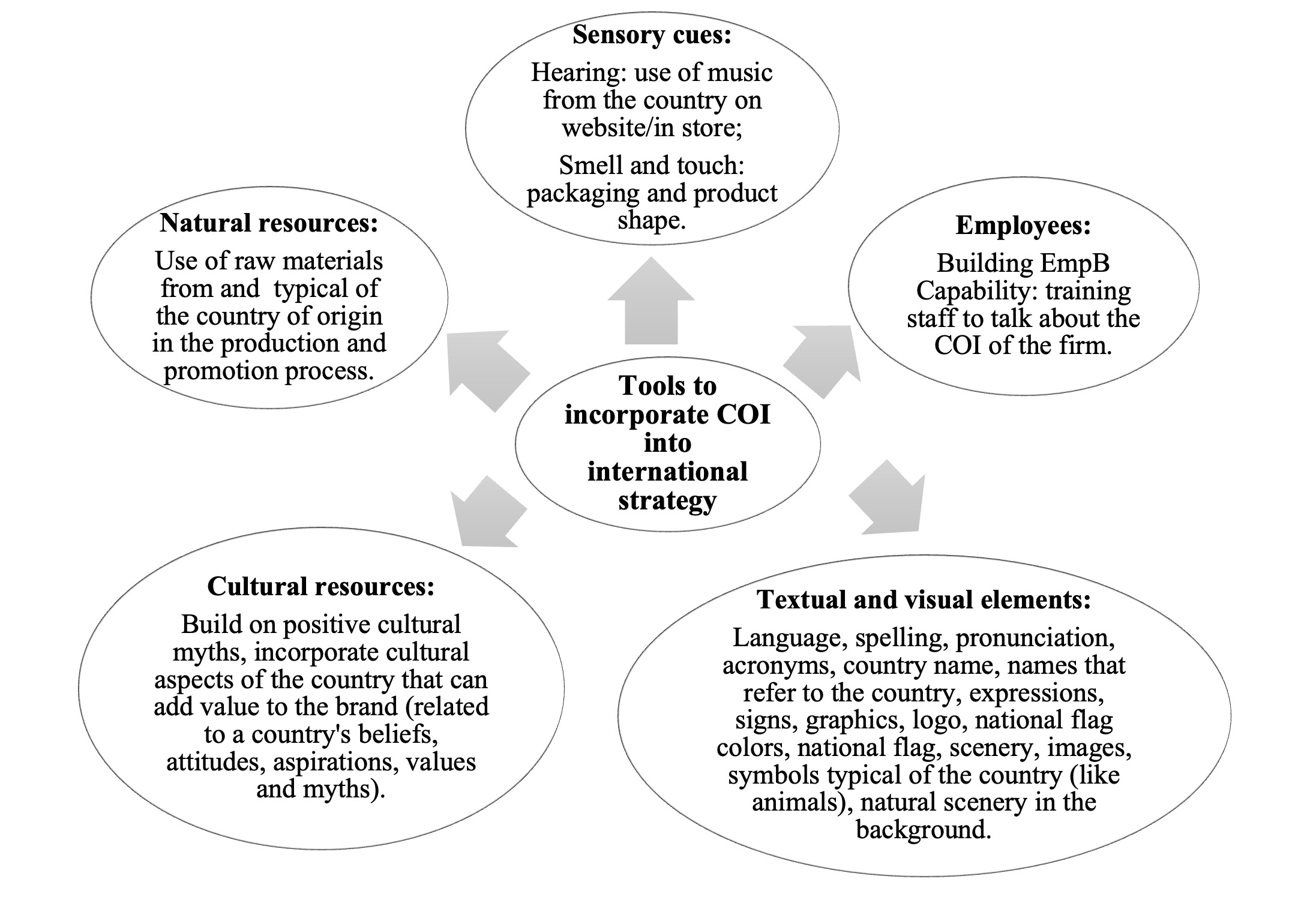
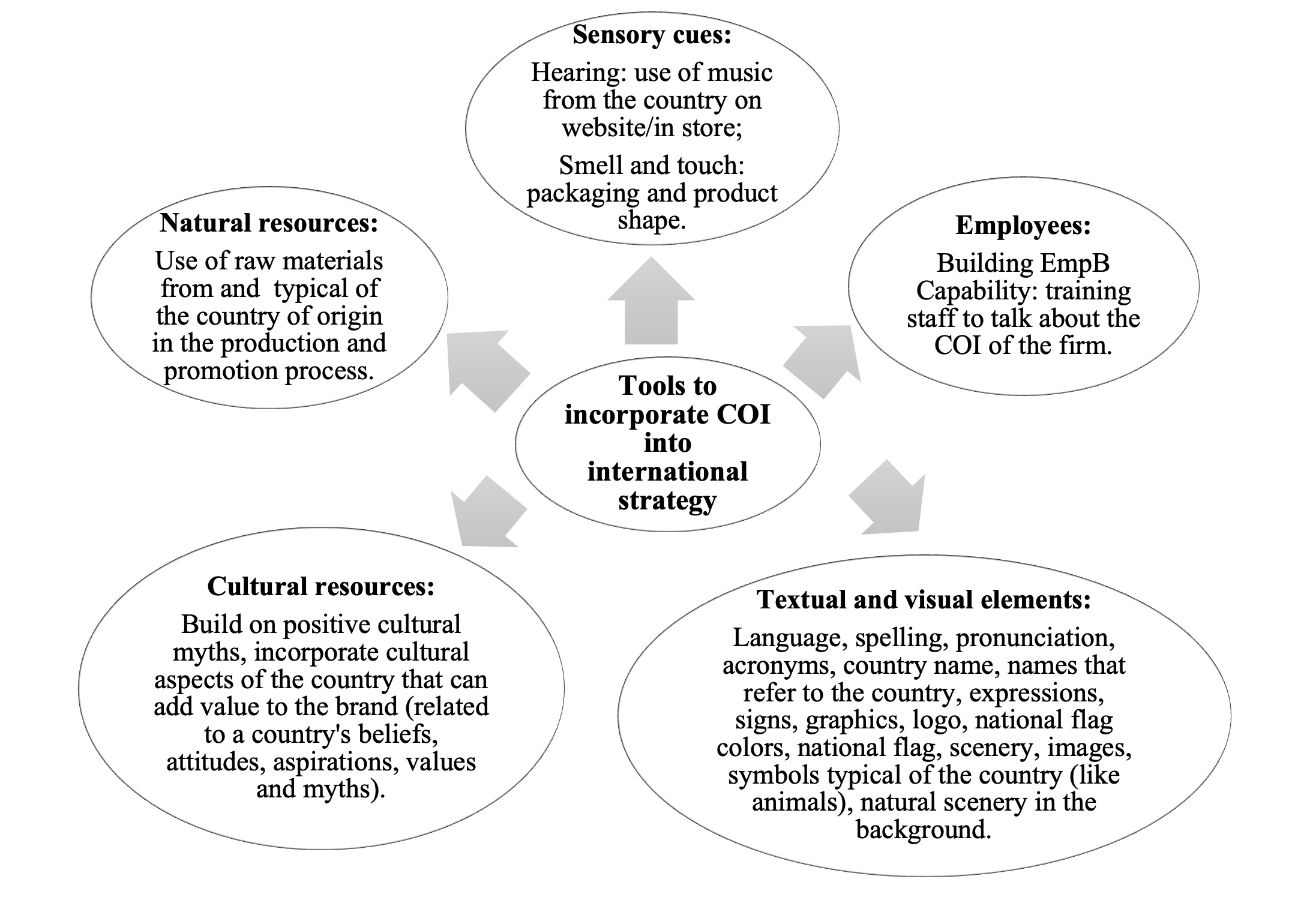
Yet country resources alone do not create competitive advantage. Firms need firm-specific capabilities, such as branding, marketing, innovation, and employee capabilities, to translate these COI attributes into differentiated products, services, and experiences (Cuervo-Cazurra & Un, 2023; Suter, Borini, Floriani, da Silva, & Polo, 2018). For example, Brazilian cosmetics firm Natura does not simply rely on a “Made in Brazil” label. It embeds “Brazilianness” through using local ingredients drawn from Brazil’s biodiversity and through sustainability narratives, and relationships with Amazon communities. Similarly, FarmRio activates Brazilian associations such as colour, joy, creativity, and connection to nature through design and branding. Together, these examples illustrate that COI does not become valuable simply because a firm comes from a particular country; it becomes valuable when managers actively identify, internalize, and deploy COI attributes through firm capabilities. Figure 1 summarizes this, showing how different COI attributes (e.g., natural resources, cultural resources, sensory cues, and textual or visual elements) can be embedded into firm strategy through capabilities such as branding, communication, product development, and employee engagement.
The “Inside-Out” Approach: Understanding Country Self-Image
Before firms can leverage COI externally, managers must first understand which country attributes are considered authentic and valuable by internal stakeholders. We propose an “Inside-Out” approach for this, beginning with an internal appraisal of COI that can be referred to as a Country Self-Image. This reflects how firms perceive and interpret the unique characteristics, values, and strengths of their home country. The next step is the strategic projection of this internally validated image to external stakeholders. While COI is about how outsiders (international consumers, B2B buyers, governments and investors) view a nation’s products, Country Self-Image is about how insiders (the citizens, firms’ managers, employees, and local partners) perceive and value their own country’s attributes (Suter, Munjal, Borini, & Floriani, 2021).
Why does this internal view matter? For COI to become a strategic asset, internal stakeholders must recognize and believe in the COI attributes the firm seeks to leverage. When employees and other stakeholders understand and take pride in these attributes, firms can communicate them more authentically in international markets.
Managing COI across Levels: From Nation to Firm
While our focus remains on how firms leverage COI, country images are not created by firms alone. They are shaped by broader narratives involving governments, industries, and institutions, which influence the country-level associations available for firms to activate through their own capabilities. COI does not automatically create competitive advantage; it becomes valuable when these country attributes are recognized, aligned, and strategically embedded across multiple levels: country, industry, and firm (Pappu, Quester, & Cooksey, 2007; Suter, Borini, Coelho, de Oliveira Junior, & Machado, 2020).
At the country level, national branding campaigns or government initiatives promote a specific image (e.g., “Germany: Land of Ideas”). Governments and institutions influence broader narratives through public diplomacy, trade policies, and nation-branding initiatives aimed at strengthening international reputation, exports, tourism, and investment (Nye, 2008; Papadopoulos, 2004). Well-known illustrations of COI reconfiguration include Germany’s and Japan’s post-World War II transformations, where coordinated government, industry, and firm-level efforts reshaped country-level narratives that subsequently informed COI around quality, reliability, and engineering excellence, creating long-term benefits for firms from both countries. These efforts shape the context in which firms operate, creating either positive associations that can be leveraged or negative perceptions to be overcome (Cuervo-Cazurra & Un, 2023; Raji, Magnusson, & Martirosyan, 2025).
At the industry level, associations and clusters can help shape country-industry images such as “Spanish Wine”, “Café de Colombia” or “Swiss Watches”, through coordinated promotion and collective positioning efforts (Lopez & Balabanis, 2021; Lourenção & Giraldi, 2017). Finally, at the firm level, managers decide which COI attributes (Figure 1) align with their strategy and embed them into products, branding, operations, and customer experiences. The greatest value emerges when these levels reinforce each other. Firms can actively contribute to, and benefit from, this layered approach through collaboration with government institutions, industry bodies, and trade or tourism promotion agencies while ensuring that country-related messages are consistently translated into firm-level actions.
The Human Element: Employee Branding Capability and COI
While it is common to focus on external marketing campaigns, COI can only become a resource when it is also embedded internally. This is where Employee Branding Capability (EmpBCap) becomes critical. EmpBCap refers to a firm’s ability to engage and empower its employees to act as authentic brand ambassadors, ensuring they understand, commit to, and consistently deliver on the brand’s promise, including its COI attributes (Bassi-Suter et al., 2024).
When firms develop strong EmpBCap, they move beyond passively benefiting from their COI to actively translating country attributes into employee behaviours and customer experiences. This requires integrating COI into training, internal communication, and organizational culture so employees understand how country attributes support the firm’s international positioning. For example, in the case of Natura, ingredients such as açaí illustrate how Brazilian biodiversity is embedded beyond product formulation. Employees are trained not only on the functional benefits of açaí but also on its origin within the Amazon biome and its connection to sustainable sourcing and local communities. Through internal storytelling and corporate values emphasizing local roots, açaí becomes a representation of Brazil’s natural heritage that employees can communicate consistently to consumers.
As illustrated in Figure 1, Employee Branding Capability represents one mechanism through which firms internalize COI attributes and ensure alignment between country associations and international activities.
A Step-by-Step Approach for Managers
Managers should not wait passively for external audiences to form an opinion about their firm’s COI. Instead, they can actively manage COI through three complementary actions: understanding internal perceptions, embedding country attributes into firm strategy, and collaborating with external actors.
Look Inside First
Before communicating country associations externally, managers need to understand how their country is perceived both outside and inside the organization. Managers can assess external COI through existing tools such as nation brand rankings (e.g., Anholt Nation Index, The Good Country Index), international reputation reports, customer insights, and international distributor feedback. However, firms should also evaluate Country Self-Image by identifying which country attributes internal stakeholders perceive as authentic, valuable, and relevant for international markets. Managers can conduct country-image audits, internal surveys with employees and national stakeholders (e.g. distributors, partners, suppliers, associations) to identify which country associations are authentic, valuable, and transferable abroad. This internal alignment strengthens the authenticity and credibility of COI-based strategies.
Own the COI in the Firm Strategy
Managers should stop seeing their country’s image as a fixed perception and instead identify which country attributes can strengthen their competitive positioning. COI attributes worth using may include natural resources, cultural elements, sensory associations, or visual cues (Figure 1). Once identified, these attributes should be embedded into product design, service delivery, branding, communication, and organizational culture. For example, natural resources can be reflected in product ingredients and sourcing strategies (e.g., Brazilian biodiversity in cosmetics), cultural attributes can inspire design and visual identity (e.g., colours, creativity, or craftsmanship), and country expertise can reinforce quality and positioning claims. Building Employee Branding Capability is central to this process. Managers can go beyond basic product training by developing training modules, internal storytelling initiatives, onboarding programs, and employee communication activities that explain why specific country attributes matter and how employees can translate them into customer experiences. Employees then become authentic ambassadors who transform COI into credible market-facing actions.
Collaborate beyond Walls
Because COI is shaped collectively, firms should engage with industry associations, government institutions, and trade or tourism promotion agencies. These actors help reinforce consistent country-related messages and translate broad country narratives into sector-specific images through coordinated promotion and export support. Industry associations can strengthen country-industry images by promoting shared quality standards, certification schemes, and collective branding efforts (e.g., Swiss watches, Italian fashion, or regional food and wine clusters). They can also provide firms with guidelines, market knowledge, and communication tools (through initiatives such as training programs and industry seminars) that help managers leverage COI consistently while remaining aligned with broader industry positioning efforts. For example, in Brazil, firms can participate in ApexBrasil’s Export Qualification Program (PEIEX), which supports companies preparing for international markets. Managers can use such initiatives beyond export readiness by translating acquired knowledge into internal workshops and employee training activities that strengthen their understanding of the strategic value of COI and improve the firm’s ability to communicate COI attributes internationally.
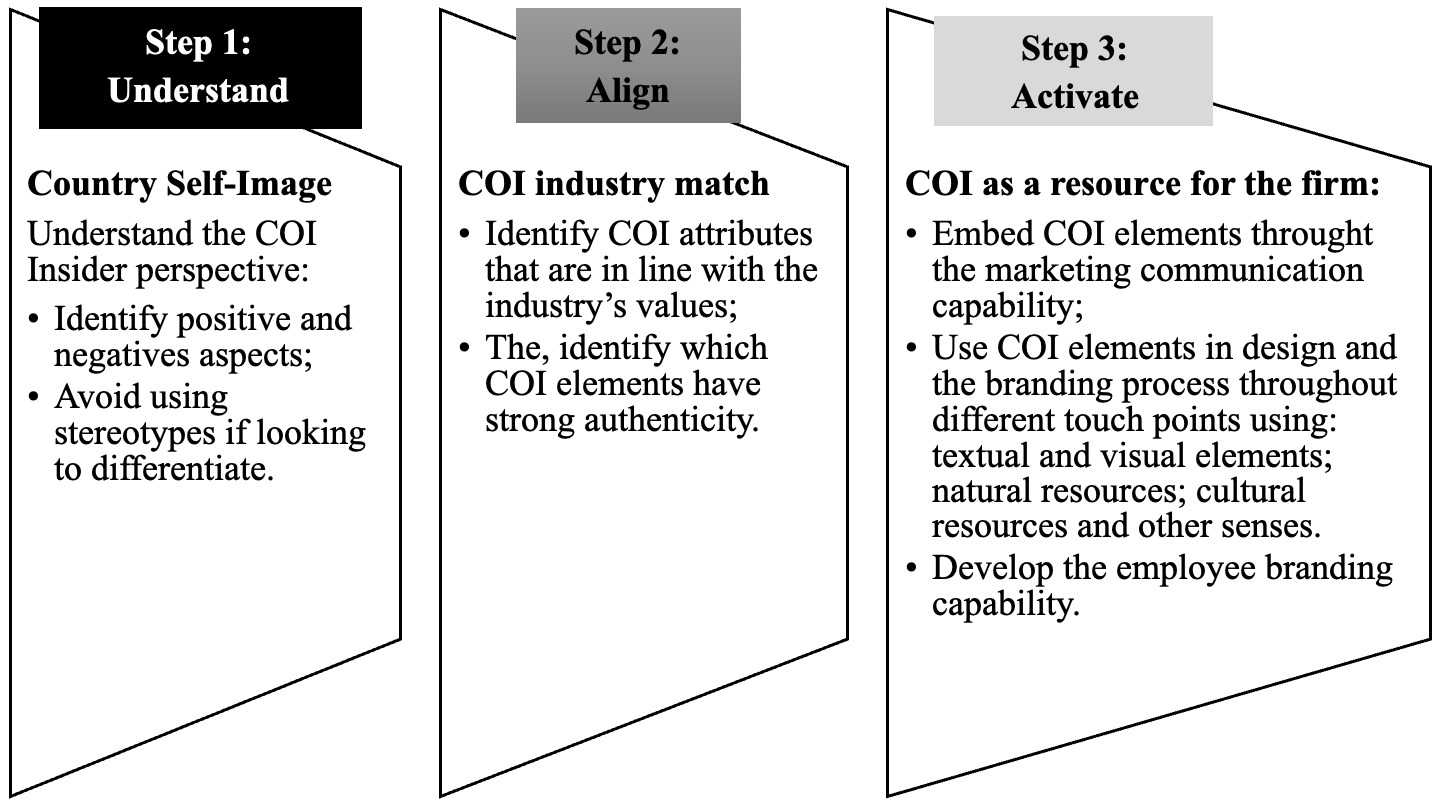
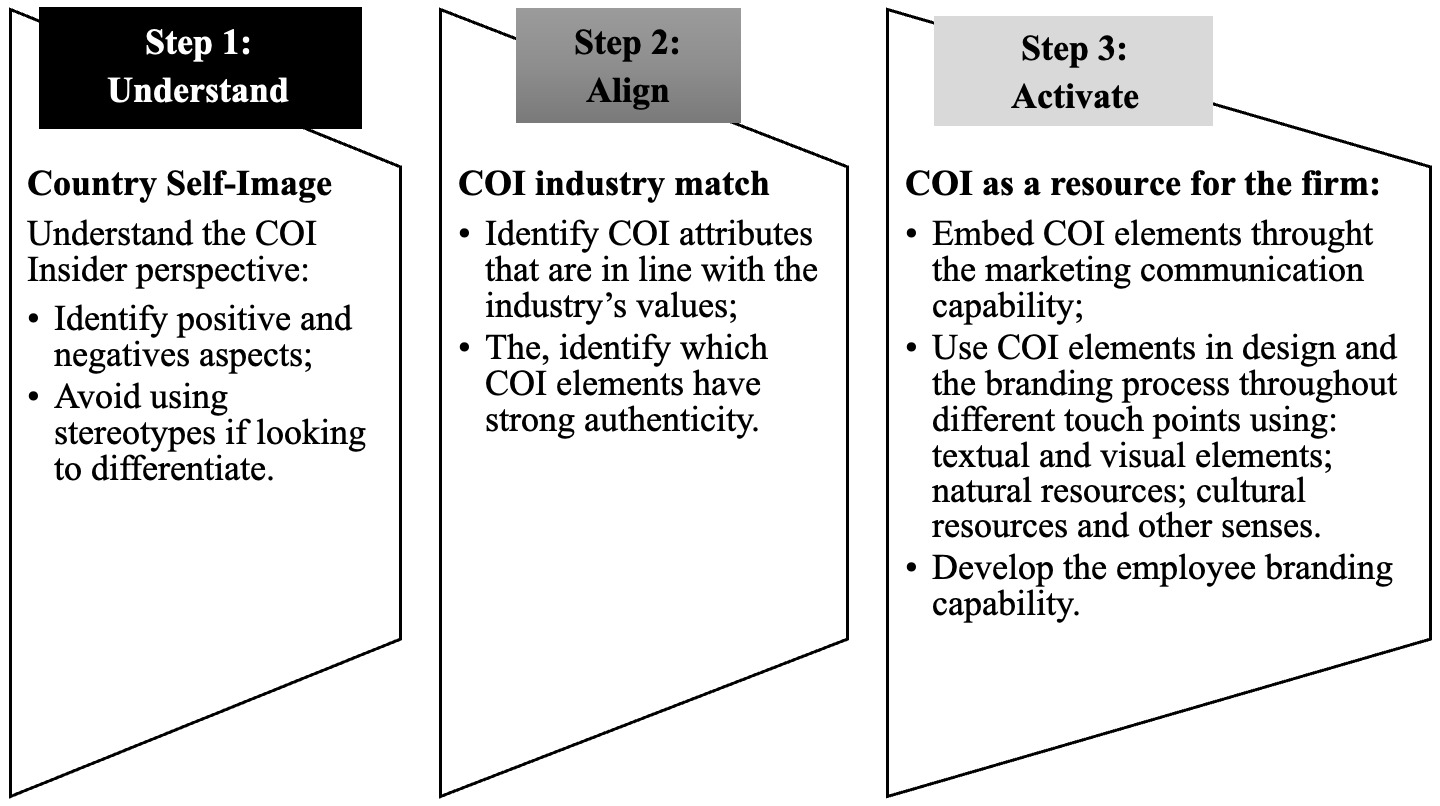
Figure 2 summarizes this process. Managers must first understand and identify authentic country attributes, then evaluate their relevance within the industry context, and finally embed these attributes into firm practices through branding, communication and the actions of employees. Through this process, COI moves from being a passive country image association to an actively managed source of competitive advantage.
Future Directions for Practice and Research
Leveraging COI as a strategic resource is an ongoing process. Managers can further explore how to assess the value created by understanding internal country perceptions, building employee engagement, and embedding COI attributes into firm strategies. Researchers can examine how firms transform country-level resources into firm capabilities and how this process influences internationalization and performance. For policymakers, our framework highlights the importance of developing initiatives that not only promote national image abroad but also help firms identify, communicate, and activate valuable country attributes in global markets. Future research can further explore how governments, industry associations, and public policies strengthen this broader COI ecosystem.
Conclusion
As global markets become more fragmented and firms face increasing exogenous pressures from shifting geopolitical, environmental, and institutional conditions (Dau, Moore, & Newburry, 2023), managers would not assume that country image is merely a background factor beyond their control. Instead, a firm’s COI can become a source of competitive advantage when managers actively identify valuable country attributes and transform them into firm-level resources through their capabilities. Rather than accepting COI passively, firms can leverage it strategically by understanding internal and external country associations, collaborating with external actors, and embedding country attributes into their brands, operations, and the actions of their employees. By aligning what a country represents with what a firm delivers, internationalized firms can build stronger brands, create authentic market positions, and enhance competitiveness in global markets.
Acknowledgments
The authors gratefully acknowledge the financial support from COFECUB and CAPES.
About the Authors
Mariana Bassi-Suter is Associate Professor of Marketing and International Business at TBS Business School, France. She earned her PhD from the University of São Paulo, Brazil, and previously held academic appointments at the Universities of Leeds and York, UK. She is also Visiting Professor at the University of Vale do Itajaí, Brazil, and Rikkyo University, Japan. Mariana serves on the Board of Directors of the AIB-LAC Chapter. Her research focuses on marketing and strategy in international business contexts.
Felipe Mendes Borini is Full Professor of Management at the School of Economics, Business and Accounting, University of São Paulo (FEA/USP), Brazil. He is a Senior Researcher at GLORAD and a researcher at BRIDGE. He holds a PhD from FEA/USP and an MRes from the Pontifical Catholic University of São Paulo (PUC-SP). His research focuses on strategy and innovation, with particular interests in global strategy, global innovation, and organizational capabilities.
Surender Munjal is Professor of International Business and Head of the Department of Economics and International Business at Aston Business School (UK). His research focuses on international business strategy, emerging market multinational enterprises, international entrepreneurship, offshore outsourcing, and SME internationalisation, with particular expertise in India, South Asia, and Africa. A qualified chartered and management accountant, he has published extensively in leading international business journals and provides academic leadership through research, teaching, and global collaborations.
Dinorá Eliete Floriani is Full Professor of International Business at the University of Vale do Itajaí (UNIVALI), Brazil. She holds a PhD in Business Administration from the University of São Paulo (USP) and completed postdoctoral research at the University of Florence, Italy. She currently serves as Chair of the AIB-LAC chapter. Her research focuses on internationalization strategy, SME internationalization, sustainability, innovation, foreign direct investment, and Latin American multinational enterprises.