
Introduction: The Talent Paradox for International Business in Africa
Sub-Saharan Africa has become a region of strategic importance for international businesses seeking growth in emerging markets. It is home to the world’s youngest and fastest-growing population: by 2050, the continent’s population is projected to reach nearly 2.5 billion, with more than 1.4 billion people of working age. Africa will account for over 85% of the global increase in the working-age population by mid-century, adding approximately 796 million people to the global labor force (World Economic Forum, 2023).
Yet this perceived opportunity is overshadowed by a paradox that many firms face: an acute shortage of skilled labor. According to KPMG’s (2024) Africa CEO Outlook, 56% of CEOs identify talent shortages as one of the top risks to their businesses, ranking second only to operational disruptions. This concern is echoed in PwC’s (2024) Global Workforce Survey, which reveals that for Africa, 59% of firms expect the skills required for their jobs to change significantly within five years, a figure far higher than the global average of 36%. At the same time, 86% of African workers express readiness to adapt to new ways of working, underscoring the adaptability and resilience of the African workforce. Yet, many lack the technical, managerial, and digital competencies employers demand. Neither formal education nor job creation has kept pace with population growth. Compounding the challenge, a persistent mismatch exists between the qualifications many graduates acquire and the specific job requirements of companies, leaving MNEs struggling to build capable, competitive teams (Horwitz, 2015).
This article explores the root causes of SSA’s skill gap, offers conceptual reflections on talent as a strategic resource in international business, and identifies three practical approaches that firms can adopt to address the skilled labor gap, which reflects both the shortage of qualified workers and the misalignment between educational outcomes and industry requirements. This article contends that the skills gap should not deter international firms from doing business in SSA. Instead, it should inspire firms to rethink how they engage with talent development.
Understanding the Root Causes of the Skilled Labor Gap
The skilled labor gap in Sub-Saharan Africa is deeply rooted in structural, institutional, and systemic factors. While increasing school enrollment supports inclusive growth, the education quality, which is the decisive factor shaping employability and productivity, is challenging in SSA, where well-resourced but often quality-lacking urban schools coexist with underfunded institutions in rural and (disadvantaged) urban areas. Thus, structural inequalities rooted in geography, gender, and income exclude large segments of the population from educational and training opportunities, perpetuating unequal access to quality education (Wood & Bischoff, 2022). A further and significant challenge lies in the persistent weakness of vocational education and training (VET) systems, which are often underfunded, misaligned with market needs, and overly theoretical in their curricula. They also face a negative image as being destined for those who do not make it academically into colleges and universities. Many graduates leave such programs with certificates but without the practical skills employers require, forcing firms to retrain new hires at considerable cost or recruit expensive expatriate staff. Attrition rates at technical and vocational colleges remain high, further shrinking the pool of work-ready graduates (Zulu & Mutereko, 2020).
The characteristics of SSA’s labor markets further compound these challenges. Informality dominates employment structures, but informal jobs rarely offer structured training, social protection, or career progression, thereby discouraging workers from investing in their own skills and limiting the supply of experienced talent to formal employers (Wood & Bischoff, 2022). At the same time, the rapid pace of technological change associated with the Fourth Industrial Revolution is transforming job requirements faster than education systems can adapt. automation, artificial intelligence (AI), and digitalization are reshaping industries, deepening the skills gap between workforce capabilities and employer needs. Weak collaboration between educational institutions and the private sector aggravates this mismatch. Although many universities and training centers have improved internal capacity, they still struggle to align curricula with market demands. Beyond the point of aggravating potential skill gaps, AI may darken job prospects, with a considerable share of the workforce being replaced by modern technology (Poisat, Cullen, & Calitz, 2024).
Conceptual Reflection: Talent as a Strategic Resource in International Business
From an international business perspective, human capital is a strategic resource that drives competitiveness, innovation, and global expansion. The resource-based view conceptualizes talent as a source of sustained advantage when it is valuable, rare, inimitable, and embedded within organizational processes. For multinational enterprises in emerging markets, this underscores the need to develop and retain talent as a central strategic priority. Luo and Tung (2018) highlight that successful MNEs employ springboard strategies by investing in local capability building and talent development to strengthen global competitiveness. Adeleye, Anibaba, and Babatope (2024) argue that SSA’s youthful labor force offers vast potential for firms adopting innovative, context-sensitive approaches to talent management, but job creation has to keep pace with population growth to turn the young population into a productive demographic dividend. They emphasize the importance of aligning organizational culture with societal values, continuously laying the base for leveraging digital technologies for scalable skills development, and fostering inclusive, adaptable workplaces. These imperatives require a shift in how talent development is understood, moving away from solely relying on global best practices towards tailoring training concepts more to local realities, cultures, and institutions.
Seen through this lens, SSA’s skills shortage is not merely a constraint but rather a significant opportunity. Firms, as will be shown below, that integrate human capital development into their internationalization strategies can differentiate themselves in competitive markets, enhance their legitimacy, and build resilient operations capable of adapting to rapid change (Ayentimi, Burgess, & Brown, 2018). Moreover, such strategies align with global sustainability priorities by advancing inclusive growth and enhancing firms’ contributions to achieving the SDGs, particularly SDG 4 (quality education) and SDG 8 (decent work and economic growth) (Züfle & Adu-Gyamfi, 2025).
How International Firms Can Bridge the Skills Gap
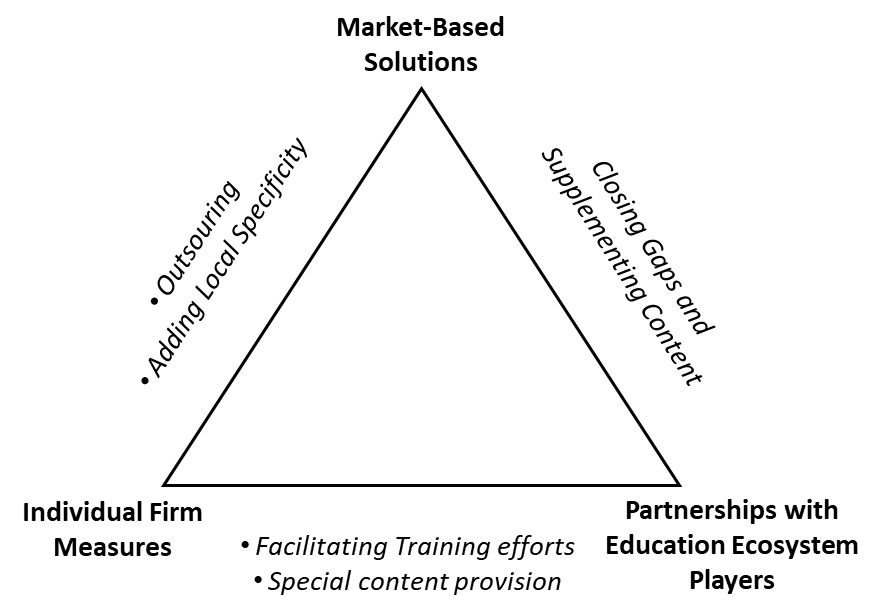
Many international firms are already implementing innovative strategies to address SSA’s skills gap and, in doing so, are shaping the future of work on the continent. These efforts can be understood along three interrelated dimensions (Figure 1). First, MNEs internally build skills pipelines through work-based and digital learning, and design inclusive career pathways and leadership pipelines. Second, they collaborate with other education-related entities to achieve systemic impact and ecosystem development, and third, they leverage market-based solutions (Boddewyn & Doh, 2011).
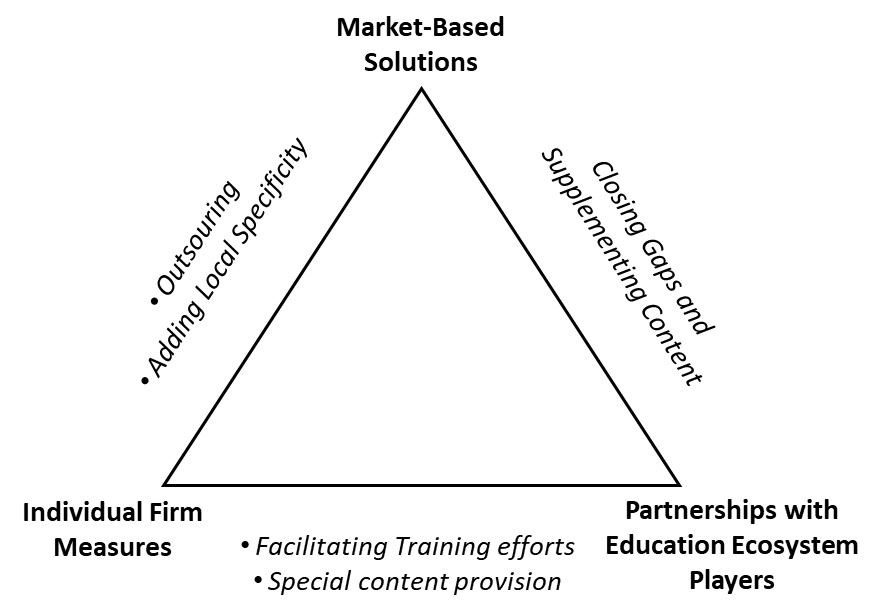
Firms that want to address the skill gap need to be aware of the interrelationship between the three proposed dimensions of measures. Improving and enhancing the education ecosystem by partnering with its stakeholders will facilitate individual firm measures to train staff while the company can provide special content into the education system, which is in a complementary relationship with the market-based solutions that can close training gaps. Also, firms might outsource some of the trainings to market players and, thus, add local specificity to trainings.
Internalizing: Building Skills Pipelines and Career Pathways
One of the most effective ways for firms to overcome the skilled labor gap is by investing directly in the skills they need. Work-based learning models such as apprenticeships and dual training systems combine classroom instruction with practical experience, producing graduates who are immediately employable. The German engineering firm Krones recognized the limitations of the external labor market in Kenya and launched a dual vocational training program in mechatronics in partnership with Centurion Systems and local companies. The initiative blends theoretical education with hands-on experience, ensuring participants gain both technical and practical competence. Krones also operates the Krones Academy, a digital platform that connects trainers in Germany with employees and customers across SSA to facilitate continuous learning and consistent standards across locations (Carlowitz, 2024).
Similarly, Caterpillar’s Technicians for Africa program is another example of scalable skill development. Launched in 2015 to address shortages of mechanics and equipment operators, it has expanded from three to 15 countries. The free multilingual e-learning platform provides modules on mechanics, electrics, hydraulics, and safety standards based on Caterpillar’s internal curriculum, leading to a basic certification. Supported by the company’s African dealer network, the program incorporates practical workshops and certified rebuild centers that offer hands-on experience. By equipping thousands of young people with market-relevant technical skills, Caterpillar enhances employability and helps ease the shortage of qualified workers in construction and mechanical engineering.
Developing talent is only part of the solution; retaining it and providing opportunities for advancement are equally essential. Firms can offer structured career progression, mentorship, and leadership development programs to better position themselves to attract and retain skilled professionals in competitive labor markets. The Afrika Kommt! Initiative exemplifies this approach. Being a collaboration between leading German companies and African professionals, it offers year-long placements in Germany during which participants receive management training, mentorship, and exposure to international business practices. Many alumni return to their home countries to assume leadership roles, often within the sponsoring firms.
A similar approach was pursued by Ericsson focusing on developing the next generation of technology leaders. Its Graduate Program in Africa, launched in 2020, trains young professionals, particularly women, in telecommunications, IT, and emerging technologies such as AI and 5G. In Kenya, participants rotate through roles in engineering, IT, and strategy, supported by virtual training introduced during the pandemic to enhance flexibility. In 2023, Ericsson expanded this commitment through the Gen-E Graduate Program for the Middle East and Africa, offering structured training, mentoring, and exposure to cutting-edge fields like IoT and network automation.
Collectively, these initiatives illustrate that international firms can play an active role in shaping SSA’s future workforce. By combining classroom instruction, on-the-job training, and digital learning, companies can create self-sustaining talent pipelines that meet both corporate and societal needs. Beyond filling immediate labor gaps, such efforts contribute to long-term skills development and build the foundations for inclusive, innovation-driven growth across the continent. By aligning professional development with global standards while responding to local aspirations, they build resilient leadership pipelines and strengthen their reputations as employers of choice. This requires a change in perspective as talent needs to be developed by firms in contrast to being available on the labor market as in most industrialized countries. Leveraging their global digital training platforms, focusing on firm-specific skill requirements, and practical training will help create a human capital based competitive advantage.
Partnering for Systemic Impact and Ecosystem Development
Many firms are addressing the skills gap by collaborating with governments, educational institutions, and civil society organizations to strengthen the broader talent ecosystem. Major technology firms are forming large-scale digital-skills partnerships that link training, infrastructure, and inclusion. Since 2016, Google’s Grow with Google and Digital Skills for Africa initiatives have trained over seven million Africans, with a focus on women in digital literacy, coding, and entrepreneurship, aiming to reach ten million by 2030. Delivered in local languages such as Swahili, Hausa, and Zulu, the programs blend online and in-person learning and are embedded in national education systems through partnerships with ministries of education and other public institutions.
Huawei’s collaboration with Ahmadu Bello University (ABU) in Nigeria illustrates how multinational firms can drive systemic impact through long-term partnerships with higher education and government. The partnership has grown into a network of more than 90 academies across Africa that deliver lab-based digital training, train-the-trainer programs, and integrate Huawei certifications into university curricula. Since 2022, over 300 instructors have been trained and 80 certified, creating a multiplier effect across participating institutions. Implemented with UNESCO, national ministries, and regional universities, the initiative links industry expertise with academic infrastructure to strengthen Africa’s digital-skills pipeline.
Together, these initiatives demonstrate that addressing SSA’s skills challenge requires more than isolated interventions; it calls for ecosystem building. When companies, governments, and educational institutions collaborate strategically, they can amplify the reach and sustainability of their efforts, ensuring that talent development contributes not only to business performance but also to inclusive economic growth and societal advancement. As the quality of the educational ecosystem facilitates (costly) individual training measures, cooperation with its players should be considered by the MNEs. Especially supporting curricular content that trains the basics needed for the skills later required is useful. Train the trainer programs help to scale the skill content and by concentrating on content that is beneficial to the firms’ future skill requirements: a win-win-win situations is generated for the individual, the country, and the MNE itself.
Leveraging Market-Based Solutions
Internal training initiatives and partnerships are not without limitations. Expanding into large-scale talent development can draw MNEs away from their core business activities, raising questions about efficiency, competitiveness, and long-term financial sustainability. Such initiatives may also blur institutional boundaries, as governments and educational institutions could perceive corporate involvement in areas such as vocational and higher education as encroaching on their traditional mandates. Moreover, several corporate programs, including Caterpillar’s Technicians for Africa and the Afrika Kommt! Initiative, tend to target individuals who are already relatively well educated or digitally literate. While they may build high-level capabilities, this focus risks reinforcing existing inequalities by privileging more advantaged (urban) groups while leaving broader segments of the population underserved. These concerns highlight the importance of ensuring that talent development strategies are not only effective but also inclusive and sustainable. In this context, leveraging market-based solutions offers a complementary pathway to distribute skill development more broadly while aligning incentives across actors.
A particularly promising avenue lies in Africa’s rapidly growing ecosystem of innovation hubs and entrepreneurial platforms, which develop skills through market-driven mechanisms (Züfle & Carlowitz, 2026). A leading example is Co-Creation Hub (CcHub), a pan-African innovation center with locations in Nigeria, Kenya, Namibia, Rwanda, and Togo. CcHub supports start-ups and young entrepreneurs in refining business ideas, scaling operations, and building critical digital and managerial capabilities. The hub facilitates acceleration programs and innovation challenges that embed learning into real-market activities. By connecting global firms with local entrepreneurial talent, including in rural and impoverished areas, innovation hubs illustrate how market-based solutions can complement firm-led and partnership-based approaches, creating more inclusive and adaptive pathways for skills development while contributing to long-term competitiveness.
These initiatives enable and foster demand-driven skill development that responds directly to market needs. They complement existing educational and training activities in the educational system, making them more relevant for companies’ needs. Firms should consider outsourcing some of their specific trainings to local market-based players, such as “ed-tech” firms, to maintain their focus on their core activities and to add a local perspective to the trainings.
Conclusion: From Constraint to Catalyst
The skilled labor gap in SSA remains one of the most significant and deep-rooted challenges for MNEs, but it is also a catalyst for innovation and new forms of collaboration. By investing internally in work-based and digital learning, fostering inclusive career pathways, partnering with governments and educational institutions to strengthen talent ecosystems, and leveraging market-based solutions, multinational enterprises can transform this constraint into an opportunity for shared value creation. Firms that embed human capital development into their core strategies, while balancing internal initiatives with local collaborative and market-driven approaches, will not only secure their competitiveness but also advance global goals for quality education, decent work, and inclusive growth, thereby turning population growth in SSA into a demographic dividend for the benefit of both business and society.
Funding
The research project on which this publication is based was funded by the German Federal Ministry of Research, Technology and Space under the grant number 01DG25007. The responsibility for the content of this publication lies with the authors.
About the Authors
Philipp von Carlowitz is a professor for strategic and international management and head of the Think Tank Doing Business in Africa at ESB Business School of Reutlingen University. His research focus is on business topics in the African context while his consulting also covers strategic and internationalization issues. He is committed to transfer research findings into practice, following the Business meets Science logic. He is a sought-after keynote speaker and expert on operational and strategic business topics in Emerging Markets.
Simon Züfle is a Research Fellow with the Think Tank Doing Business in Africa at Reutlingen University. His research, consultancy, and teaching focus on the interrelationship of geopolitics and international business, market entry forms, and strategic alliances in emerging markets, particularly Sub-Saharan Africa.