
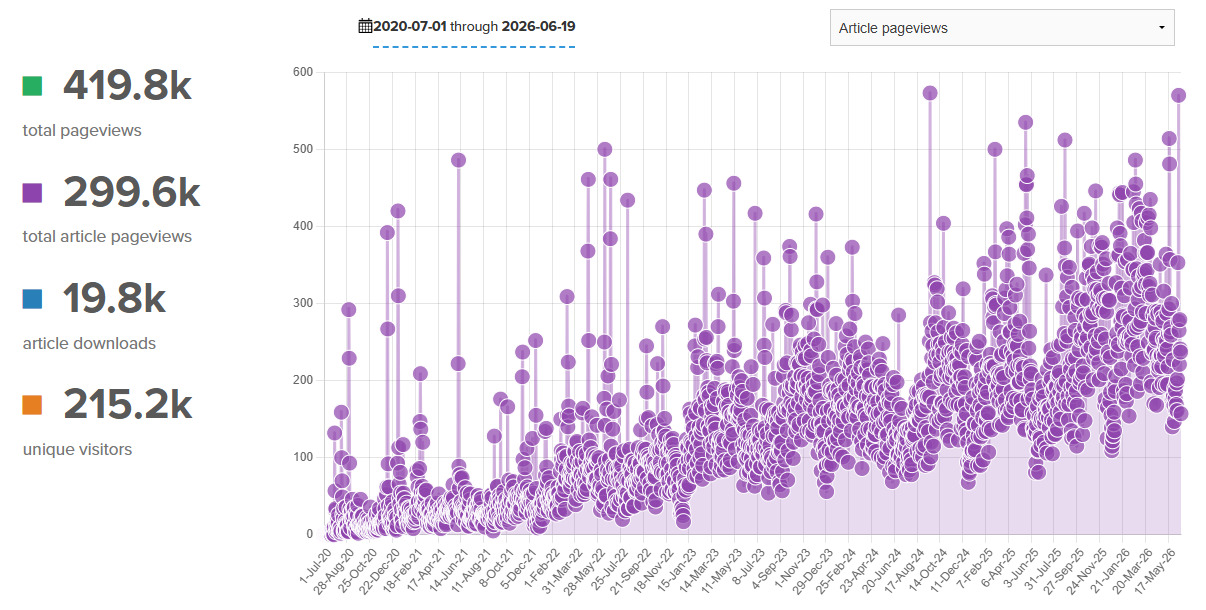
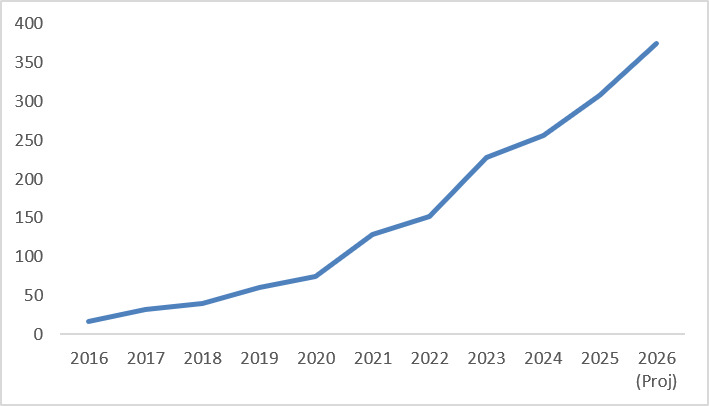
Welcome to the fourth AIB Insights issue of 2026. The journal continues to advance in terms of article views, citations, and unique journal portal visitors as we pass the six-year mark since we transitioned to a peer-reviewed journal in July 2020 (see Figures 1 and 2). Our editorial team of William Newburry (Editor), Elizabeth Rose (Deputy Editor), Desislava (Deputy Editor), and Matt Raskovic (Reviewing Editor), along with Managing Editor Anne Hoekman, continue to work hard to further build the journal.
The journal’s advancement is supported by our outreach efforts to the AIB Chapters, Special Interest Groups and other organizations. Example efforts include a recent paper development workshop (PDW) conducted at the AIB Latin America and the Caribbean Chapter Annual Conference in Lima, Peru, in March 2026, a special session at the AIB Africa Conference in Nariobi, Kenya, in May, and another PDW at the AIB Annual Meeting in Manchester, UK in June. We are also developing a healthy presence on LinkedIn, thanks to the efforts of our Social Media Director, Hide Ito: https://www.linkedin.com/showcase/aibinsights.
Our AIB Insights Award presented at the annual AIB Meeting in Manchester, UK was also renamed this year as the “Daniel Shapiro AIB Insights Award for Actionable Insights”. The award is being sponsored by the Beedie School of Business at Simon Fraser University. Coincidentally, a paper in this issue is coauthored (posthumously) by Daniel Shapiro. This paper entered our normal double-blind peer-review process prior to the award sponsorship. The AIB conference paper “Public-Private Partnership Governance Adaptability and Resilience” by Liliya Mergaliyeva Dongmei Cao, both of Nottingham Trent University, UK, received this year’s award.
This issue contains nine articles addressing a range of international business topics, including four related to geopolitics, one on emerging market multinationals, two on sustainability issues, and two related to international business education. These themes resonate heavily with AIB Insights readers and continue ongoing conversations within the journal. The articles are written by scholars across four continents and nine countries, including Brazil, Canada, China, Colombia, Finland, Mexico, Singapore, the United Kingdom, and the United States.
Geopolitics
We start this issue with four articles related in various ways to geopolitics, a highly relevant topic that has been featured frequently in AIB Insights. (See Ciravegna, Hartwell, Jandhyala, Tingbani, & Newburry, 2023, for the introduction to a special issue on this theme.)
First, Jing Li (Simon Fraser University, Canada), Daniel M. Shapiro (Simon Fraser University, Canada) and Carlos Vecino (Universidad Industrial de Santander, Colombia) authored “Geopolitics, Host Country Policy, and Critical Mineral Investment in Latin America”. This article examines strategies pursued my multinational enterprises (MNEs) in the context of Latin America’s critical mineral sector. Examining factors related to the geopolitical rivalry between the U.S. and China, along with variations in host-country regulations regarding mineral policies, the authors overview the main issues faced by foreign MNEs in general, Chinese MNEs and US/Allied MNEs, while also providing guidance for these three investor groups.
Our second issue article, “From Conflict to Consumer Backlash: How Multinational Corporations Navigate Boycotts in the Middle East and Beyond”, by Mamoun Benmamoun (Saint Louis University, USA), examines four responses multinational corporations associated with Western brands use to respond to boycotts: defensive denial, corrective action, strategic adaptation, and proactive measures. The article draws on case studies of Starbucks and Carrefour to develop recommendations for multinational managers regarding the usage of these four response types.
Xinwei Shi (Durham University, UK), Yirun Lu (Imperial College London, UK) and Wenwei Chen (Tsinghua University, China) authored our third article, “Beyond Adaptation: Institutional Anchoring for Multinationals in Conflict Zones”. Conflict zones present some of the strongest geopolitical risks faced by multinationals. The authors introduce the construct of Institutional Anchoring to develop their ANCR Compass based on the level of institutional voids and fragmented authority in a conflict zone. This tool distinguishes four governance roles for MNEs in conflict zones: Adapter, Negotiator, Co-creator, and Reconfigurer. The authors then provide guidance for managers and policymakers on using the framework in managing MNC roles.
Our fourth article related to geopolitics, “Rising from the ashes of geopolitical conflict: New career identifies of Finnish experts on Russia”, is by Virpi Outila (San José State University, USA), Rebecca Piekkari (Aalto University, School of Business, Finland) and Carol Reade (San José State University, USA). This article highlights individual effects caused by geopolitical conflicts, drawing from the case of the Russia-Ukraine war, and how it created a career shock for Russian experts within Finnish-based multinationals. The authors develop a typology of four new career identities for these individuals: reframed identity, entrepreneurial identity, liminal identity, and involuntary retiree identity. They then provide recommendations for international managers, HR professionals and governments for each of these identity types.
Emerging Market Multinationals
Our next article relates to our prior geopolitical theme to the extent that emerging market firms encounter geopolitical issues when they invest in foreign countries.
Nitin Pangarkar (National University of Singapore, Singapore) and Naveen Kumar Jain (Augustana College, USA) authored “Leaping Multinationals: A New Breed?” In this article, Pangarkar and Jain develop the term “Leaping Multinationals” to represent emerging market firms that sell their products and services internationally but not in their home countries. They contrast these firms with other MNC types (e.g., born globals and Springboard MNCs). The authors note that Leaping MNCs face a combination of push and pull forces that drive their internationalization. Using exemplars such as Transsion Holdings and Shein from China, and Nihilent and Maser from India, the authors propose a four-stage model (Leverage, Adapt, Accumulate, Expand) for how these firms evolve. They also develop managerial recommendations based on each of the four stages.
Sustainability
The issue also features two articles with sustainability themes, another common focal area within AIB Insights articles, most recently with respect to our special issue on Sustainability in Africa (Dikova, Newburry, & Rose, 2026).
Gustavo Gomes Rocha (Universidade Federal do Rio de Janeiro, Brazil), Ariane Roder Figueira (Coppead, Universidade Federal do Rio de Janeiro, Brazil) and Eduardo Russo (Rio Grande College of Business, Sul Ross State University, USA) penned “The Role of Subnational Investment Promotion Agencies in Supporting Global Energy Transition Policies”.
Based on evidence from five subnational Brazilian IPAs, the authors identify their strategic roles in connecting global sustainability agendas with regional development needs. The authors develop a Subnational IPA Strategic Compass to guide policy makers and managers that involves the four pillars of Alignment and Policy Coordination, Targeted Investment Attraction, Multi-Stakeholder Engagement, and Fostering the Innovation System.
Our second sustainability-related article, “Oceans as the Missing Stakeholder: How International Business Impacts Marine Ecosystems”, is authored by Ivanete Schneider Hahn (Universidade do Extremo Sul Catarinense, Brazil) and Miguel Cordova (Tecnológico de Monterrey, Mexico). Schneider Hahn and Cordova note how international business contributes to marine degradation in many ways, such as plastic leakage, unsustainable fishing, and offshore resource extraction. Schneider Hahn and Cordova then reframe the conversation by identifying oceans as an overlooked stakeholder in international business. Building upon this reframing, they advance two insights: that international business systematically overlooks its negative impact on the ocean and that five IB-generated risks must be addressed by companies through their corporate policies and actions.
International Business Education
The final two articles within this issue examine international business education and various types of international experiences. International experiences have been shown to be a highly valued and influential component of international business education by various stakeholders (e.g., Deans, Recruiters, Students, and Alumni; see Newburry et al., 2023).
Jillian Avendano (Florida International University, USA), Hami Usta (The University of Tampa, USA) and Sumit K. Kundu (Florida International University, USA) authored “Enhancing International Business Education Through Faculty Development in International Business Programs”. The authors note the importance of firsthand international experience within international business programs. These experiences are important for instructors as well as students, since they increase instructors’ cultural understanding, while simultaneously boosting their credibility. This article examines the Center for International Business Education and Research (CIBER) Faculty Development in International Business (FDIB) programs, which are designed to provide educators with direct exposure to business conditions in foreign environments to integrate into their home country classrooms. The authors develop recommendations for organizers to effectively develop these programs.
Our second international business education article, “MOUs Without IOUs: Sustaining Leadership in International Business Programs Through Disruption”, is authored by Jack Marr (Boise State University, USA). Marr notes how international business programs are vulnerable to disruption when program champions and key partners leave, even when formal partnership agreements remain. He examines three case studies of IB study abroad programs that experienced recovery, collapse, and redesign after the departure of a program champion, and identified core lessons from each of them. He then develops a diagnostic framework for program sustainability based on issues identified within the cases.
We hope that you gain valuable and practical insights from this issue. Please look out for our forthcoming issues on International Business in South Asia, the 2026 AIB Annual Meeting Theme of Generational Shifts and International Business: Navigating Demographic Change in a Diverging World, and our annual awards issue featuring the finalists for the AIB Best Dissertation Award and interviews with the winners of the 2026 AIB Fellows Awards. As always, please continue to submit your applied international business research to the journal!